Maximum Apocalypse Board Game Review
Games in This Video
1 game is featured in this video — it unlocks as you watch.
Transcript
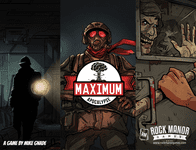
Let's start it off. I guess. Sure, go for it. My name is Erica. And my name is Giancarlo. Welcome to Board Today. Yes, and this is our review of MAXIMUM APOCALYPSE. EVERY TIME YOU EVERY IT'S AMAZING. It's always like metal with you. Every game we do it's like metal. It's crazy. all have like this destruction. It's awesome. Disaster. Which is a That's actually what it is. It's the world is over and we're just trying to survive what's left of it. So, a co-op game. One to six. Is it any good? Yeah. There. Review done. Just buy it. It's good. Just buy it. It's good. In this scenario, post-apocalyptic cooperative game, players take on the role of survivors fighting off aliens, zombies, mutants, or robots. Game here is set. Each player would have chosen a character and taken their decks and standy. The scavenge decks and map tiles will be comprised of what the mission card says. For this review, we'll showcase the first one, save the scientist. Each player starts off with four cards from their deck and may mulligan if they wish. Place the hunger die on one and draw a monster card for each player placing it in front of them.
The monster deck chosen can be of any of the four types the players wish to play against, but a recommendation will be written in the bottom right corner of the mission card. In this case, zombies. Determine the first player and play proceeds clockwise. You're ready to play. Objectives will be different on what the mission card states. In this case, players will have to find the police station tile, spend two turns to rescue the scientist, and return to the van tile with four canisters of gas. If all players die or if you can't place a monster token because you've run out, you all lose. Each game turn consists of five phases in this order as written here. In spawn monsters, the active player will roll two dice and place a monster token on each tile with the combined total. The more you progress, the more chances you have of spawning a monster.
Next, you'll draw a card from your deck, then you'll take three actions in any combination, and may repeat any action. Some of these are free as listed here. For one action, you can move one space, revealing the tile if face down and triggering the effect if any, draw a card, there is a maximum hand of 10 for each player, scavenge, drawing a card from the appropriate deck as denoted by the tile, play a card, either an instant as shown by the icon, or take a card action. Let's expand on some of these actions. When moving, never diagonally, to a location with a monster token, if you have no monsters in front of you, you may choose to do a stealth test. Each monster token reduces your stealth value by one, and then you roll two dice, and if your total is less than or equal to your stealth value, you are successful, meaning you can leave the token there.
For playing cards, instants are discarded after use, whereas gears are kept face up in front of you. These have a storage value listed here, and characters typically start off with a value of four carrying limit. So, keep that in mind because if you go over, you'll need to discard a gear as well as any duplicate gears played. Weapons might have ammo count and start off with that much ammo. Besides these, they'll have a range value, short, mid, or long range. These will tell you which monsters can be attacked based on where you and your teammates are on the grid. Yes, you can help out teammates by defeating their monsters should you have enough range. Apply the damage on the monsters until you kill it. Let's move on with the remainder phases in the turn.
When the actions are done, move the hunger die up a level. If you're at a six already and have to move it up, your character is starving. Flip it over and it loses its ability. From now on, when starving, move down this track. You reach here, you die. Every food you eat will recover that much off your starvation value. If you ever bring this back below six, flip your character back. Lastly, at the end of the turn, monsters in front of the active player attack with damage as the value listed here. Go to zero, you die. If that happens, all your gear falls on that tile for your teammates to grab, should they need to. When the turn is over, the next player in clockwise order takes theirs. Finish the objective, which usually includes fighting a boss as well, and you win. Maximum Apocalypse brings back intuitive and simple gameplay back to scenario and/or campaign co-ops. This one can be a real winner for beginners, but also has enough tactical and strategic depth.
And best of all, it's all portable in this box. As you can see, all the good components with suitable cartoony artwork fit rather well in it. Now, the alpha gamer problem is not really resolved with this one, but it's not that much of a detriment. For me, the biggest con is the luck factor, especially on when making that map with the tile grid. Some games, your objectives can be at the other end, whilst in other games, you'll have it in right next to your starting van by sheer luck. Although the mechanics are simple for anyone to learn, they aren't really that original. So, this act like a double-edged sword. Still, with 13 scenarios and various ways of mixing and matching heroes and monsters to each scenario, the game provides enough modulation for high replay value. Though set up for scenario, finding the right tiles and making sure you have the correct deck each game is a bit of a pain. But only a slight one, so a half point penalty. Maximum Apocalypse does what it does pretty well, and with most cons being at half-point score only, the game scores a 7.5 out of 10. Be sure to look out for the Kaiju expansion if you like the game, and as always, if you have any questions, feel free to comment below. I'll answer them to the best of my abilities.
Subscribe now to our channel to stay in the loop. If you like our work, help us continue by sharing the channel to your gaming group. Thanks for watching and happy gaming.