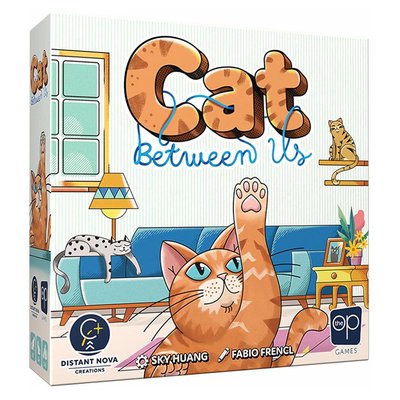
Cat Between Us - How To Play
[Music] Hi and welcome to Watch It Played. My name is Rodney Smith and in this video we're going to learn the two to six player game Cat Between Us designed by Sky Huang and published by The OP who helped sponsor this video. I never wanted a cat. I actively resisted getting a cat. Now I have a cat. And do I love that little furball?
Yes. Yes, I do. He won me over. Have I won him over? With cats, can you really tell? Well, here's our chance. A cat has gone hiding in the house, and we're going to compete to see who can draw them out best. So, join me at the table, and let's learn how to play. To set up, put these four room cards in a row so that the numbers on their bottoms, which make up the interest track, go in order from 0 to 35.
Now, find these six double-sided toy cards. They have the same image on each side, so which side you use doesn't matter. But each one represents a type of object a cat might play with, and each has its own color. Every one of the toys also has its own set of lure cards, which have this back, are numbered from 0 to six, and match that toyy's color.
The lures also show the related toy both in the corner here, and in its art. Cards that share the same toy symbol are known as a suit. So, this is the green or cactus suit. If you have a game with five players, pick any one toy and its matching suit to remove from the game. All other player counts, use all six suits, and we'll assume we have three players in this video.
Either way, in the area below the rooms, you now place the toy cards in any order. Then each person collects two player markers in their chosen color, adding one of them to the shelf found on the leftmost room card and the other onto the zero space of the interest track nearby. I also put this player aid and round tracker, setting the round marker onto the one space.
Then shuffle together all the lure cards into a single deck and reveal one randomly. Each lure will show a paw print and number in the corner here. You now place this cat token onto the numbered space of the interest track matching the revealed card. So 18 in this case. You then shuffle the card that was drawn back into the deck.
Now using this chart found on the player aid, deal each person a number of cards from the lure deck based on the number of players and how many wins they have so far. At the start of the game, everyone has zero wins. So, we only look at this column. And since we have three players, that means each person is dealt seven cards.
All the remaining cards are set aside. They won't be used during this round and should not be examined by the players. You can look at the cards in your own hand, but keep them a secret from the other players. Now, the person who most recently held the cat is chosen to be the first player, or you can pick someone randomly.
And that's the setup. In Cat Between Us, you and the other players are trying to attract the attention of a hiding cat. You'll play cards in your hand to influence which toys the cat will be most attracted to. And at the end of the round, the toys remaining in your hand will either cause the cat to come to you or go rushing into the arms of another player.
Be the first to attract the cat three times and you'll win. The game is played over a series of rounds and each is broken into three phases starting with the prep phase where each person is dealt a hand of cards. But we can skip the prep phase during the first round as we already dealt the cards as part of the setup.
So now we can move directly to the lure phase. Beginning with the first player and going clockwise around and around the table, each person takes a turn. And on your turn, you pick a single lure card from your hand to put face up directly under any toy card. And the card you play does not need to match the suit of the toy it's under.
So, if I was the first player, I might put my card here. Then, the next player takes their turn and maybe they put a card here. The only restriction is that each toy can have at most two cards under it. And feel free to overlap cards under the same toy, so long as you can still see their values. So now, with two cards under this toy, no more can be added here.
We'll see why you might want to assign certain values to certain toys later, but turns will continue like this around and around the table until each toy has exactly two lure cards under it. And that means it would look something like this. The total value of the two lures under a toy represent the attraction value of that toy.
So, as an example, the total attraction of this green cactus is 4 + 2 or six. While the total attraction of this purple mouse toy is zero, red is five, and so on. At this point in the first round of the game, with two cards on the table under every toy, each player will still have three cards left over.
And now it's time for the nuzzle phase where each person reveals the cards they're holding. Let's assume I had a purple, orange, and blue lure left in my hand. I ignore the values printed on them and instead total the attraction value of these cards based on the values of their related toys in the display.
For example, this purple has an attraction value of 0 plus 0, so zero. Orange has an attraction value of 5 + 4 or 9. and blue has a value of 5 + 2, which is seven. So the attraction value of the cards I have left over in my hand is 0 + 9 + 7 for a total of 16. So let's now do another example looking at this player's leftover cards.
They have two red toys which have a total attraction value of five each and one orange which is worth 9. So that's 5 + 5 + 9 for a total of 19. As a final example, let's assume our third player had these cards. Their total would be 6 + 0 + 8, which is a total of 14. Each person now moves their marker to their total value on the interest track.
And it's okay if you share a space with the cat marker or another player. At this point, the person closest to the cat's interest marker without exceeding its value wins. So, in this example, that would be my blue marker because it's closest without exceeding its value. If you're on the same space with a cat, that also counts as being at its value without exceeding it.
On the other hand, if every player exceeds the cat's marker, known as the target value, then the player who exceeded it the least, that is the player closest to it wins. So green in this case. If there's a tie, whether it's when all the players exceed the target, so between these two players in this case, or between players closest to the target but under its value, which would be these two players in this case.
Well, then all tied players win the round. So, green and blue here. Either way, the winner or winners in the case of a tie advance their other cat marker to the right onto the next shelf in the rooms. Then, players put their cat markers back onto the zero space of the interest track, and you advance the round marker to the next space.
The next round begins just like the last, but now we can go through the prep phase together. This is normally how you start every round, but remember we completed this as part of the setup before. So many of its steps are similar. First, gather all of the lure cards together, taking them from players hands from below the toys and combining them with the ones you'd set aside.
Shuffle these and then draw one randomly, adding the cat marker to the space it shows here. So, a 12 in this case. Shuffle the revealed card back into the lure deck and then deal every player a number of lure cards based on their wins so far using this chart on the player reference. The number of paw prints showing on the shelf where your cat is located reminds you of your wins, which will be either one or two.
In this case, I have one win and the other two players have zero. So that means for our player count, I'd be dealt eight cards and the other two players would be dealt seven each. And once again, any leftover cards would be set aside. And then you move on to the lure phase where players will take turns adding cards below the toys just as before.
This time though, the player who won the previous round takes the first turn. If there was more than one winner in the previous round, the starting player is the winner of that previous round that is closest in player order to the previous rounds starting player. As rounds continue, one or more players may have more cards than the others.
And this can be helpful as you'll have more options to choose from, but it also means you'll have more cards left over at the end of the round during the nuzzle phase. For example, during round two as the blue player, I'd have four cards left over instead of the three I had at the end of the last round.
And that means I'd have even more to score, which could push my total higher than I wanted, especially during a round like this one where the target number is so low on the track. So, you can start to see how the game creates new challenges based on how many cards each player has from round to round.
and rounds will continue until either you just finished the seventh round or someone is on the final shelf with this crown icon. In either case, the player who has won the most rounds wins. So, in this case, the blue player. Now, if there's a tie, the tied player who performed best in the last round according to the normal rules is the winner.
So, in this case, the blue player. Now, if there's still a tie, all tied players share a combined victory and pet the cat together. So, blue and green in this case. And that's everything you need to know to play cat between us. If you have any questions at all about anything you saw here, feel free to put them in the comments below and I'll gladly answer them as soon as I get a chance.
You'll also find forums for discussion, pictures, other videos, and lots more over on the games page at Boardamegeeek. And I'll put a link to that in the description below. And if you found this video helpful, please consider giving it a like, subscribing, and clicking that little bell icon so you get a notification anytime we post a new video.
And if you'd like to support us directly, you can join our Patreon team, which I'll have linked below. But until next time, thanks for watching.