Market Fresh Review: Eat Your Fruits and Veggies
Games in This Video
1 game is featured in this video — it unlocks as you watch.
Transcript
Hey everybody, I'm Tom Vassal.
I'm Zee Garcia.
Today we're taking a look at a new game from the war game company Avalon Hill.
Cut throat, baby.
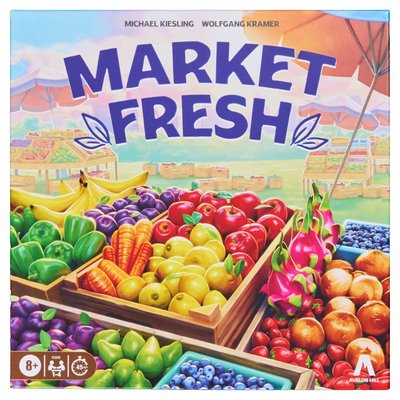
Years ago, they were a war game company. Now they publish all kinds of things. This is called Market Fresh and it is from a very well-known design duo, Wolfgang Kramer and Michael Kiesling, who have done some of the most popular games ever made. Uh and well, do you like dominoes? It's kind of domino-esque.
Sure.
But with veggies. Here's how it plays. This game has a whole ton of tiles that are two different fruits or two of the same fruit in them, sort of like dominoes. Each player is going to draw three of them and have them behind their board. At the beginning of your turn, you'll draw an extra one. You can take one of the face up ones or you can take a face down one. And then you're going to play a tile on your board. When you play a tile, you can just put it in empty spaces like this. This is an apple. I could put the apple on top of the apple that's already there. If you have tiles already on the board, let's see here. Let's say for example, I have this next to this one. I could place this double apple on top of them.
But I can also place a double apple on top of this. Even though that's an apple and a pepper, as long as one of them matches, I can place it on top like that. When you place a tile down on a board, after you're done placing it, however, as long as you place it legitimately, you pick one of the two things in it and you're going to score for that based on a number you can see on the board. So I could pick the dragon fruit here, but that's the only one I can see. Or I could pick the carrots and score one, two, three on the carrots. Also, if you place your tile in such a way, let's say I did apples and I place it here, so that both sides match. Remember, you don't have to match on both sides, but if both sides do match, you're going to get an extra five points. So, here I would get five plus there's only two apples visible, so that'd be a total of seven points. So, you're going to keep track of your points on the outside of this track here, how many points you're getting, but also, if you score them more than one point for the produce. So, let's say for example, I just did three carrots, then I'm going to place my token here in the column where I have three carrots. If someone else got three carrots later, they can't go to that spot, they would go to a lower one. But maybe later on I score carrots again and I got five, then I would move up [snorts] like this. This matters because at the end of the game, you're going to score. The highest in every column, you'll score these farmers. The highest farmer will score double that amount.
The second highest will score whatever the amount is that they're in. So, here orange would get 10 points, pink would get three, and if there's third place or more, you simply just get two points. And then you add how many tiles you have total out on this board, you know, as you're counting up all the different farmer tiles, and whoever has the most get 16 points, eight, and then four. And that's going to be added to the points that you've scored during the game. And whoever has the most points is the winner. Also, you can play a smaller side of the board if you want to. There's also a rules for crate heights variant, where you're going to score based on how high your crates are that you build. Well, that's how you play.
Avalon Hill is at this point pretty close to being a mass market company.
Yeah.
You can find their games all over the place. And so, we often tend to look at mass market companies as lower quality cuz they're trying to cut corners, but goodness.
Sure.
Those little domino things with the My only complaint is that the pictures look really good on the board. And sometimes the little paint I wish they were almost like dry brushed a bit.
All right, right, right.
like, oh yeah, these are bananas. I I forget which ones there's a there's a couple.
I there's two that I confuse. And it is the lemons and the pears I want to say are very close. The pears should have been I think they're pears. They could have been a little more green and less yellow.
Yeah, yeah, yeah, you're right.
It's those two right there, right. Um but generally speaking, except for those two, I don't have I don't have a problem with telling them apart except for those two, honestly. These pieces are tremendously well made. They're they're great. They feel good to collect. They feel great to put out. They just look good. They're they're Yeah, awesome. They they picked one component and went all out. The rest of it, component wise, very okay.
But there's not much else. Oh, you're The characters, I don't love the art.
Yeah.
And I think two of the characters uh look so similar, I was constantly moving the one the wrong one on the track. I thought they looked a little similar. I know they're different colors. Anyway, that's minor, but
But no, like the the the sort of centerpiece of them is these pieces and they knocked them out of the park. They're great.
The game is really interesting in that it is a very simple game to teach.
Mhm.
Do it as you play this. But and scoring you're like, "Ooh, I'm going to get scoring for this and scoring for that." And at the end, it's one of those games that if you don't pick something and concentrate on it, you will score very little at the end.
Sure.
You know, you want to score seven or something at the same time? You got to work for that.
Yeah.
And at the beginning of the game you're like, "Oh, I can place these tiles anywhere I want and stuff." And at the end you're going, "Huh." Now, I have not played with the alternate uh scoring.
The harder side where you have to build up. Yeah, that's trickier. You're going to run into more people having to go, "Well, I can't play." And you discard a thing uh and lose a point or whatever it is. I forget what the rule is. But, yeah, it makes that more likely. Um So, it's just a little more challenging. I'm glad they include both sides, but you can also like literally ignore that one forever cuz the other one is way more forgiving. Um It is interesting because the the one of those things if you were if you play a lot of games, the one thing I think will trip you up is the feeling of having to put the fruits next to the same fruits. And it's not a rule.
It isn't. In fact, you probably shouldn't because there's only one double tile of each fruit in the game.
Right. But, it's like that feeling of like, "Okay, I'm building a big group, right?" No, no, no, no. Just count them count them anywhere they are. But, it's counterintuitive. You want to put the same thing together on a stall. You know, you don't want to like There's lemons everywhere. Um So, that takes a little sort of getting over that feeling. It's happened Every time I've played this, there's at least one player who's like, "Okay, I'm grouping up all my plums." Like, no, you don't have to. You can do it, but you shouldn't and you don't have to. Uh that feels a little weird to get used to. And it's very satisfying, the flip side of that, to to start worrying about stacking up higher earlier and then getting those free five points for nailing it, which you don't have to do either. That's the other thing, you know.
In fact, if you put make that your main strategy, and you're like, "I will just always do those matches and get those five points." Not enough to bring you back at the end of the game. That's not enough.
Nope. Definitely not.
You're better off covering things up, but you're right. You're like, "This feels wrong." Putting I'm only covering up one correctly. The other one I'm not.
Right. Those five points definitely do not um you'll lose the the race at the end for the the bonuses at the end. Now, speaking of the race at the end, this game includes in the rulebook a bunch of variants, which I'm not I have not messed with them. I'll be honest. I've played the game in the way the way they suggest you should play. But, there's a bunch of different things you can do at the end with like score this way, score that way with with one of those being maybe it's just one really big variant, I guess. But, it like it is wildly different. Like, the scoring is Yeah, that's what I'm talking about. print. The
I'm I'm I'm kind of interested in that, though. I'm kind of interested in the idea of the height mattering more.
sounds much more gamery. That's the thing, and I can see why they relegated it to the back of the rulebook. They're like, "Look, if you want to do this stuff, fine, you know. Kramer and Kiesling made this, also. But, this version that we're teaching you up front is way friendlier, a lot easier.
You've played a decent amount of dominoes in your life, right?
Mhm.
Yeah. This game There's a parts of it, though, that really I say dominoes, it's not really dominoes at all, but there are a couple things, especially when I go I'm going to put these next to each other. I need to put a tile on top. Oh, wait. I see that tile over there on Z's board already. There's only one of that tile in the game. And so, things like that Oh, I've already seen the double carrots come through. It's not going to come through again.
Right.
So, if you can count ti- counting tiles is a strong thing, but cuz most of time you can just look at people's boards and see what's out there. But, that does matter.
It definitely for me.
I draft, I might pick because
Yeah.
the tile that goes on top of it hasn't come out yet.
Yeah, I I found myself doing a lot of sort of you have the three and you draw a fourth on your turn and then play, so you're back down to three. I would I would do a lot of like sequencing the ones I'm holding. Like, I'm playing this one here, then this next one goes above it, and the new spaces adjoining that I just created. And then after that, okay, I see one there of the available ones, then this will get played. So, I'm sequencing my plays. I was playing right here. I guess if you're playing up here, then yes, you can be like, well, I haven't seen that tile, maybe I'll draw it. If you're playing with four people, the odds are pretty low it'll end up on you though. So,
It might be better with fewer, a little less random cuz you don't have You can When you take a tile,
You do remove tiles though, so they might just not be in play.
Yeah, it's tricky. It's interesting because the game is such an easy game to teach and play. I feel like the strategic level is pretty high.
Probably a high ceiling, right? Um, it's a it's an enjoyable game. It's sort of like not bumbles along, but it is like a fun little like drip feed of points. But it is also not a game that gives me personally a lot of high highs and low lows. It was kind of like, this is pleasant. This is a game that I found very pleasant. It is a game that I think if you get into it with a family and treat it as your after-dinner game, you know, I think you're going to have a good time. Little cutthroat maybe, but not too much, right? But it also is not a game I would call exciting personally. I wasn't At no point in this game was I like, "Woo, excited." You know what I mean?
So, what would you give it?
I'm coming down at a six on it. I liked it. Um, I'd be happy to play it again and I think the production value, the one thing they decided to focus on, nailed it. Uh, kind of. They they they those pears or whatever they are should have been more green. Uh, not quite, you know, a green pepper green, but not quite as lemony. But the game's neat. I I enjoyed what it does. I like the I like what it kind of asks of the players. I like that it's it's slowly starts to get more and more constricted on your board. There's some nice, you know, rising tension there. I suppose I could call it that. But it also never sort of wowed me or excited me. It is a pleasant game. I think it's a good publication for Avalon Hill. I think families will enjoy this game. Uh not a theme you can object to, you know?
Uh so, yeah. Yeah, I I I'm going to give it a six out of 10.
It's odd because my thoughts are very similar. Although, my rating is a seven. I cannot rate games based on what I think you should buy. I don't
Right.
That That seems odd to me. This is my rating of it. I enjoyed it. I liked it. I'd play it again. But, you're right. The excitement's not there, but I'm also I'm excited on a different level cuz I'm excited that someone might buy this game at a big box store, and I'm like, "Good."
Yeah.
I think you'll like it. I think it will work well. Do you like dominoes? There's a chance you'll like this. It's not like dominoes, but I think you'll understand the idea pretty quickly.
Yeah, it's This uses a set of dominoes where the numbers are replaced by fruits, and then it does something different with them. But, yes, it's a domino set.
There's definitely interaction cuz we're fighting over who's the highest, or you might be like, "I'm the only person who ever scored blueberries. Heh heh heh. Points for me and no one else."
Yeah.
And so, I think that works well. And it's a it's a small box size comparatively for how good it is. This This makes me happy that it exists. And for me, I'll play it. I enjoy it. Seven out of out of 10 for me. So, there you go.
Nice.
Also, I need some fresh veggies. That's Market Fresh. I'm Tom.
I'm Zee.
We'll see you next time.
Hey everybody, thanks for watching this video. If you liked this review or whatever you just watched, wasn't it amazing? Uh check out our channel, Dice Tower. Uh we have all kinds of things. We review games. We do top 10s. We play games live. It's all about board games, but especially the people who play them. Check out Dice Tower YouTube channel.