Talisman - Fifth Edition - A Casual Conversation
Games in This Video
1 game is featured in this video — it unlocks as you watch.
Transcript
Hey everybody, welcome back to the Dungeon Dive. Daniel here. I hope you're doing well, and if you're not, I hope you are soon. Okay, today on the channel, we have a casual discussion on Talisman, the Magical Quest Game fifth edition. And I wasn't sure if I was going to get fifth edition, but something kind of pushed me over the edge, so we'll talk a little bit about that in today's video. Uh first things first, if you actively dislike Talisman, uh the base game of fifth edition isn't going to change your mind. It's a largely the same game as before with a few minor tweaks that do seem to speed the game up just a little bit, and that is something that I appreciate.
If you're unsure about Talisman fifth edition because you already own an older version, and maybe you're wondering if you should invest in this, there might be something here for you, and that is the main reason why I chose to get it. And uh that is the the first expansion that was announced. I believe it's called Talisman Alliance, and that will be coming out in October, and that actually adds official rules for co-op and solo play. And they're doing that in kind of a light legacy mode. It is a resettable legacy mode where it sounds to me like you're going through uh around three to five games in a row uh defeating stronger and stronger bosses. There are things to unlock. There are little packs to unlock, and I think that looks really interesting. It sounds like this new edition of Talisman from Avalon Hill. It sounds to me like they are going to be pushing it in new directions, and I'm really hoping that that is the case. I hope they don't just reprint all of the stuff that has come before. I would like to see all new kinds of expansions for fifth edition.
And I'm hoping that the uh co-op {slash} solo expansions end up being popular so that there are more of those. Um if you're unsure about Talisman fifth edition because maybe you've never played any of the previous versions, I'm hoping that I can provide enough information in this video for you to make a decision. So, in this video, we'll take a kind of a look back at Talisman's second edition and third edition, and in doing so, we'll compare some of the board features, uh some of the in-game uh mechanisms, and some of the characters. Unfortunately, I don't have a lot of experience with Talisman fourth edition, and I know that seems to probably be the most um popular edition of Talisman. It's the one that a lot of people play. They came up with so many expansions. I think there were two kind of a fourth edition and then revised fourth edition, and just so so many expansions, and I just never got around to it, and it wasn't for any particular reason. Uh the Dungeon Dive is 100% against edition wars of any kind. I thought fourth edition was fine. My friend owned it. We played it a couple times only, and I just never personally owned it, and that's mainly because of this stack right here. That's mainly because of uh my history with Talisman is a second edition, and it's the edition that I already have a an abundance of stuff for, and so I was
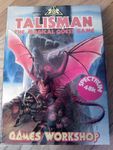
happy with what I had. And I also have third edition. I no longer own the box for third edition, and that's because the box was ridiculously big. For some reason, they decided to put Talisman in the same size box as something like Warhammer Quest and Advanced HeroQuest and Space Hulk, and there just there was hardly anything in that box, and it was so big. It was easily uh squishable, and my box over the years for third edition has just got completely demolished. And uh that's okay because the box was like 90% empty. Uh but yeah, so we'll take a little bit of a look at some second edition stuff and some third edition stuff, do a little bit of a of comparisons. So, long-time viewers of the Dungeon Dive will know that that Talisman uh second edition is kind of the the foundation upon which I built my love for adventure board gaming.
It provided me with an RPG-like experience, an RPG-like substitute. Uh games like this focus on the RPG things that I enjoy the most, going on quests, getting loot, leveling up your character. Um I've never really been into the social interaction, the role-playing part of RPGs, and so that's why these kinds of adventure games like Talisman, like Arkham Horror, like Runebound, and so on. That's why I kind of view them as RPG substitutes, and they are RPG-adjacent. So, uh here we have the box for Timescape, and this is my favorite expansion from second edition, and I'm really hoping that they take fifth edition into some weird and wild places like they did second edition. So, with second edition here, they Games Workshop kind of brought Talisman into their grander 40K world by introducing a kind of a a a science fiction uh expansion, and in this expansion, you could play or there were space orcs, there were space marines, there was the chainsaw warrior, and I've done a let's play on this where I played the chainsaw warrior as Ash from Evil Dead, and it was Ash versus Talisman, and that was a lot of fun, and I really do like this expansion, and this is one of the reasons why I like second edition so much is because of this expansion here.
And then I also have the two other expansions here. We have the Talisman City and Talisman Dungeon. And I do know that both of these have actually been issued before. I think for fourth edition, had Dungeon and City as well, but these are pretty cool as well, and I I always appreciated the small box for the original Talisman, and here is the original uh second edition box. And yeah, I have a lot of stuff for second edition, some fan-made stuff, and so it's just my preferred edition, but um it's not for any reason. I don't dislike any of the other editions. So, speaking of a small box size, I was really happy when I finally did receive my uh pre-order of fifth edition because the box is relatively small. As a matter of fact, I wanted to grab something to show a comparison. So, here is the Fantasy Flight uh kind of mid-size box for their games like Elder Sign and Warhammer Quest, the adventure card game. And as you can see, the new box for Talisman isn't that much bigger. I was very happy to see this. I was afraid that maybe they would try to make the game look bigger than it is, look more important than it is by releasing it in a huge box.
And I was so happy that they didn't do that. I really hope that they keep the boxes small, they keep the boxes uniform, so they stack nicely on shelves, and they're easy to store. Take hold of your fate. Welcome, champions, to the magical land of Talisman. The otherworldly artifacts known as talismans, I guess that is the plural. I The other day in the Hobbit video, I was wondering if it's talismans or talisman talisman. I don't know. Talismans have once more descended into the mortal plane, signaling the dawn of a new era and the need for a new ruler. Race after other players to the center of the board and vanquish the powerful guardian that defends the coveted crown of command to win and guide the world through its next era. I do like that they emphasize the fact that at its core, Talisman is a race game, and it's a race game with RPG elements. And so, being a race game, there are elements of of risk of risk-taking, of pushing your character right to the brink of defeat, but trying to to to push them faster than the other players push their characters. And so, even though there is a lot of luck in this game, of course, it also uses roll to move. There are some strategies, there are some skills. I think a skilled player at Talisman will beat a non-skilled player at Talisman more often than not because they know when to push, they know when to press their
luck, they know when the chances are in their favor. So, I do have all the components out of the box because I I didn't want to flip it over with everything. So, we'll take a look at them in a minute. So, I did want to start here on the rulebook. The rulebook is really nice. It is a really well-made. Avalon Hill, I think lately has been killing it on their production quality. The production quality of the uh of the new HeroQuest is just off the charts good. I love it. I think it's one of the most exquisitely produced board games I've ever seen. The rulebooks in the new HeroQuest are stitched. They're not stapled, and that is the same for this new rulebook for Talisman. And it just makes everything just feel a lot higher quality, kind of I don't know, kind of prestige, and I think the rulebook looks really nice. They've done a fantastic job. It's very detailed with great layout, really good colors, and good art. I think everything looks fantastic.
I've enjoyed my time reading this rulebook. I like all of the characters here, the overview of the different characters you'll get. We'll take a closer look at the characters um later on in this video, how to read your character's cards, your strength, your life, how to use fate. And one of the things I really appreciate about this rulebook is right at the beginning here, they have a section about what is different. And so this little symbol here marks rules throughout the game where the rules are different than fourth edition. I believe that's the main edition that they were working with. And so here we have some major things that are different. The end game condition is different. The end game condition here is a little bit more like the end game condition from third edition where you don't have to defeat the players, the other players. You have to defeat a boss on the board and that really does help to to speed up the game.
Um you can choose your character and the first person to choose your character ends up going last in player order. You can change your character's alignment at the beginning of the game. Uh the carrying limit talismans no longer take up a slot. So you can have four items plus a talisman, four objects. Character death has been uh greatly improved in my opinion. You don't lose all of your stuff. So if you lose all of your lives and are defeated place your figure on the village space in the outer region, you'll keep all objects, magic objects, followers, spells, trophies, fate tokens, and gold. So you will keep everything. It's more like just getting knocked out. Personally, I think that is a fantastic change because if you lost towards the end game of Talisman, there was really no point in uh creating a new character. That's what you had to do in the earlier editions, at least in first and third. I don't know about fourth. I I'm not quite sure what the death penalty was in fourth edition.
But uh yeah, you were just kind of out of the game and would not be able to play for the last hour and a half or so. So I appreciate almost all of the changes I think are done for the better. Actually, I I don't have really a complaint with any of the changes that they've made in fifth edition. I think it does help to speed up the game. And that's a good thing because one of my main complaints about Talisman in general is how long the game takes to play. So it also uses fate tokens. So fate tokens were I believe introduced in fourth edition and these are tokens where you can spend to re-roll dice. They can help you mitigate luck, but one of the new things you can use your fate tokens for is to move. So when you roll to move, if you don't like the roll, you can spend one fate token to move up to six spaces on the board as long as you don't land on another character. Fantastic. That's great. And also they've lessened the devastation of being turned into a toad. So it only lasts for one turn and you also retain all of your cards. So again, just things to help speed up the game. I know they've also gotten rid of some of the spaces on the board where you could lose a turn. Uh losing a turn is such a dumb mechanism. Uh name a more iconic duo.
Vintage games and losing a turn, right? I I I just I never liked that mechanism. Any game that has a losing a turn, I usually try to find a way around that just because when you are sitting around to play a game, you should be playing the game. A punishment shouldn't be not being able to play the game that you showed up at the table to play. But anyway, so yeah. So I think the rulebook is really good. I have read through it a couple times. I like it. It's very clear. Uh I things seem to make sense. If you want to know more in depth on the rules changes and what people are talking about, go to BoardGameGeek. There's already Of course, there are already a number of threads where people are pointing out the differences and yes, arguing about which one is better. But hey, guess what guys? It's 90% of the game's the same. It's Talisman.
It's the same game. And just as a quick comparison, I thought we would take a look at the rulebook from second edition. So this is definitely an old school rulebook with all of the sub-section the sections and the sub-sections. But um overall, this is actually a pretty good rulebook. I actually really enjoy this uh second edition rulebook. It's very straight to the point, just kind of a list of the things that you need to know to play the game. No nonsense, hardly any art, hardly uh no color at all. But so that's the second edition. Now the third edition rulebook, it has to be one of the most slim the slimmest rulebooks I have ever seen. It is ridiculous how short this thing is. So you have your cover page, one, two, and three pages. I think that's was the only rules This is the only rules that I have. Maybe there were more detailed rules. Maybe I don't know. Maybe my copy of see uh your copy of Talisman, the game board.
Yeah, I don't know. But man, this is so crazy how slim uh the rules for third edition were. There must have been more rules. This must have been a a quick play guide or something. But I also have some other things here. So there was an expansion for Talisman the second um edition called the adventure and it was really cool. We'll take a look um uh more at this later when we compare the endings. And this came with some multiple endings that you could play. And then one of the expansions for second edition also came with an FAQ because hey, back then there was no internet. And you had to get your questions answered via mail. And so you would send questions to Games Workshop and they would hopefully answer you uh via snail mail or maybe they would print your questions in a white dwarf or in one of their fanzines or something. But then sometimes game companies would compile frequently asked questions and put actual uh printed FAQs out. And so here we have all kinds of questions answered. And then there was also this uh little pamphlet here in third edition on on how to paint your models. And I always like these kind of old Games Workshop painting guides. They always filled me with so much envy because I could never get even even a little bit close to to how they how they painted their miniatures. And then I guess we'll also talk a little bit later about Like I said, this is a very casual discussion. We'll also talk a little bit later about uh my compiled uh house rules, collection of new and
borrowed house rules. And this official official document is actually available to Dungeon Dive patrons as as a little perk. Okay, don't think we need the box anymore. Let me put the component tray back in. Again, the box is a very nice. The component tray is a very nice. Everything fits in uh nicely. Uh we'll move that off to the side for just a moment. Now let's take a look at some of the boards. So again, I don't have fourth edition board. The fourth edition board was massive. It was even bigger than the fifth edition. It was a huge huge board and it looked great. I've I've always liked all of the board art in Talisman and and Talismans in the Talisman games um including the fifth edition. I think the fifth edition has really really great art. It looks cool.
There's a lot of detail in it and good detail. So here is the uh board for second edition. Now for those of you who don't know, the second edition board was a puzzle piece. Uh games like this used to come with puzzle boards. Dungeon Quest came with a puzzle board. Uh Warlock of Firetop Mountain. So yeah, they just didn't have the folding technology back in the early '80s. But uh this board art was I believe done by Gary Chalk and Gary Chalk's art is one of the reasons why I like uh second edition so much. I also like the small size board. It's really nice when you have your expansions. I can actually fit uh this board and the other expansions on my small table. You know, with fourth edition, I could barely fit the main board on my small table. No way I could fit any of those corner expansions. With fifth edition, I might be able to fit one corner expansion if they make them. I'm hoping they don't make those corner expansions.
I'm hoping they make different kinds of side board expansions that don't have to fit on the corners. But yeah, so here we have second edition and then underneath second edition, let me slide this out. We do have our board for third edition. And this is of course is when Games Workshop was really into skulls. And so there are just skulls everywhere, so many skulls. But hey, you know what? I like this edition as well. I never really played this edition. I'm thinking of actually getting this map uh framed and hang it up on the wall as a piece of art because I think it's a really really nice looking board. Uh let me fold this up. So when third edition came out, they did have some folding technology. So you didn't need to uh to have a map or a puzzle.
And now here is the board for fifth edition. And we still have our outer uh region, same, the middle region, and the inner region. And in a game of Talisman, you are taking a character and you are starting on a space in the outer region. And the outer region is relatively safe. You will be moving along kind of like Monopoly, fantasy Monopoly, landing on spaces, drawing random adventure cards to encounter monsters and NPCs, and finding gold and objects. Uh pretty standard RPG style things. Uh leveling up your character and then you want to make your way from the sentinel here. He guards the the middle region and you can make your way across the bridge into the middle region. There's also ways that you can build a raft to cross this stormy river into the middle region. And you can also pay a ferryman to ferry you across the river.
And then you'll be in the middle region. The middle region is a little more dangerous, a little more deadly. And all you're maybe trying to make your way over here to the warlock's cave in order to go on a quest to get to get a talisman. Once you get a talisman, you can go over here to the portal of power and you can make your way into the inner region. Once you're in the inner region, you stop rolling for movement. You move one space at a time. And one path is more strength-based, one path is more craft-based, so intelligence or strength, and then eventually, you want to make your way to the Valley of Fire, and then you make your way onto this stone bridge in here where there is the Crown of Command, and you have to defeat a dragon in either a battle of strength or battle of wits as of craft, and the dragon has a strength and craft of 10, and you get to choose how you want to fight the dragon. Let's talk about the in-game situation here first. So, in second edition here, let me put the second edition board back together. In the second edition, you would make your way to the Crown of Command, and then you would have to kill all the other players. You would roll dice, and you would either do one damage to them, and then they would slowly slowly start losing damage, and you you would either kill them or you would force them to give up. You would force them to surrender. And so, that's how you won the game, and that could actually go on for quite some time, and it made for some very long drawn-out in-game
scenarios. The third edition sped things up by actually completely getting rid of the middle of the inner region, and that's one of the things I dislike about third edition. I don't like this here. Hey, I love that piece of art because it is incredible, but I don't like that they got rid of all those spaces because those inner spaces are really cool. We have a crypt, we have a a dice with death, you can face off against a werewolf going through the Valley of Fire into the the pits and the vampire's tower. I mean, these are really iconic things for you to do in an adventure game, and to completely get rid of those in third edition, I think was a big mistake. They substituted that with just a deck of cards that you go through one at a time.
So, you go through the Portal of Power, and then you go through a magical trap, and then a pit trap, and then you face off against the Dragon King, and then you get the Crown of Command, and you win the game. One thing that this did do was speed up the game, and like I said, a game of Talisman can go for a long long time, especially if people aren't playing it like the race game it is. And so, this did speed up the game, but it got rid of some really iconic things on the Talisman board that a lot of Talisman fans really did enjoy. Now, eventually, they did come out with an expansion. The expansions for second edition are so expensive. And one of the expansions it did come with was a tower that you built, was this dragon tower. You actually built the tower, and that added back in some of that in-game element that was missing. So, that was good. Now, so we've talked about the original ending for second edition, the different ending for third edition. Second edition also added a modular end where the first player to make it to the center, to make it to the Crown of Command, would draw one of these secret cards, and then that would determine what the ending was. The really cool thing is one of those could be a horrible black void where if you were the first person into the Crown of Command, and you drew this, you fell into a black void, and your character just died. Absolutely brutal. That's the
kind of brutality that Games Workshop was known for. But there are other there are other endings. We have our typical ending, we had our Crown of Command ending. You we had a Belt of Hercules ending, a Pandora's Box ending, a Demon Lord ending, and a Dragon King ending. And each one of those endings had slightly different rules, and so you never really knew what you were going to get, and this is such a great way to play Talisman. I love it. I would actually the rule state that you the only one player can fall into the black void. Once the black void is is drawn, it's removed from the game. Uh we would keep it in, and you would just roll a a D6 and determine. So, more people, so maybe everybody could fall into a black void, and nobody would win the game. But this is a really neat idea. I know I do know that in fourth edition, they did introduce some variable endings, and I believe I believe fourth edition did have one or two uh ending scenarios that were co-op or soloable, so but I've never played those, so I don't really have any experience with them.
But uh let's go back to uh the fifth edition here. Fifth edition, the end is kind of a it's it's kind of a combination of old and of old and and or or or first edition, second edition, and third edition, and fourth edition, I should say, cuz fourth edition is like second edition. But uh you still have your inner area, you still have all of your cool spaces, but when you get to the Crown of Command, you just have to defeat a boss. You don't have to kill all the other players, so it keeps things going, and that is something that I really really do appreciate. Now, some of the spaces have changed as well, and they have eliminated the losing a turn. So, let's take a look here at the forest here. So, the forest in second edition is you roll a die, and then on a one, you're attacked by a brigand of strength four, so you have to fight a brigand of strength four. On a two to a three, you lose a turn. On a four to a five, you are safe, and on a six, a ranger guides you out. So, that's the forest in second edition. Let's look at the forest in third edition here. Uh where is the forest here? So, the forest here in third edition, roll a die, one, you're attacked by a bandit with a strength of four, two to three, you're lost for a turn, four to five, you're safe, six, a ranger guides you out, gain a craft.
So, the forest in the new edition, let me see if I can pick this board up. I'm not sure uh how how unwieldy is it? Okay, that's nice. Okay, so the forest in the new edition is one to a three, you are attacked by a brigand, you just lose a life. Okay, so you don't have to engage in combat, so that's something that speeds it up. It's just kind of a risk, you lose a life. On a four to five, nothing happens. On a six, a ranger guides you out, gain a craft. So, the six is the same. Uh no longer can you lose a turn, which is really nice, and you have a better chance of nothing happening. So, thematically, it's kind of the same, but I think all of the changes go to speeding things up. And that's pretty much how the few spaces that have been changed, how they play out. It's just there to make things faster. I did want to call out one special space here. This is a brand new space, and this is the Caverns, and it exists in the outer region between the tavern and the city.
And when you land here, you have a random chance of coming out somewhere else, and this is really interesting. You can come out on the Crags, and uh the Crags are in the outer region. You can come out in the forest in the outer region. You can come out in the Chasm, which is in the middle region. You can come you can reach the Sentinel in the outer region. You can go to the Ruins, which is in the middle region, or you can end up straight at the Warlock's Cave to get your quest to get a Talisman. So, that's pretty interesting. If you land there, you could be sent straight to the middle region. It would be entirely possible for a character to reach the middle region on their first turn. Again, a lot of these changes go towards speeding up the game, and that is something that I think they really focused on in this edition. For instance, uh let me move the camera again.
When you go to the tavern, instead of having a random chance to cross the river here, you can actually just pay the ferryman two gold for a for a trip to the temple to the middle region. So, if you have two gold, and you want to speed up the game, you can go straight to the middle region. I think that is pretty great. So, I think the new board overall is fantastic. I love the way it looks. I love the way it folds up small. It's really nice. It's super well made. It feels really high quality, and that's one thing I can say about everything in fifth edition is it is high quality. I I think the art on the board is really nice. You can look down here, and you can see some really good detail. You can see how much of how much I think love that the artist put into this game. It looks fantastic. I know there were some accusations that it was AI art, and Avalon Hill came out and said, "Nope, here's the person who did it. Here's the company who did it. It is human-made art, and I think it looks great. I love the way it looks." Now, I have heard some complaints about the perspective.
It's a little weird. It's a little more like Prophecy. If you guys remember my coverage of Prophecy, another kind of uh basic adventure game, that game kind of has a fish-eyed lens where you are moving around the world kind of like a globe, and the the board the map is circular. That is kind of how the board is here, but it's square. The point of view is focused on the Crown of Command, and then everything from here kind of bends out and around. And so, depending on where you're sitting, you might have an upside-down view of some of the things. I don't think that's really a problem. One of the things that I do enjoy, and let me bring out my second edition board again, so you can see here. So, because of the perspective on the older boards, the river that you crossed was kind of in the sky?
Just it always it was always a little weird. So, here's the river here, and it's kind of coming up under a weird bridge, and then it's flowing into the sky. It's a sky river. It's actually not, but that was just a perspective. Uh by by uh presenting the perspective like they did here, the river is actually on the ground where rivers belong. And so, yeah, that is something I do appreciate. I think it looks great. I love the art. I love playing in this new world of Talisman. Okay, now let's get into something that is amazing that everybody loves about Talisman, and that is the characters. There are so many characters, and there are good ones, and I like them a lot, and I think um whenever you start a game, picking a new character is always fun. So, we have our new fifth edition characters. We have my large stack of uh second edition characters. I'm sure the stack for fourth edition with all those expansions, it must be I don't know, is it twice this many? But, there are a lot. I think there are something like 50 or so, 70 characters here.
In uh first edition or in second edition. And this is with I think I think all of the expansions. So, all different characters. Now, third edition, I did not really care for the character cards. I just think they're kind of boring. They didn't really have any art. They just had a picture of the mini, which is okay, but I would rather see hand-drawn art for that. But, um the differences between the third edition, uh there aren't as many there aren't as many overlapping characters in third edition, and so we'll take a look at that as we go. And so, in the new fifth edition, we have uh these following characters. We have the prophetess, the assassin, the ghoul, the sorceress, the wizard, the elf, the monk, the priest, the dwarf, the thief, the troll, the warrior, and then when you get turned into a slimy toad, there is your toad character. And so, a character will have a number of different stats. They will have their strength and uh the cones return, the cones of Dunshire, the cones of Talisman return here. And so, we have our strength. So, when you create the the prophetess, when you play the prophetess, you'll take two cones to be your strength. You will take uh four cones to be your craft.
Okay, so there's your four cones for your craft. The large cones count as five. And then you can have a number of objects, so you can have four objects. Objects are things like trinkets, armor, weapons, that kind of thing, magical objects. You can have followers. Those are NPCs that you can find you and you can have any number of followers. You have a certain number of life, and life will be represented by these uh green cones. And so, all the characters, I believe, start with four life. Again, the large cones are five. Now, some of you might have seen these purple cones uh when I showed the components, and I should have mentioned those before. But, these purple cones, these are not included in Talisman uh fifth edition. These are from third edition, and these were experience points. And I think we'll we'll talk about that a little later. I still prefer the way that third edition handles leveling up and handles experience points. I think it makes the game a lot faster and a lot more fun for me, and so I'm going to continue to use third edition rules when I'm playing fifth edition for uh for leveling up.
Just because I think it really does speed up the game. And so, uh that that's again, one of the main complaints about a lot of these styles of games is that they're too long for what they offer. And then we also have a fate. And so, like I said before, we have these fate tokens. Fate tokens can be spent to mitigate luck, to reroll dice, and they can also be spent for movement. That's pretty cool. And then the characters will start with some gold, and fifth edition comes with some uh plastic currency that actually looks pretty good. Uh that's one of the things, the uh the the the gold coins, the little tiny cardboard chits in second edition are really bad, and I don't I don't like to use those. And then each of the characters will have a number of different powers. So, for instance, the prophetess, you begin the game with one spell, and so we do have a spell deck. Uh the spell deck feels a little slimmer to me, especially compared to second edition. Um I'm not as excited about the spell deck. This is one area where I would like to see the game um expanded upon greatly. And so, we have a number of different spells, healing spell, psionic might, preservation, random acquisition, destruction, healing, teleportation, divination, immobility, nullify, destroy magic, counterspell, and so on. I think they look really nice. The cards are really nice, and uh you will recognize that no longer does the game use uh mini cards.
So, here we have our third edition cards, here we have our second edition cards, and our fifth edition cards. They are much larger. I was surprised to see that they went with larger cards. I think that adds to the cost. I am not somebody who dislikes small cards. I know some people hate them, some people call them hobbit-size cards. I don't care. They they usually work fine. It I actually kind of prefer them in some ways, because I sometimes I feel like you can get more for less with the smaller cards, but they went for full-size cards. And I think that's interesting. It It is a little weird, though, because the cards don't exactly uh fit on the spaces anymore without covering things up. I did appreciate the old smaller cards, because they would actually fit in the spaces. And so, it is a little weird. It's a different decision, but hey, um I'm I'm kind of all about it, because I think the art looks really nice, and they look really big. You get a big piece of art, which is really nice.
But, yeah, so the prophetess starts with a spell, and if you're ever out of run out of spells, she can draw one. So, she always has at least one spell. Uh that's a lot better than the magic users in third edition. In third edition, you didn't you weren't guaranteed to always have one spell as the wizard. Uh once per turn, whenever you must draw an adventure card, and the adventure cards, these are all of the things that you will encounter, all of the combat, all of the NPCs, all of the objects, all of the events, all of the places that you will discover as you are exploring the land of Talisman. But, the prophetess being the amazing character that she is, I love the prophetess, uh she can uh discard her first card and draw a second card. So, she has a little bit of a choice in what she is encountering. And anytime you can look at the other players' spells. So, some of the characters, their their abilities, they do focus on that coop on that uh competitive nature of the game.
And so, if you are playing solo like I do a lot, uh some of the characters, they don't work so well solo. Just um they feel a little neutered, because uh their their powers are not meant for solo or cooperative play. I would bet I have a feeling that the alliance expansion, I have a feeling that it's not going to come with any new characters, but it's going to come with co-op versions of the old characters. I I bet that's what happens. But, anyway, so that is the prophetess here, and as you can see, here we have the old prophetess from second edition. Pretty much the same uh strength two, craft four. There was no fate in second edition. Uh everybody started with the same number of lives, and uh the the the rules here are the same, the same exact abilities. You begin the game with one spell. During the game, you always have at least one spell. Whenever you draw an adventure card, you may draw one more than necessary, then discard one of your choice. And at anytime during the game, you may look at the spell cards held by the other players.
Okay, then we have the assassin here. Strength three, craft three, life four, fate three. Three points of fate, that's pretty good. And the assassin, when you battle any character or creature with strength, you can choose to assass- assassinate them. You cannot assassinate when you are attacked by another character. So, this is a kind of a PvP style of character. When you When you assassinate, battle takes place as normal, except that your opponent may not roll a die to add to their strength. So, there's two kinds of combat, there's battle, and then there's a battle of wits, or battle of strength and craft, basically. And uh most battles are fought with strength. One person rolls a D6, adds their strength, adds the strength of any objects, totals that. The other character rolls a D6, adds to their strength, modifies that by anything they're carrying or any followers, and whoever has the highest total wins.
Um some characters can fight with their craft, can fight with their mind. Some encounters are ghosts, some encounters are spirits, and so they will always attack with craft. And so, uh most of the time I find that that craft characters are a little It's a little harder to play a craft character, just because there aren't as many, and in the way that the uh leveling up usually works. So, when you uh when you fight a character, when you fight a creature, you will take their card as a trophy. And so, this ogre here has a strength of five, it would be a battle a battle of strength, and you would take that, and that would add a trophy value of five. And then if you had another card with a strength of three as a trophy, those combined to be eight. And in most games of Talisman, you trade in seven points of trophies for a similar level up. So, strength is traded for strength. So, I could trade in this uh these two cards here worth a a trophy value of eight, that's a seven, and I would get one point of strength to add to my uh to my strength. So, if I had a three, I could add one cone to go up to level four in strength. And the same with craft. If these were both craft, I could trade both of these cards in for one point of craft.
Now, fifth edition changes that a little bit by making your current strength or craft or uh the target number. So, to level up the assassin, it's much faster. I only have to have trophies worth three, or craft worth three, and then it goes up from there. Next would be four, five, six, seven, eight, and so on. I think that's pretty cool. It makes things go faster. It makes that that that beginning game that that initial kind of the firing gun starts and ignites some fire under the race because you can level up quicker, but then it takes longer as you progress. And that's kind of how things should go, you know, in most RPGs. The earlier levels are easier to to get to than the higher level, so that makes sense. However, I prefer third edition rules for leveling up. And third edition rules say that when you defeat an enemy, you get experience points that are worth the strength. So, if I defeated this ogre, I would take five experience points. If I defeated this bear, then I would take three experience points. So, now I have eight experience points. I can trade in seven for anything if for any stat. I could trade seven for strength, seven for craft, or even seven for life for hit points. I like this system a lot.
This is my favorite of the leveling up systems. And because it gives you that choice. You know, if you start with a character who's focused in strength, but maybe you find a really cool spell, you might want to switch over into a craft style character. And so that's one thing that I will probably continue to play with that rule that you can level up any of your values, any of your stats for seven. But here we have the the original assassin here from second edition. You can pause that and if you want to compare. I'm not going to compare each character here. But here we have our ghoul, so one of our evil characters, strength two, craft four. The ghoul can siphon life off of other characters. Fate of four, that's great. I think that's the highest fate. And here is the second edition ghoul, so you can pause that if you want to compare those there.
Here we have our sorceress, craft two, strength two, craft four, evil character. And there are the powers there. You begin the game with one spell. When you attack another character, you can choose to use psychic combat, so she can use her craft for combat. You cannot use this ability if you are attacked by another character. You may attempt to beguile another character on the space you land on. If you succeed, you may take one gold, one follower, or one object. And you can roll the die to beguile. And so there is the second edition sorceress there. Here we have our wizard. And our wizard looking at his spell book there. You begin the game with two spells. If you ever run out of spells, immediately draw a new spell card, so you always have at least one spell card. That's good. When you attack another character, you can choose to use psychic combat, so they can use their craft. There is the original wizard. And then finally, we have a crossover between fifth, second, and third. Our first crossover here. We have this wizard here. So, it say you begin the game with one spell. You may keep a spell card after playing it if you wish, but you must discard another spell card in its place.
And you may use experience points to gain spells. For every seven experience points that you discard, you gain a spell. So, that was a different way to spend experience points, but the wizard in third edition was not guaranteed to always have one spell. And they also weren't allowed to use their craft in combat. They weren't allowed to decide to do that. So, a very different type of character there. And then here we have our elf and elf. So, the elf strength three, craft four, a fate two. And you may choose not to roll in the forest. So, when you land on that forest space that we talked about earlier, you don't have to roll. You can evade creatures and characters in the woods. And if you are in the wood space instead of rolling a die for movement, you may instead move to any other wood space. So, they can kind of teleport around that outer region.
There is the second edition elf. Love that drawing of the elf there. And here is the third edition of the wood elf. I believe they are they are somewhat similar, but they do have quite different powers there. All right. And then we get into our monk. The monk here looks really happy. He's This monk is actually kind of smiling as well. There is no monk in third edition. And so here we have our monk here. Inner strength allows you to add your starting craft value to your strength during battle, but they cannot use any weapons. When you roll to pray pray, you pray at the chapel. It's one of the spaces on the board. You add one to your die cuz the higher the die roll, the better your your prayer goes. But you may not use any weapons or armor during battle, but you do get to always add a plus three to your strength. And they actually Oh, no. So, a fate of five. That's That's must be the highest.
And here is our original monk. And then again, there was no monk in third edition. Here we have our priest. The priest begins the game with a spell. When you roll to pray, you may add one, so that's very similar to the monk. You can automatically defeat an enemy spirit without resorting to psychic combat. When you use this ability, you may either keep the enemy card as a trophy or discard the card to gain a spell. So, they can trade spirits in for spells. They may not use weapons during battle. A two, a four, and a fate of five there. And here is our original priest here from second edition. If you want to pause. And there was no priest in third edition. Our dwarf warrior here, a three, a three, and a five.
You may choose not to roll in the crags or chasm. If you roll, you must accept the result. You can evade creatures and characters in the hills. When rolling in the cave, you may add one to your total. You need only one roll one die when attempting to open the portal of power with craft. You need only roll two dice in the mines and you are unaffected by the maze. So, a lot of things that the a lot of things that the dwarf can do. There is our dwarf from second edition. And the dwarf from third edition is really stripped down. Take a battle axe, helmet, and armor from the purchase deck, so they start with a lot of gear. You may add one to your dice roll in the cave and you are not affected by the maze and the siren. So, those are the the characters there. All right. And then we have our thief.
So, the thief, you may take one object or gold from another character on the space you land on without fighting, so you can just steal items. When you visit the village space or market and market day cards, take one card from your choice from the purchase deck at no cost. So, they can steal from the from the city, from the market. And then there is our thief from the second from second edition. We have three, three, a fate of two. Kind of a low fate on the thief. I would think the thief being a rogue, kind of relying on luck, would possibly have a higher fate of maybe four or so. No thief in third edition. And here we have our troll. The troll has a strength of six and only a craft of one, but man, that strength of six is massive. And only a fate of one. And they start with six lives. These guys are pretty beefy here. And you may choose not to roll in the crags. If you roll, you have to accept. Whenever you roll a six on the die for your movement, you may heal one life. So, they get to heal whenever they roll a six for movement. That is super cool. And here the the original troll had a strength of six, a craft of one.
And their only ability is you need not roll for the crags. You are always safe. So, I think they thought that strength of six was really going to carry the troll, and I'm not really sure how that worked out. Again, no troll in third edition. And then finally, our our final character in fifth edition is the warrior. When you roll during when you roll during battle to determine your attack score, roll two dice instead of one and take the higher. And they can use two weapons. Very powerful here. A four and a two and only a fate of one. And there is our original warrior from second edition. And we do have a crossover with third edition with the warrior. Take a broadsword from the purchase deck from the start and roll two dice in battle and take the highest. So, that is the warrior there.
And then we do have a few characters left in third edition for which for which there is no crossover in fifth edition. We have a ranger, a swashbuckler, a knight templar, a skaven, a goblin fanatic, a minotaur, and a barbarian. So, they were really kind of pushing more of the 40K feel, I think. Or not 40K, but a Warhammer fantasy battles with the third edition of Talisman. And we won't take a long time looking through all the characters from um from second edition. I have a tier list that I've gone through when I hit 10,000 subscribers. I did a list here of of all the characters. But we'll just do a quick flip through. The ninja. Yes, the warrior of chaos, the chaos warrior, the cyborg, dark elf, the inquisitor. I love that inquisitor. The little hobbit, the halfling, the highlander, the druid.
The witch doctor, the gladiator, centaur. The pilgrim. I love that pilgrim drawing. The space pirate, the amazon. The amazon was awesome. The astropath. The hobgoblin, a zulu, a barbarian, the space marine, an astronaut. An archaeologist. I really hope that fifth edition gets a little weird, gets a little goofy. I would like them to introduce some kind of timescape element, some kind of interdimensional element to the game. I think that would be really really cool. But all right. So, that was all of the characters. And yeah, the characters are fun. I'm really looking forward to seeing the new characters that they come out with in fifth edition. Now, let's take a quick look at the adventure cards. So, adventure cards for fifth edition are here. I really do like the back. I think it looks great.
My stack of adventure cards from third edition and my stack of adventure cards from second edition and this is with all of the expansions that I have. I can't even imagine how large that stack of adventure cards must be for for fourth edition. It must be like a foot tall because there are so many for that thing. And man congrats to people who have all of those expansions because those things are skyrocketing in price. They are so expensive some of them. So, that game has gotten very collectible. That is one of the the other reason why I didn't jump on on fourth edition was just by the time I got around to maybe buying it some of the expansions were already out of print and we're getting pretty pricey.
But yeah, so they did go with full-size cards and I think this is cool. I don't know if it's going to come back and maybe bite them in the ass later because it's going to be more expensive to produce full-size cards. I don't know, but Avalon Hill seems to be doing okay. I know Hasbro is struggling. I really hope there's a future. I really really do hope there's a future for fifth edition because again, I want to see what they're going to do that's different and I think the just the fact that they're making full-size cards, the fact that the first expansion is focused on some kind of light legacy co-op and solo mode. It makes me think that they are going to push this game into some different directions. But let's do a quick flip through of these cards. So, we have our enemies here. Hobgoblin, a ring is a magical object.
We have there's our specter. There's a maiden, so that's a follower. So, she adds two to your craft. A shadow is an enemy spirit. That's a really nice art there. It looks really good. A bag of gold so you can find gold. You can find a mule follower and the mule will help you carry more objects. You can find a place like a cave and when you find a place, that place overrides the space. So, that place stays on the board for the rest of the game and so that ends up with a new thing that you can do on that space. A holy symbol. A fairy is a stranger. So, you can meet strangers and they can help you on your journeys here. The sorcerer stranger. The enchanter, an ape is an enemy animal, a devil. There's the spirit again, a guide.
An amulet, you can get lost in a maze, you can find a unicorn, you can fight a ghost. You can come across a magical belt that gives you strength. Might get attacked by a bandit. You might find a raft and if you find a raft, you can cross that river. Also, if you buy an axe, you can also build a raft in the forest, I believe, to cross that river so you can get to that middle region. You can happily and luckily find actually find a talisman without going on a quest for the warlock. And so yeah, just luck can help you find that talisman. There's I think there's two talismans in the adventure deck. So yeah, just a lot of neat things to encounter. This deck here. These are always my favorite kinds of decks in adventure board games. It's just having all of the random encounters and I can't wait to see how this is expanded. Second edition, the cards here. So, this is just this is a lot of different expansions mixed together. But there are there are similarities. You can find doors to dungeon and that would doors to the dungeon and that would lead to the expansion. But you know because the expansions are already mixed in here, you're going to see a lot more variety and a lot more a lot more different things that you can discover. But there's your original talisman there.
And a warhorse, a familiar, a gargoyle, a Chinese dragon to fight, banshee, a pool of life. There's another talisman. So, I love these old cards like this. I don't know. It just it it is nostalgia. It just makes me think back to a high school when me and my friends used to play this and we had so so much fun playing Talisman for hours and hours and hours on the weekends. And we would also play at school in the science lab during lunch and we had a board that we could kind of lift up and save so we could save our game and we could put it up on top of a cabinet to continue playing our games and games would last like a whole week during lunch. Super super fun. A lot of really good memories wrapped up around this game.
And then we have our adventure cards for our third edition here and they're mostly the same but with with different art. It has that that more kind of mid to late 90s mid-90s Games Workshop arts here. But I do like the I do really like the look of the of the the art and the cards in third edition. I think it looks really cool. It's very bold and kind of stark and unique. But yeah, so that was fifth edition. Let me go over let's see. Did we take a look at everything? When you go to the blacksmith or the city, you can also buy some things. The things that you can buy the deck is pretty slim. I think it's quite a bit slimmer than second edition, but you can buy armor, you can buy an axe, a helmet, a mule. You can buy a raft, you can buy a shield, a sword, and a water bottle. And water bottles will help you in the desert spaces. If you land on a desert space without a water bottle, you take damage. And then we also have our four talisman cards here.
And these are the cards that you will hand out when a character completes a quest for the warlock at the warlock's cave. I guess we should take a look at the minis, huh? That's one thing I always forget to look at. The minis are really nice. We'll take a look at a few of them. I think people who who really like minis will be will be impressed by these. They feel really good and really sturdy. I would have loved it if they had returned to the days of the standee like second edition with some of that art. That's just my personal preference. But I think the minis look really really nice. They're well done, especially this troll. Man, he's beefy. That's really cool. Think it has a I think it has a a good look there. And then here's our dwarf. That's a really cool looking dwarf there. And our wizard studying his spell book.
And then also our I believe that's the prophetess there. So yeah, overall like everything in this game everything is really well made. It is a high quality product and I'm very happy to have this in my collection now. So, I do want to quickly go over my house rules. I've played only two games of fifth edition and I've played rules as written, but I'm not sure which of the house rules that I have used over the years will be incorporated. Probably the experience house rule that we talked about earlier. That seven points of any trophies can be spent to level up any stat. Can be traded at any time on your turn except when combat. No change is given for unused trophy points. That was if you were using the cards.
The close enough rule. The close enough rule is that the corner spaces of Talisman are the really important spaces and the close enough rule is if you land on the space right before the corner, you can for part of your movement choose to move into that corner space. That does help speed up the game. If a six is rolled in combat, it's an exploding die and so you can roll again and you can add and that affects heroes and monsters. I like exploding dice. I think that's fun. If you're using cards, so one of my favorite house rules that somebody came up with in Talisman is using cards for movement and for combat and this is definitely a house rule that I'm going to continue to play. It does kind of neuter some of the abilities, some of the spells maybe or some of the characters powers, but I think the game is just way more interesting this way because it gives you more it gives you more choices.
And so what you do is here I have a deck of cards with values one ace one through six four times and a few jokers, a couple jokers and the jokers are wild. And so what you do is I think I have I think I have a joker per the number of players. So, if you were playing a four-player game, you would have four jokers. So, what you do is you shuffle these up. And then at the beginning of the game, you deal each player six cards. 1 2 3 4 5 6. And these six cards can be spent for movement around the board or in combat. Any other thing that you roll dice for, you have to roll dice. So, there is still some luck. There is still a lot of randomness. And you have to use your complete hand of six cards before you get a new hand of six cards. So, you can move for two. The joker, you can move for anything from one to six. Here you can move for six.
A move for one, a move for five, a move for five and so on. So, you have more control about where you are going on the board. And then you can also use these for combat. And so instead of rolling a die, I could just play a six. Or if I had already used my six for a movement, I could play a five or maybe I might only have a one or a two left in my deck and so that would be very deadly in combat. And so I do really like playing the game in this way. I think it makes the game more interesting. You have a few more choices and it just kind of maybe modernizes a little bit of the game. So, I do like that and I'm going to play fifth edition soon using using this rule. I incorporated the fate I know the fate token was from fourth edition. I took that and played my second edition with fate tokens. I never played with the new rule because it was introduced, but a fate token could be spent to move up to six spaces. I think that's a great rule to play second edition with.
Um, your max life stat is double your starting value. That one is rarely used. Um, discovering the dungeon and discovering the timescape expansions in second edition. I played that if you landed on certain spaces, you could search for those and you would roll a D6 and if you ever found a six, you could find a way into those expansions. It just made finding those expansions and using those expansions a little easier. Um, and then if you have seven or more craft and when you have no spells at the start of your turn, draw a spell. So, if you ever level up your character to a seven or higher craft, you always have at least one spell. So, those were the house rules that I have compiled. I didn't make up all of those. I made up a maybe a couple of them. I've compiled them over the years from other people, um, BGG and just kind of the ways maybe that we developed our play while we were playing Talisman.
So, yeah, that was a kind of a long video here all about all about Talisman second edition, but tangentially also a little bit about third edition, a little bit about second edition. And like I said, I am very very excited to see where the future of Talisman fifth edition leads. I'm hoping that they take it into some bold new places. The fact that the first major expansion is co-op solo bowl slash light legacy really makes me happy. It makes me excited for the future of Talisman. More excited than I have been in a very very long time. So, all right, you guys. Well, I hope you enjoyed this video. We will talk to you later. Bye-bye.