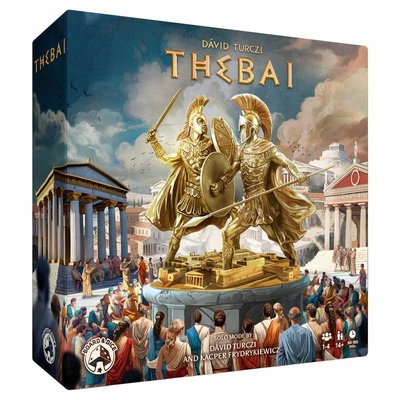
Thebai Review - Is this game on Spartify?
Hello and welcome out to the Dice Tower. I'm Wendy Yi. >> And I'm Chris Yi. >> And today we're going to be reviewing David Turczi's game Thebes. >> Yes, Thebes. It takes place in the city of Thebes. I put that connection together way too late in the process. >> Wow. >> Yeah. >> That makes sense. I was calling it Thebes for the longest time.
>> Yeah, we had to look up on the internet machine how to pronounce Thebes. So, anyway. >> that they make those. >> Yeah. So, this is a complex dice placement manipulation movement kind of a game here. >> Yeah, I will show you how this is briefly played and then we'll come back and we'll share our thoughts on it.
Thebes takes place during the Bronze Age of Thebes, which is a very tumultuous time. So, there's battles going on and there's the rebuilding of the Cadmea. Um and in this game, our goal is to get the most victory points. Uh very thematic. Got the victory point tracker right there. And the main way that you're going to be getting points is by moving up on these tracks, fulfilling these orders over here or these contracts, and then actually getting your citizen dice to ascend, placing them up here, and then there's one of the actions on your board that also let you get victory points, and then the round structure over here will have some as well.
Speaking of round structure, let's start there. So, the basic way a round works is that someone's everyone's going to take one turn. Uh and then we'll complete the end of round that happens uh in the top left up here, and we're going to reveal a future round. Now, there are only 1 rounds to the game, so it's 1 2 3 4 5 6 7 8 9 10, and every time that the one above it is completed, you reveal the one below it so that you progressively can see uh where the battles are going to be happening, and that's these lines over here, as well as what's going to be traded in for points and other bonuses throughout the game.
When you complete a round, you also flip it over just so you know um what has been completed and which one is next. Next, I want to talk about dice. Now, you have two different types of dice that do different things, but they upgrade very similar ways. So, you have your citizen dice, which allow you to take actions on your board in the city, and then eventually ascend up to here for victory points.
And then you have your hippolyte dice, which are your warriors. They will fight the battles in these lanes over here. Um and when they ascend, they are going to actually allow you to get these commanders. Now, these dice are never rolled, but instead they are pipped up ways during the game. So, they start out at a one and they move to one star.
So, they're still a single power worth of strength, even though they've upgraded. Then they move to two, two star, three, and then eventually three star. And once they've reached that three star, if they were to upgrade again, that's when they would either ascend to become a captain or to this ascension board over here.
Now that you understand how the dice pip up, let's talk about an actual turn. And there is a good player aid that explains everything that you need to do during the action phase, as well as during the fate phase, the conflict, all of that. So, useful player aid. On your turn, you're going to be taking two different types of actions.
The first one is with one of your white citizen dice. You can either choose to place it on one of these visual areas here that's not covered up, or you can choose to place it between two buildings, taking one of the benefits and then paying additional money if you want to take another one. Dice on your board, you will eventually get back when you run out of dice.
However, dice that stay out in the city are going to stay there. When you choose to start a turn that has no citizen dice, you get an additional one from the supply, as well as the ones off your board, clearing those to take additional actions. After you use a citizen die, then you can use your arkon.
And what he's going to be doing is he's going to be moving around, and as he passes over dice, he's going to pip them up if they're someone else's, or if he passes his own, they will actually pip down. Um and he's going to be getting the actions on the spaces or the little bonuses that are there where he lands.
Finally, the last thing you can do on a turn is if you have a contract in hand and you have the resources you need to complete it, you can choose to complete it and then just set it aside in some way to show that it is done. And these are used for points, special abilities, new resources, and then set collection at the end in the top left corner.
Now, because this is just an overview, I'm not going to explain every action that is on your board, but there are ones that allow you to build out more Acadia tiles, um and those will give you little bonuses as you build them. There are ones that are actions that allow you to place out your Hippolyta dice, and these are important for the battles, and I'll explain those in a little bit.
There are also ways to move up on these two tracks over here. This one is going to determine uh player order at the end of a battle, um and then this one over here allows you to benefit your Hippolyta dice. So, basically, if you want to improve citizenship or you want to improve Hippolyta, there's kind of two different tracks to do similar things and give you special powers.
Actions are also a good way to pick up contracts, to gain resources, to complete contracts, um and then also just picking up dice and exchanging things for points. All right, next I want to talk about battles. There are four that are going to happen in the game. You only know the first two towards the beginning, and they reveal over time.
And the first one is going to take place in row five. So, this little symbol's going to be here, so we know that's what we're working towards next. Now, as you gain commanders, you'll also be able to place out whoop these little guys here, which are hard to see. Um if you're the first to place out a guy in that line, which means you ascended your Hippolyta die, uh you place out your lowest number, you'll take one of these guys over here with these commanders and get some sort of ongoing power, uh but this is going to stay in this row, and it's going to add towards this battle.
Now, the first battle starts with a base of one, and we're going to flip over this modifier card over here, and this is going to tell us what we add to it, which happens to be zero. So, with the base of one, we'll go ahead and we'll count up to see what everyone's battle power is. So, right now blue has one, pink has four, and then green Oops, sorry, that's not one.
Green actually has six. If you ever have three more than this, you're going to get extra points. Everyone who wins in the battle, so they beat whatever this army level is, is going to get benefits. And the If anybody for some reason has not included things, they'll actually lose significant amount of points.
Then the ultimate winner, so the person with the most, is going to get this tile over here, and it's just going to work towards a wild for their set collection on their contracts. Now, at the end of the battle, you do have to pay money to keep your dice out, and if for some reason you can't afford it, or you decide you don't want to afford it, then you'll go ahead and you take those black dice back, and then they'll start back over at basic strength.
The benefit of placing them here in the middle actually though, is that they can benefit multiple battles. All right, well, I tried not to go into too much detail, but at the end of the game, you're going to collect victory points from a variety of different places, your set collection, your ascension board, whatever this last tile is over here, usually victory points.
And then just the person with the most is the winner. All right, so starting off talking about components, especially because the Cadmea tiles are really fancy. They're like screen printed wood. >> I I Yeah, they're very nice. This is I think that Board & Dice is doing many things correct. One is that the resources are more distinguished from each other.
I think that they're their use of wood in stuff like this is superb. >> Yeah. >> So, yeah, I agree with you there. Some of the standees are kind of weird. >> They're really hard to see the commanders. Like I feel like it's a silly part of setup. But why do I have to put out so many commanders and find the exact match, and then I also have to set up those little tracks on the side that it's like stack four tiles, four tiles, four tiles, four tiles.
Man. >> Yeah, it's also weird that >> I'd just rather a cube to say I got this upgrade. >> I don't think you need the standees at all because on the personal player ones when you level up a die with the one of the hoplite military dice and you put out the standee, you're like, "Oh, half the piece of that plastic covers some of the number." I think that those are weird and you don't even have to use them.
That's probably the solution there. Overall, I do like the production. I think that it's nice. The pipping up the dice. >> Oh my goodness, I wish there were arrows. I finally figured it out as I was doing the overview. I was like, "Okay, it pips forward and then it's side side side side forward. Okay, got it." But oh man.
Yeah, just just resetting the die even is But that is what it is. >> Yeah, but overall, I think it is a very nice-looking production everything. It fits most tables despite the fact that it's kind of a large setup of things. Yeah, you don't have like Well, >> push the boundary of this table that I did the overview at.
>> That's true. That's true. You do have a rather large player board. But Yeah, it's true. I take that back. >> You take it all back. All back. >> Yeah. >> This review is null null and void now. >> It fits well enough, I guess we should say. >> I think it does and I think that they made the pieces modular so that you can kind of fit them where you need to fit them for the most part.
>> Yeah. Speaking of modular, if you like modularity, then this game is is immense. I think that it has both like a lot of setup variability. What tiles do you get? What order they come out in? Which of the far right neutral tiles do you get? >> Every player color has a different set of tiles and I didn't sit and analyze them all to understand what that rhyme and reason is, but they do.
They have different actions on the tiles. >> Yeah. Yeah, absolutely. But there's also going to be a lot of player-driven difference with this game which I think a lot of people are going to be really gravitate towards. The way that you set up the actions on the map, what actions you choose to put out there, it's going to change the game as pretty significantly, I think, from game to game.
>> I think the the setup can change things, which is nice or not nice, depending on how much you like to set up variability and stuff. Um the interaction is definitely there, and I don't feel like it is brutally mean. Even though you're competing, you're having these like little mini area control games over the the battle lines.
But the the negative for losing, as long as you participated, isn't so bad. And honestly, I've had battles where I lose like 12 points, and I thought that I was just going to be devastated for the rest of the game. And it wasn't that bad. I made it up because there's other ways to make up those points.
And I wouldn't say this is a massively high-scoring game, either. It's not like you're in the 300, 400 points. Um but yeah, that 12 points didn't hurt as bad as I thought. >> The There It comes with a little disc for each player, the plus 100 points and plus 200 points. So, yeah, 12 sounds brutal. In the grand scheme of things, it could make or break a game, but it might not be the only difference there.
>> Yeah. >> David Turczi is a designer that I think has a brilliant mind that I don't always click with. And unfortunately, as much as I like many of the systems in this game, I think that the round structure, for example, is pretty sensible, actually. You know, it's four steps. There's like some optional things in there, and you can complete a contract when you want.
But outside of that, it's not too It's not overly difficult or overly convoluted, like I feel some of his other designs, notably Voidfall, not too long ago, were that still there's a lot of interlocking systems and a lot of restriction in this game. And I I've I've been trying to figure out what exactly is it that I like and what are exactly the parts that I don't like.
And if you were to ask me on the surface level, do you like the dice placement mechanism? Yeah. Do you like the fact that it's interactive? Meaningfully interactive as you move around uh pipping up each other's dice as you jump over them and all that stuff? Yeah. But I I think that it overall feels kind of too restrictive for me.
>> It's interesting because I think for me the restrictive part is very specifically the action board and the way that the dice come out on it. Um it makes sense that as you're putting dice out into the city, you need a way to get more dice, right? So you don't run out of actions. But also maybe you don't need more dice because they have to you have to take like you have to be completely out of dice before you can wipe them so that you can take those actions again.
And that is what feels restrictive to me is that the things that I want to do, I can do them once. And if I have four dice, I can do it once every four actions out of 10 actions in a whole game. >> Yeah. >> I mean? It's not like I have the opportunity to do it you know, maybe only four or five times a game.
No, I might only do it twice the entire game. That's it. >> And I think that you have to play a pretty aggressively putting dice into the central city board then in order to not be constantly blocking yourself. >> Mhm. >> But that's also that comes with its own costs and its own setbacks and everything.
>> Cuz then you're not enjoying your player board. >> Right. >> With those action spaces. >> And I I think that's the problem I have with the game. I enjoy so many aspects of it, but there's not much time. There's not many actions in the game to enjoy the different things. Now, even when it feels like you don't have enough opportunity to complete something, one of the things I do like about the game is that yeah, there's there's ways that you can can re-manipulate things, change things, find kind of this long-winded way around it, you you around it and be like, "Ooh, I can complete this contract and take that action and move up this track this turn." Once you're done figuring out what that long process is going to be, all the other players at the table are going, "It's still your turn, huh?" And not even in like an analysis paralysis like, "Everyone stop and watch me take a 10-minute turn." But just just the the logical flow of this is, "Well, I get to move this guy.
I get to complete this contract and I get to complete that contract in a specific timing I want to, which may Oh, if I get to after actually, then it opens this up and I can return this and It's It's kind of a lot for what feels like a No, but many turns can be short and smooth and other ones are not.
>> Yeah, it's like take two actions to fill a contract. Done. Um I like that in games and I enjoy that part in this game. Uh one of the struggles I have just a little bit is that sometimes that happens and then you realize that you still couldn't do the thing you wanted to do. You're like, "I thought if I did all that, I'd get to build a building." No.
I forgot that die is still in the way there. >> Yes. >> Um >> That has happened more than once. >> Yeah. I think I think that that is is a part of it. But I do enjoy each individual system and I enjoy those moments where I do all that cool math and I feel very clever. And I go, "Okay, I did all of this and oh my goodness, I ascended that die so I can finally get one of these end-game scoring things." Like, I'm so excited about that.
Um and it feels good. However, there are also turns where I go, "Wow, I have like four things I could want to do and I really can't do any of them because I can't get another stupid tile out on the board or because there's just not access to a certain type of action. And I think that that's what happens with each player color being so variable is that those just might not be out on the the They might not be available.
And so if you haven't uncovered it because your dice are stuck there, and it's not on the main board, and so your arc hand your Arkon can't get there, then you're just kind of like, "Well, I need to do this thing, and it's just literally not available, and I can calculate three turns from the end of the game that it will not be available to me by the end of the game." >> There's also moments where as oh, the battle's going to take place on the seventh row down.
And if everyone kind of just refuses to build down there, so that no one can put their dice out there, then you're also restricted map-wise and everything. So, it's it's brilliant, and yet I don't like how restrictive it is. And that is obviously going to be a matter of opinion. >> Mhm. >> I think it's also going to be a matter of how much are you willing to dive deep into this game, play it repeatedly to get better at it, to to be able to read the board state six turns before you realize you're three turns from being locked out from something, and pivot.
But that's not necessarily how I want to strate- ex- strategically approach games. And so, yeah, this one just doesn't quite resonate with me. As much as I do enjoy you know, many aspects of the game, and I have had fun games of it, and fun turns of it. >> Mhm. >> It just doesn't overall resonate with me.
>> Yeah, I think that I have some fun moments. I really enjoy if I can build out a tile to one of those edge spaces that no one's built out to yet. If I can build out there and somehow get one of my Hippolyta dice out there, I'll be like, "I took that really good spot. Ha ha ha ha ha." Like, I think there's some cool moments.
I have fun with this game during those times. Um yeah, like there are some of those cool things. I really enjoy those commander powers. There are some that feel really great. Um being able to get a contract, but not actually have to like pick it up and hold it and have it potentially be end game negative points, but instead to just be able to "I want that one." And if as long as it's there my next turn and I can afford it, I can just buy it from there.
Like, there's some cool cool things. There really are. >> Contracts are probably one of my favorite parts of the game, yeah. And and >> they're hard to do and they're pricey if you collect them, they you take an action to collect them and then you can't complete them. They're negative, yeah. >> Yeah.
>> Oh, final scores, man. >> Yeah, final thoughts and scores. I, like I said, as much as I enjoy the different aspects of this, the the entirety of it all summed up together, I'm giving this one a six, right? As much fun as I have with the dice placement, it's not the best dice placement game that I've played.
And I love opening up that player board and creating new action spaces. But I'm not I I just don't see myself coming back to it that often. I love the contracts and that flexibility of being able to flexibility of being able to complete a contract in any part of the phase of turn order that you want gives you the ability to make some really important and powerful decisions, but it's it's it's almost exhausting by the end of the game for me.
And I know that's not going to be the case for everybody else, so the six is going to seem like a really harsh score, but it's just because I I I don't see myself retaining the rules and coming back to this one. It might sound like a a higher score than it should be given all the complaining I've done, but it is well made and it is fun.
So, I'm trapped in kind of this weird place. So, it's a six for me. It's one that I'm not recommending, but it's also not a bad game at all. >> I did honestly think you were going to give it a lower score. >> Mhm. >> I really did. Um, just the frustration that you've had during playing it and just those turns that are kind of empty.
Um, I'm going to come in at a 6.5. I'm not right I'm not too a seal of approval and it's really because there are just moments in the game where it feels like I want to do something cool and there's nothing that really cool I can do this turn, and I don't see anything cool happening in maybe my next two turns.
And then it's the end of the game kind of thing. So, there are just those moments. Whereas, there are some high moments, there are some exciting times. Everything really does work together. And if you are a Turczi fan, um I could see this being one of those games that is almost like a little bit lighter for what he does.
Like, I think this is an introductory um Turczi game in that regard. But, yeah, I just I can't quite recommend it because I do feel like it's just fine. This is not going to stand out to me. Um thematically, it doesn't stand out. Gameplay-wise, like the tracks are tracks. Building stuff around the city is building stuff around the city.
I mean, I do think that there are some unique concepts to it, like the dice being placed out, like the Archon moving around, pipping up dice. I think there are some cool, unique things to it, but the whole ensemble just doesn't really sing. So, there you go. 6.5 for me. >> All right. >> Ooh, on a side note, we didn't mention the two-player mode.
>> Don't love the two-player mode. That doesn't help. >> simple. It's just flip a card at the end of the turn before you like resolve all the the end-of-round stuff. It's really simple. However, it doesn't add enough build out to the board or enough like Yeah, so often that card flip it doesn't almost do anything.
>> does nothing or it's just kind of lucky how it helps. Yeah. Uh it and it and because of the amount of interaction and moving around and everything, it does benefit the higher player counts. >> Very true. >> All right. Well, there you go. That's our thoughts on Thebes. Thanks for coming out to this review here on The Dice Tower channel.
My name is Chris Yee. >> I'm Wendy Yee. >> Go ahead, like, subscribe, and then uh check out more reviews here. Thanks, everyone. >> Hey, everybody. Thanks for watching another video from The Dice Tower. Hey, you want to learn more about us, communicate with us? We have a Facebook group. We have a Discord channel.
Lots of different ways to get involved with The Dice Tower. You can find that in our link tree link below. So, just click that and it will take you and you can communicate with us on Facebook, join our Facebook group. So, there's lots of cool things that you can find and become part of the Dice Tower.
Thanks so much for watching. I'm Tom Vassal. >> We bounced with a microphone bounce. We're good. >> Oh, we got bounce. >> Bounce, baby, bounce. Bounce, baby, bounce. Oh, look at your moves. >> Was it it's this one, right? >> Yeah, the walk like a duck. The walks like a duck and talks like a duck. >> Duck Egyptian.
>> Then it's going to quack like a duck. >> Duck Egyptian.