Nature - Climate (PART 1 of 2) - Overview
Games in This Video
2 games are featured in this video — they unlock as you watch.

Transcript
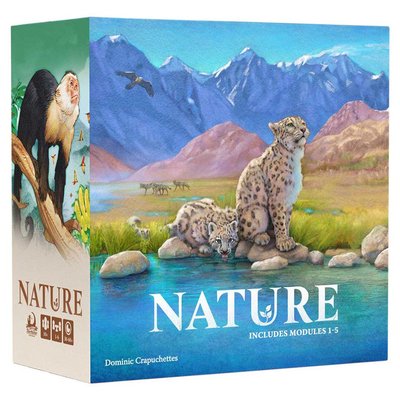
Okay. Hi everyone. Welcome back to Box of Delights. I've got something a little extra to show you today. This is Nature Climate Module. This is the sixth module of the game. As you know, I did the solo rules for this and I've done some extra solo content for the climate module. So, what I'll do is Well, this has just arrived. So, it's literally heading out to our Kickstarter backers. Uh so, what I'd like to do is open the box, show you what this expansion's all about. What does it add to the game? Uh show you what I've done and then perhaps we'll we'll do a little demonstration, shall we? Of of the solo game. We'll have a little play through. So, it's there's also a couple of extra mini modules. We've got the decomposer and the salmon run.
Yeah. So, maybe we'll have a look at those as well to show you what that's about. So, this is Dominic Crapuchettes, North Star Games Studio. Solo rules by myself. All right. Let's go. So, as I say, this is the sixth module. Um compatible with all the other modules, incidentally. But, it does do some Look at that. That's so beautiful. Does do some things fundamentally different and I'll show you that in a minute once we get inside the box. We've got a game board, a rule book, some solo rules with the plaque. And a big shout out to Madeline who worked on the rules with me to get the rule book properly formatted, written well. She's done a great job.
Let's have a look. Let me show you some of the key components before we look at the cards. So, we've got a couple of dice. So, the important thing about this is that the climate is changing. This like the evolution of the earth, if you like, from back in the scorching age and those Jurassic dinosaurs through to the first ice age and everywhere in between. Now, we actually start the game here at temperate. And the temperature can swing. You roll this die at the start of every round and it says whether it gets hotter or whether it gets colder. Okay? And then by how much. So, for that, you roll this 12-sided die. The important thing here is that Do you remember in Arctic Tundra, one of the other modules that was introduced, we had to protect ourselves from the cold.
And we had to roll a cold die to say how cold it was. And then when we got to the Arctic Tundra, we had cards with cold protection. Okay? And we also got inherent cold protection from our size. So, if we were a size four, we had protection from four cold, three, two, one, and so on. Okay? Well, instead of rolling a die, in the climate module, the coldness is given by this track and we have a token here to say what our current climate is. So, if we're up here in this is equivalent to having a coldness of two on the tundra die.
And then two, four, six. So, as we move up, and it can go all the way up to 12, you might ask, "Well, why is that important?" Well, at the end of the feeding phase, you'll lose population equal to the climate if you're unprotected. So, if the climate says eight cold and you've only got six, you'll lose two population, for example. Okay? so we're going to have to evolve larger animals or add lots of traits that add cold protection. We'll look at these new climate cards in a minute see what kind of traits it offers. But also we can go this way back towards the scorching age where it gets hotter and this time we need heat protection protection from the heat.
Bigger animals offer protection from the cold but smaller animals provide protection from the heat. So it kind of works in reverse. So a size one a size one animal has one cold protection but has five minus one heat protection. Okay. Conversely, if you go up to four, so if size four animal has four inherent cold protection, it has five minus four just one protection from the heat. Okay, so the smaller you get, this gives you three cold protection two heat protection. Two cold protection three heat protection and so on. Okay, the smaller you get the more protection you have from the heat. All right, so as you roll these dice at the beginning of each round this says we're going to move four towards the cold the cold side. So if we start here, that'll be one two three four. Okay, so we now would need six cold protection.
Okay, but if we roll this way, let's say we rolled six this way, one two three four five six, we'd now need two heat protection. There is a variant that says don't roll this die but instead the active player chooses whether it gets hotter or colder. Okay, so that's the variant for that. If you wish we still roll this dice to say by how much. So that's the first thing And then the other thing you'll see on this track is the food icon. In the base game of nature, the start of every round, how much food do you put in the watering hole, you you reveal one of these cards. Remember the bottom right, this would give you four food per player, three. Okay, different numbers of food. Two food per player.
It would just be purely random and that would be fixed for the entire game. But, in climate instead, this track not only determines how much heat or cold protection you need, but it also determines how much food is available in the watering holes. We start at temperate and there's three food per player. And as it gets colder, the amount of food will reduce all the way down to zero. And as it gets hotter, the amount of food will at first increase. When it's warm, there's more food. But then again, as we move towards the scorching edge, the amount of food will decrease. Also, down to zero. Okay, so this scale determines how hot or how cold and how much food is available. And this board here replaces the watering holes. So, you can put your dice here, you can put your cards here, you can put your hunter cards here if you wish. You know, this acts like a little player area and this food in the watering hole.
Now, this scale makes it a lot more interesting. The amount of food will vary, the you'll find that as, you know, time passes that your species will need to adapt to whether it gets hot or whether it's cold, that kind of stuff. So, let's see, what new traits do we have? We have burrowing. Can't be hunted by a larger species unless the hunter has clawed and it also offers a little bit of cold protection, a little bit of heat protection. So, your burrow is giving you some protection. You got defensive herder. Can't be hunted by species with a lower population. Strength in numbers. Okay, some cold protection offered there as well by huddling up like a long neck, you got some protection from the heat, you're less vulnerable to a hot environment.
And you can eat food from the supply, so you're reaching food that others cannot reach. We've got nocturnal here. So, we got a shell, extra little bit of protection from hunters, can only be hunted with a species with nocturnal. So, these guys are only coming out at night, so you'll need to create nocturnal hunters to to hunt these, and they have protection from the heat because they're coming out when it's cooler. Seasonal migration. Again, we got a heat and cold protection. What's program of foraging may discard a card to forage twice from the supply. Okay, so you can forage twice in a turn using your cards. Might be useful. Thermoregulation. This is a variable amount of cold and heat protection. And you can store food up to four on here, and the amount of food you store gives you that variable amount of protection from the weather.
Underground hoarding. Two defense, two cold, two heat protection. May store food on this trait up to its population. Again, you can hoard food. And you can move stored food to hungry populations, so you don't need to forage. And then finally, we have ultraviolet absorbing fur, just like a a polar bear. And it gets plus three claws in the frigid or ice age, so they do well when it's cold. But lots of cold protection. And also good defense. Okay, so lots of additional traits here for us to use and combine with your base traits or any other modules you want to throw in as well.
The other thing to add, because you're going to need a lot of this extra protection from the cold and the heat, in the climate module, you can add an extra trait to your species. So, in base game, it was a maximum of three traits. With nature, you can now go up to four. Okay, so four traits. Use some of these actually. It doesn't have to be these. Okay, could be any any traits, but up to four traits. Right, what else we got in here? So, we got some reference cards or player aids. Yeah. There we go. So, it tells you how much I'm on your size gives you climate protection. So, size one, one cold protection, four heat protection and all the way up to size four plus.
Okay, four cold protection, one heat protection. And then a description of the new traits in there. All right, so you got four of these player aids. What else we got? Ah, here's a promo card. Yeah, nice. Homeothermic Hunter, this is our promo. Turns you into a hunter, but also gives you plus one claws, one shell, one cold and one heat protection. So, nice little promo. Okay. Once more, the solo icons are in the bottom left on the not just on the promos, but all the climate cards as well. So, you can use these in your solo games. And we should have some new solo species. So, there's your player aid for climate solo.
And who do we have? We have Winifred, who's like an an elephant. Bill, the badger. Okay. Gizmo. It's like a stoat or weasel, if you like. And then Sammy, like a reindeer. Okay. So, these guys, these solo guys for Rani, they come in with when played effects. So, they start with a couple of traits to get them used to the the climate. I'll talk more about the solo when we get into to the game, but there they are. There's our new four new solo species. And again, you can mix these in with the base game AI species. In fact, you can mix in any of the of Rani's species from other modules, too. How well they'll perform in an environment they weren't designed for, well, that's a bit of an experiment. You can you can try that out and see for yourself.
So, those are your new cards. And all the rules. Oh, there's one other rule change. Because size isn't always beneficial. You know, in nature, when a species goes extinct, and you lose the that species, and the size will carry on to your next species, so your species will kind of get bigger. That rule's gone in Nature Climate. Instead, when a species goes extinct, yes, you keep the population population carries on, but the size is lost. And instead, for each size you lost, you gain a card instead. All right, so you have more cards to use next time, potentially for using as extra traits.
Um yeah, there you go. Extinction. When a species goes extinct, draw draw one card per size instead of carrying the size over to your next round. So, that's it. That's your That's your rules. Okay. You'll also find in here there's rules for Sahara Desert. We haven't seen Sahara yet, but this is preempting what's to come. All right. There it is then. That's your climate module. It's a bit of a beauty. Should we set up and play a solo game? Let's do it.