Nature in about 3 minutes
Games in This Video
1 game is featured in this video — it unlocks as you watch.
Transcript
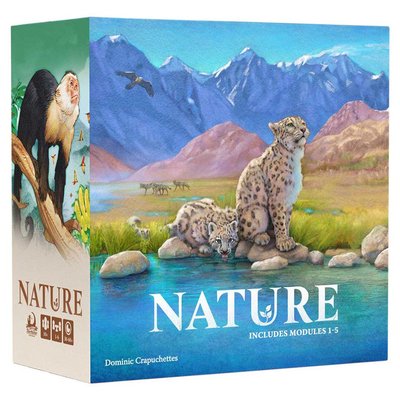
This video is brought to you by the threeminute board game patrons. Keep us independent by supporting us on Patreon. Kyoto and welcome to Nature in about 3 minutes. Review copy used. It has a solo mode. It's a game for one to four players. Playing time is short and it's simple to moderately complex. You are a species of animal. Well, several species. Can you adapt, survive, and thrive your way to victory? The game ends after four full rounds of play where you try to evolve and feed your animals. The winner is the player with the most points and you get points for each surviving animal and how much food it's eaten. Card management. There are a bunch of different cards you can manage. Secret orders. Evolution cards are played face down and revealed simultaneously. Player turn. Nature is a game that comes with a simple core system and then five modules you can add to the game, usually one or two at a time. These change the game rules. Let's look at the basic game. Start with the watering hole and draw a single card. It will show one to four food in the bottom right. This is the amount of food per player the watering hole will get each turn. Do not draw a new card each round.
Each player then collects a size dial set to one, a population marker, and five cards. A dial and population represents a single animal species. On your turn, you can do the following actions. Discard a card to increase your animal size, discard a card to increase an animal's population, or play a card face down beside an animal to give it a trait. Animals may not have more than three traits, including the hunter trait that you can freely add at this time. And that changes the animal from a herbivore to a carnivore. Once all players are done placing cards, reveal your animal traits. Then in player order, you feed. You can eat plants at the watering hole or if it is empty, play a card to add more plants there. You then take one plant per animal size and put them on your population. This tusk animal gets some food when the watering hole runs out. But if it can't fully feed by rounds end, some of them will die off. An animal has a defense value equal to its size plus any gray numbers. So the top animal has a defense of five. A hunter has an attack value equal to size plus any numbers in red.
So five as well. If you tie or beat another creature, you can eat it like food. Killing off one population to gain food equal to its size. This can happen multiple times. At the start of each new round, you will gain a new size one creature with one population. Any population that were killed last round are added to this new critter. And any size from any animal that was wiped out is added, too. You also draw five new cards. Why would you like this game? Nature is a game about keeping up with the Joneses. If the Joneses were trying to eat you. This is the fourth game in the evolution series of games, and it feels exceedingly well polished and refined, as though the game has reached its final form on how they want the game to work. The thing is, the core game is quite mid, and the whole thing lives and dies on the various modules and how you incorporate them. And whether you like this modular system is going to be a huge factor in whether this game is for you. The Jurassic mode makes everything bigger and really ups the amount of player versus player combat. Arctic tundra introduces freezing to death as another option, and you have to evolve to deal with that. Flight adds migration and nesting, while the Amazon adds poison and claiming food from the canopy. And finally, natural disasters give you challenges, you have to evolve to survive. The modules are easy to include. You simply increase the game to five rounds, and when picking cards, you choose from any stack. And it's this modularity that has to appeal to you to make it a good fit for you and your table. The best thing about this game is it's 100% biodegradable and packs away nicely in its own special containers.
However, there is something slightly off about nature. The whole game feels so very polished and well, a bit sterile. The modules are cool and all, but they add to a core system that just feels too simple and too streamlined. Ultimately, I'd rather have one game I really like than dozens of ordinary games made from combining different modules each time. And while I think this game was designed with more casual gamers in mind, they aren't buying this huge box with five modules in it. That one game I'd really like is called Oceans, and it's by the same designer and publisher, Nature. It's so polished, it's smooth. No ridges at all.