Nature Board Game Review How Does Gencon's Hottest Game Hold Up?
Games in This Video
1 game is featured in this video — it unlocks as you watch.
Transcript
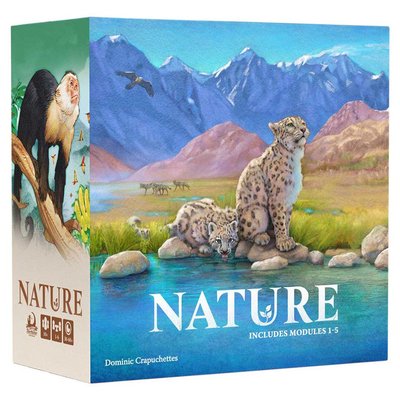
Miniature Market is thousands of board games at discounted prices. Click the direct link below to see all those discounted games. Hello my friends. Today we're going to be out in nature. We're going to be creating species. We're going to be giving those species traits. We're trying to survive, have a big population, and get the most food and keep our species alive. Today we're taking a look at nature. This is from Northstar Games. This is sort of an evolution, huh, of the game evolution. This is basically like evolution 3.0 0 cuz there was evolution, then there's oceans, now there's nature. Uh, it sort of takes the core mechanics of that and sort of streamlines it out, does some different things with it. And this was the number one hottest game for Gen Con. Let's take a look how it works, and I'll see you on the other side.
Now, the game comes with a really cool first player marker, the white snow leopard. Everyone's going to start with a species, and this tracks your size. You start as a size one. This can max out at four, which essentially is like the size of a rhinoceros. Now, you'll start with a population. Each of these is a population that you're going to need to feed over the course of the game. And that's how you get the majority of points because at the end of the round, any population that's alive that you fed will go behind your shield. And those each food is a point at the end of the game. And each species you keep alive is two points in the game. But you can be able to do things like add population, which is going to allow you to possibly feed more, which is means possibly getting more points at the end of the the round. And you can also increase your size, which is going to allow you to get more food at the same time, and also it helps you with your attack and defense. So, let's show you how this works. Now, the game lasts four rounds. First, you go through a preparation phase where you'll add some food to the watering hole. This is what the herbivores are going to eat. In future rounds, you'll actually draw a card. It will tell you how many to add there. Everyone will get a new species at the beginning of every round. So, at the beginning of the game, you have one species and a population of one. Now, you go to an adapting phase where in turn order, players are going to do different things. Everyone gets five cards each round, regardless of how many cards you had left over from last round.
And these are going to do all sorts of different things. Uh, they can be used as a big hand management game because they can be used, you could discard one of these cards to do different things. You could discard a card to increase your size, which is going to help you with attack and defense and how much food you're getting every time this species eats. or you could discard it to add a population. Having population is great because that's going to allow you to add more food to them, which essentially is points at the end of at the end of the game, but you're going to be able to eat them each round. Now, these cards that are in your hand are secret to other players. I've got them down the table so you can see it. But another thing you can do is say take a card and place it face down as a trait. Now, each species can have up to three traits. Now, these are face down so people can't tell exactly what you're doing. Uh, and you can play as many cards or as little as you want, but once you're done, you go to the next player. You basically have one turn to do all your card adding, discarding, and things like that. Now, one of the traits that you can do is there's a deck that you can just grab a card from. It's fa it's always face up like this, and it becomes a hunter. This actually creates you as a hunter, and now people know that you are no longer going to be feeding at the feeding hole because you're no longer an herbivore. You're going to be hunting their creatures. And so, they're going to want to have some defense about that.
More about that later. After everyone's done that, you go to the feeding phase. Everyone flips over the cards that were newly placed. And again, each species is going to have at most three trait cards. And then you're going to feed. The herbivores are going to feed off the watering hole and the hunters are going to feed off of other animals. So in turn order, you're going to feed one of your species. Now the size is important because now when this species feeds, if I decide this is the one I want to eat, it's the only one I have right now. I can only take one of these at a time. So I would take this and I'd put on this population and it is fed. As the round goes on, other people are going to be feeding their species from here. However, I've added some traits that might help me like social plus two food when eating. So, I would get one plus two is three. But I only have two populations. So, that's it. I've maxed out right there. So, I'm actually good. The species is good. However, let's say we didn't have that trait on there. I would have just fed one. It' be the next player's turn going clockwise. But, let's say it came back to me. There's no food left for me to feed this. Well, it is going to starve. Essentially going to be gone. Now, at the end of the round, this goes away. It actually will help you a little bit when you get your new species. You you'll start with with an extra population. Sort of like a catch-up mechanism. Uh, but it'll starve. But you have some hand management. Remember I told you earlier is these cards do a lot of different things. Well, you can discard cards in your hand for food. Like I could discard this this card right here for three food and now there's food there and now I can feed them. But it's also going to help other people too. Now if you notice this one has a trait that says fast, which means it can only be hunted by a species with as many fast traits. Now let's say there was another player that had one species that was a hunter. Now, in order
for this to hunt, it would need to have equal or greater uh hunting. And you look at the size, which is one, plus any traits. I have plus two. So, this one's at three. This one's only at one. So, this could hunt this. However, this one had a fast card, which says can only be hunted with species with as many fast traits. So, right now, this hunter could not hunt this species unless they also had had a fast card like this, at least as many. In this case, they could hunt. Now, they will hunt because they now this one doesn't have any defense. Some cards will give you defense. So in this case, this one's one size five. When you add this four, that's going to be higher than one plus two. So if we had plated, they wouldn't be able to hunt us. But if they don't, they will uh they will eat. Now, this one had already been fed. Well, it gets killed. And this goes back to the supply. So that player does not get that point at the end of the round.
And this one will get food. It gets meat equal to the size of the one that ate. So this one gets one. It will get one meat like this. But if it had eaten a bigger one, they could have fed a larger population. There's other rules and such, but that's generally how hunting works. And you got to be careful because sometimes you have to hunt if you're not fed. And sometimes you might even need to hunt your own creatures. Now, if this one have had another population and another round went by, this one could eat again. They would eat this one like this. This would get meat and this one would essentially would be going extinct. Now, that would actually help them get a bigger size for their species that they start next round. again catchup mechanism, but there's different things like that that can happen. Now, before I get to showing you all the cards, I want to show you a little bit more in the production where these are nice little things trays that slide in and out so it holds all the token for you. Now, there's eight unique trait cards. I've shown you most of them.
Here's ones I haven't shown you yet, like scavenging. This triggers after any species hunts this the the the species that has this trait eats two meat, which means it turns a herbivore into sort of an omnivore. It actually can eat meat there, but it still will feed on the food feeding hole if it needs to. Horned when hunted kills population of the hunter equal to this the species size. So it's a good defense there. Tusk when the watering hole becomes empty. This one eats one meat. It also has some defense there. Opportunistic one uh one defense and it triggers after any species forges or hunts eats two meat if there's still food in the watering hole. So all different ways to have different strategies in the game. But that in a in a nutshell, that's pretty much it. Each round you're putting your points behind your shield so no one knows. You get five new cards adding to the cards you may or may not use last round. Plus, you get a new species each round. After four rounds, whoever has the most points, which is each food is a point, each live species is two points is the winner.
Now, there's different modules. They're launching with five separate expansion modules. And then each year they're supposed to be putting out two new modules. And these just add some cards. Essentially, you just use like one of these modules and you add it to the to a separate deck. Uh, and they have different complexity. Like this one is complexity one. This one's complexity 4. Jurassic is for players who enjoy feeling invincible. This one's for players who pref prefer to avoid conflict. Shows you the complexity levels I mentioned. Now, the modules like you'll add this deck next to the n the normal nature deck. And then when you draw cards, you can draw from this deck or the other deck. Any combination, but you can't look before you decide how many you're going to pull. There's five new trait cards in this deck. Also, you get new wheel in this deck. Uh where it goes up to 10 and it goes up and down by twos. So, now you can have a maximum of 10 there. And these traits do different things. Like this one, when hunted kills population of the hunter equal to what you roll on this die. Uh there's different predators. I'm not going to go over all the rules, but you can pause here and look at some of these abilities. Here are the different traits from the flight module. Module number one, five different cards. You can pause and see some of these. You come with a nest now. And now once you're fully fed, you'll take your your species and put it underneath the nest. It has migrated, which means once it's fully fed, it can't be killed by a hunter. Also, the birds can only be hunted by another flying species. Has a maximum size of two. Uh you'll be migrating and it does not score towards the endame bonus of getting two per species. Now, also when it migrates, there's a place called the far away land. And here you have a population with the meat. And if you migrate and there's still some food here, you get to add this to your species, sort of, you know, having
family and such. Uh so it's it's it's to avoid conflict. You're trying not to be hunted and stuff like that. But there's all sorts of different traits here that you can pause and breed as well. Yeah. So, as I mentioned at the in the intro, this game was the number one game on the Board Game Geeks Gen Con preview list, meaning it got the most thumbs thumbs ups. And so, this was the most anticipated game from the majority of people. So, a lot of people want to know how it how this feels and what do I think about it. Uh, their booth's probably going to be absolutely insanely nuts because it's the hottest game on the list. Now, this essentially is Evolution 3.0 know because Northstar Games came out with Evolution many years ago. Then they came out with a bunch of expansions. Then they came out with a separate game called Oceans. And now they're coming out with nature. And they sort of learned some things from all of these different iterations and sort of made more of a, you know, like a third edition. Not it's more of a third edition. It's pretty there's a lot of same core mechanisms, but there's a lot of things that are different as well.
And they've sort of redeveloped a lot of aspects of the game. So what did I like about it? Well, first of all, this is a thematic card game with lots of player interaction. Now, a little bit more on the thematics of bit later, but you know, generally speaking, you know, you're if you're if you have a scavenger trait, well, anytime anyone's hunts, you get two meat. You know, if you have uh you know, the plated, then you have a lot of defense. If you're fast, then you can't get hunted unless someone else has at least as many fasts as you, things like that. There are a few thematic disconnects we'll talk about later, but overall speaking, generally speaking, it's a thematic card game. Uh, and it really delves on the player interaction. This game really is about what are other people doing? what are they doing that is going to threaten you either by hunting you or by taking the food that you want at the watering hole and things like that and always always checking what's going on around you. Uh so interaction is probably the best thing that this game has going for it. I love that the timing of the order of operations that when you're doing things you get to decide especially when feeding you're like okay which species should I feed first? Uh what's the population? What's the size? What else is out there? Is somebody going to try to possibly hunt me? If so, that will change which one I feed first. I don't want to change the feed the one first that's going to get hunted because that's just going to go away anyway. So, I like that you're looking around the table. You're looking at the state of the state of the game, the state of the other players, and you're deciding what's the order that I want to feed these these uh you know, species in. And I like that that every round it gets harder and harder to make those decisions. But the timing of them, the order of operations is very important here. And that's sort of like the crux of what makes that uh the game what it is. I like the flexibility of becoming a
hunter. You know, in the in the previous in the original evolution, you actually had to have a trait card that said hunter where now you can just, hey, I'm a hunter. I take a hunter card. That's one of my three traits for that that species. Uh, and it's streamlined. It makes it a lot easier to do that. I like that the the triggering of hunting uh like like the scavenger or things like that or foraging where there's abilities where like hey if the watering hole runs out well you get to do this or if somebody hunts you get extra meat because you scavenged and things like that and I like that you know that there's these abilities that trigger on things when certain things happen because again when you're thinking about the order of operations do I want to feed the species? Well probably not because there's two hunters out there. This one has scavenge. That person's probably going to be okay. Let's start feeding the other ones. And you're trying to figure out the order. Again, that's the it's it's the really crux of the game here. Uh I like the multi-use cards. I love that they can be used.
They're so flexible. Uh and I like that the game is not too tight. It's very open. It's very freeing. You're never really like too too short on resources. And I like that you can use the cards to increase your size, which is going to give you better attack, better defense, and get you more food each time that you you feed that uh that species. you can increase your population with it. Uh or even during the feeding phase, you can discard a card and look at the little number on the bottom right and get a certain amount of food into that and you can do it right before you feed. And I like that because that gives you again a lot of flexibility of knowing, hey, I didn't play all my cards this turn. I kept some in the back in my in my in my bag because I know that the food's probably going to run short. And that's the hand management aspect of this, too. Which cards do I need to play as traits? Which ones do I need to discard? Can I discard or do some of these things, especially food? And that's kind of the the the decision space that you have in this game, too. Uh I like that the cards that you don't use stay in your hand. So even if you don't use them for anything all the way through with food, you keep those in your hand and then you get another five next round regardless. So if you like have like a shorter round where you're like, uh, let's see how these things turn out. I think I'm going to be okay this round. I'm not going to grow too much, but let's just see what happens so I can adapt. I'm not going to play a whole lot of cards. I'll barely skate around this round, but now next round I'm going to have like eight total cards or something like that. You know, it's it's cool that they allow that flexibility to do that. So, you can have big rounds and small rounds and you can you can choose your strategy in that way. I like that the arc of the game, the decision space expands each round with more species cuz every round you get a new species and it compounds and
compounds and compounds. It's like it's like um compounded interest where it's like every round it gets harder and harder and harder to make the decisions of what to do, where to put the cards, what to discard, which species do I want to get bigger, which one do I want more population, which which which one do I want the trade on, what? And it gets harder and harder to decide that as the game goes on. Uh and I like that it sort of has that arc as the game like picks up in complexity more just not in not in mechanics, but like the decision space becomes tougher and more agonizing as the game goes on because there's a lot more things that you can do. Uh, anything I didn't like about the game? Well, this is a thematic card game, but there are some things sort of abstracted out uh that if you are like a person that like, hey, everything has to be perfectly thematic. There's a couple of disconnects here that might bother you. Like, hey, if you're um you can be a hunter and then guess what? I can just take that trait car and now I'm not a hunter and now I'm an herbivore again.
Now, I guess like between rounds and stuff like time is supposed to have passed and maybe that that one just naturally evolved into not being a hunter and things like That's the way I see it. But some people might be like, "Yeah, that's a that's the Mac disconnect." Or if one of your population got eaten, well, that gets flipped over and that is now adds to the population of your new species, like embodying the spirit of it or something like that. And I think that's another stretch where some people like, "That doesn't fit. That's clearly just a catch-up mechanism." It is. Uh so some things you need to are a little abstracted about that need to get rid of. And that might bother some people. Didn't bother me, but it might bother you. Uh, another thing is I liked those triggered effects like scavenge and this and that, but it also created a sort of a teaching hurdle of this game where it's like, hey, you can be you're by default you're a herbivore, but you can become a hunter. Oh, and guess what? If you play one of these trigger effects, you basically going to become an omnivore, which means some of these cards are going to get you meat like the scavenge, but you're an herbivore.
Again, thematically that's a little disconnect, but then also that that disconnect makes it harder to teach because I I can't tell you how many times this was a tough concept. Like, wait a minute, I'm an herbivore. How am I getting meat? Well, because you have this special card that has this thing that just gets you meat. Oh, but can I hunt? No, you can't hunt unless you're a hunter. This part always seems to trip people up. And I like that they had those triggered effects, but it may have caused more fiddliness and a little bit more hard of a teach than than than the reward is for that for how good it is. Another thing is turn order can feel a little imbalance imbalanced with the hunters because you're taking a turn and then other people are taking turns in turn order and if you go first you set yourself up and then later on you see that people had become hunters you're like oh man I would have done some different stuff you know and so now the cards you're playing are face down but you know you might still become hunter and see that so sometimes turn order can decide you know what you're going to do and it can make you feel not great once you can't react to something else but you know turn order changes throughout the game. So there might be a round where you get bit by that but there might be a round where now it's your turn that you can sort of surprise people with that. So but that's something that to to think about. And also the base game uh it works. It's fine. But I think if you're going to keep this game longterm and have handfuls of plays of this, you're going to need the modules to really keep things fresh. I believe they're coming out with I think they have five modules now at launch and then they're gonna they're saying they're going to support two modules per year going forward for whoever whoever knows how long. So just
know that if you get into this and you like it, you're probably going to need to buy more modules to keep things fresh. But overall, um that's what I think of Gen Con's hottest game. I hope this helps you understand what things about it you may or may not like and allow you to decide if this game is for you or not. This has been the game boy geek breaking down barriers, growing relationships with board games by helping you on Xbox One you love. Game Toppers upgrades every game you play, being the one table to rule them all with game toppers, leg kits, dining covers, premium game mats, and more. In their 5.0 Kickstarter, they found a way to deflate prices to prepandemic levels without sacrificing their quality brand and in some cases by $200, plus dropping the shipping price as much as 50%, saving another $100. Go to gametopperslelc.com to late pledge now.