Nature - Kickstarter Tutorial
Games in This Video
1 game is featured in this video — it unlocks as you watch.
Transcript
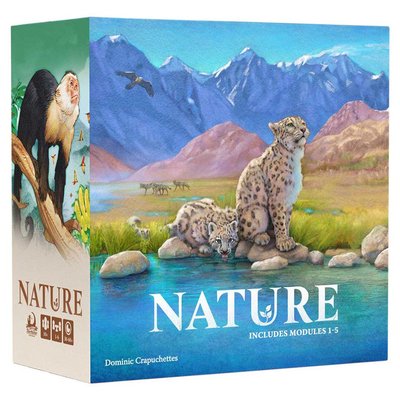
hi everyone my name is Monique and today I'm going to be showing you how to play a game that is currently on Kickstarter called nature designed by Dominic krapets and published by Northstar games who are helping sponsor this video in nature players compete to adapt their species in order to thrive in a dynamic ecosystem with limited resources and stealthy Predators over the course of the game players will need to find combinations of traits that will improve their chances of survival in this ever changing environment this is a modular gaming system for one to four players in which you can tailor your gaming experience by incorporating up to four different modules and so today I'm going to be showing you how to play the base game of nature while also discussing the five different modules that'll be available at launch towards the end of the video but before I begin I do need to mention that everything that you see here is considered a prototype copy of the game which means some of the components will be changing for the final copy especially the species tokens that I'll be featuring in the video for more information regarding the game as well as the campaign I've included a link to their Kickstarter in the description below last but not least if you enjoy content like this and would like to see more in the future please consider subscribing and with that we are ready to begin so if you please direct your attention to the center of the table we're all set up here for a two-player game of nature specifically the base game cuz like I was mentioning nature is a gaming system that can be played with up to four different modules however regardless of which modules you choose to incorporate the goal of the game is the same to grow and adapt your species in order for the them to survive
and eat the most amount of food by the end of the game and so the base game is played over the course of four rounds and each round consists of four different phases at the start of the game there will be a shared Watering Hole populated with food depending on the number of players but each player will only start with a bag to store their food and so each round starts with a preparation phase where players will gain a new species consisting of a size and a population token and the difference between the two is that the number of population token tokens that a species has is basically the number of mouths you'll need to feed per round because again the object of the game is to gain as much food as possible so the greater the population the higher the potential you'll have for scoring points assuming you're able to feed them and size will determine how much food they can forage per round as well as the strength of their defense and so during the first round players will gain a species of size one as well as one population token during this phase players will also draw five cards from the nature deck then once the preparation phase is done players will go into the adapting phase where starting with the first player and going clockwise on your turn you'll play any number of cards from your hand in order to adapt your species now nature cards look like this each card features a specific trait that'll typically have a certain combination of values in the upper leftand corner that modifies the strength at which the species will hunt or defend when attacked in addition some traits will also have special abilities
listed at the bottom of the card that may even modify the strength of which the species will forage for food now in this game cards can be played in three different ways the first way is by playing a card to a species as a trait these traits will allow your species to adapt to the everchanging ecosystem that the game provides now each species can have multiple copies of the same trait but only up to a total maximum of three traits per species as as an example if I were to play this social trait my species would gain two additional food when eating during the next phase and when assigning traits these cards are played face down and they won't be revealed until the start of the next phase this way other players won't be able to counteract your traits during their turn alternatively you can discard a trait card in order to choose one of your species and grow its size or its population now when growing a species size you're going to level it up to the next size level which in this example would be to a size of two and again a species can grow to a maximum size of four in the base game and their size determines their Baseline value when it comes to foraging hunting or defending and this will make more sense later on the other hand when growing a species population this allows you to gain an additional population token from the supply and each species can have any number of population tokens assigned to them and you can take these actions in any order so let's just say for example I were to discard another trait card in order to grow my population by one more
and maybe for my last action I decide to play another trait card face down to my current species any cards left in your hand that you choose not to play can either be used to populate the watering hole during the next phase or they can be saved for later rounds now in addition to playing cards on your turn as a free action you can also assign a species the predatory trait each species starts the game as an herbivore which means they'll only be feeding by collecting food from The Watering Hole however the predatory trait allows your species to instead eat other species which means they won't be able to feed via the watering hole but it's important to keep in mind that the predatory trait counts towards the three trait maximum although on your turn as a free action you may also discard any number of traits from your species including the predatory trait and once you finish taking all of your actions then play proceeds to the next player in clockwise order and once all players have taken their turns then players go into the feeding phase where players will be taking turns feeding their species in order to collect food tokens that will score them points at the end of the game now during this phase players will first start by simultaneously revealing their face down trait cards then starting with the first player and continuing clockwise on your turn you'll choose one of your species that has at least one population token with no food on it and if they're an herbivore you'll take take food from The Watering Hole equal to the species foraging value which again is
their size plus any trait modifications and so in this example because my species has the social trait they'll gain plus two food when eating for a total of three food although foraging is limited to the number of plant tokens that are still in the watering hole as well as the number of population tokens that are still hungry as as an example if I only had two population tokens without food even though I have a forging value of three I would only take two plant tokens from the watering hole because you can only take as much as you're able to feed and likewise if I had three population but there were only two plant tokens in the watering hole then I'd only be allowed to take two leaving one of my population tokens hungry in addition your species is required to eat for its full forage value and so in this example my species will forage for three and I'll Place each plant token on a hungry population and now this species is no longer considered hungry because all of its population tokens have one food token on it and at the end of the round I'll be able to collect each of the food tokens on my surviving populations into my bag in order to score them at the end of the game now keep in mind that after feeding a species it is possible to still have leftover hungry population tokens however once you fed with one of your species play proceeds to the next player in clockwise order who will also get to feed one of their species and so you'll have to wait for when it comes back back to your turn in order to feed any leftover hungry population tokens assuming there's still food left in the
watering hole fortunately at any time you can choose to discard a card from your hand in order to add additional food to the watering hole equal to the value at the bottom right hand corner and again this can be done at any time including at the start of your feeding turn now as for species with the predatory trait they may never eat plant tokens instead they feed by hunting other species regardless of who the species belongs to in order to hunt a species must have at least one hungry population token and their hunt value must be equal to or greater than the defense value of the species they are hunting which again is equal to the species size plus any modifications on their trait cards in addition the game comes with defensive traits such as fast which makes species more difficult to catch and so in this Example The Hunt is successful because player 2's species has a hunt value of two and player one's species only has a defense value of one and whenever a species is hunted they lose a population token returning any food tokens on it to the supply and flipping over the population token placing it next to their bag at the start of the next round any lost population tokens will be added to the new species that that player gains as for the predatory species they'll gain meat tokens from the supply equal to the size of the Haunted species species which in this example is only one now because they have two more population tokens to feed earlier in the round they
also played the opportunistic trait which says after any of your species forages or hunts this species eats two meat if there is plant food in the watering hole which fortunately there is but again if the watering hole were empty they can choose to discard a card from their hand to add additional food and so in this example because of the opportunistic trait they were able to feed their additional two population tokens however the species they hunted also has the horn trait which says when hunted it kills population of the hunter equal to this species size which means even though the hunt was successful this species will lose one of their population tokens in the same way that we've already described and so as you can see this game is all about strategically finding those combinations of traits in order to adapt your species for survival now if at any point during this phase all this species belonging to a player are completely fed then you would skip that player's turn for the rest of the phase and if ever The Watering Hole runs out of food when there are still hungry population tokens present then those tokens are lost and again will be added to the new species that the player gains in the next round and similarly if a species loses its last population token it goes extinct its trait cards are placed back into your hand and its size token will get added to the new species that you gain in the next round and once all players have fed all of their species as much as they're able to then players go into the cleanup phase where all food tokens on Surviving populations get placed into
your player bag so that you can score them at the end of the game then you pass the first player marker to the next player in clockwise order and You Begin the next round's preparation phase by adding additional food to the watering hole during setup a random card was drawn from the nature deck and the amount of food that you add is equal to the number of players multiplied by the food value of the card which in this example is two for a total amount of four food and any remaining food that was left from the previous round stay there then each player draws five new cards from the deck and gains a new species of size one as well as one population token and any population tokens that were lost in the previous round get added to the new species so in this example I'll gain a new species of size one with two population tokens going into into the second round and similarly had any of my populations gone extinct in the previous round then its size would get added to my new species in the next round up to a maximum of size four in the base game and play continues like this with players now having to adapt and feed multiple species on their turn and at the end of the fourth round the game will end and players will score one point for each food token in their bag and two points for each surviving species and at that point Whoever has the most points wins and that is essentially how you you play nature now like I was mentioning players can choose to add one to four modules increasing the game to five rounds as well as incorporating their own thematic deck of cards at lunch there will be
five different modules available including the Jurassic module which increases the maximum species size to eight and heightens the level of conflict in the game the flight module which introduces flying species that can migrate to the far away place to raise a family earning you additional points there's also the Arctic tundra module where players must endure the harsh cold and overcome the challenge of food scarcity then there's the natural disasters module that introduces gamechanging events and finally we have the Amazon rainforest module which introduces traits that allow species to eat fruit tokens and gives players the ability to decide when to reveal traits in addition to these there are many more modules planned for release in the coming years and so for more information regarding the game as well as the campaign I've included a link to their Kickstarter in the description below otherwise if you have any questions about anything that you saw here today please feel free to leave me a comment down below and I'll try to get back to you as soon as possible thank you all so much for watching the video I really hope it was helpful if you enjoy content like this and would like to see more in the future please consider subscribing thank you bye