How To Play MovieDEX Theme Park In A Box *All 8 Games*
Games in This Video
2 games are featured in this video — they unlock as you watch.

Transcript
Hey there YouTube. I'm back again today for another how to play video and today I'm going to teach you how to play Movie Decks the theme park in a box. This is launching on Kickstarter soon and there's a link in the description to follow the launch below. Now normally I'd give you the player link to time count age but this actually has eight games inside of this box. So I'm going to teach you all eight of these games one by one. And I do want to mention before we get into it everything you see here is a prototype. So, it is going to look nicer, fancier, shinier, fix some things from this version to the version that gets to you. But, we're going to start off with awards night. This is for three to eight players. It's going to take you 45 to 75 minutes to place. The first thing you're going to want to do is get out your board and go to this side of it because it is the double-sided board. You're going to get the d12 out of here. Set that to the side. You'll need that in a second.
You're going to make sure that each player picks out a colored pawn and they're going to put it on the start spot right down here in the bottom lefthand corner. And then each player is also going to get nine of these movie cards, which means you're going to have to get the big old movie deck, shuffle it up, and then deal to each player. Now, if you want to play the quick version of the game, you're ready to start the game. But if you want to play the more gamery version, what you're going to do is draft a card, put it down, pass all your cards to the left. Someone will do the same. And then you'll get a hand of eight. You'll be like, "Oh, I'll take that one. Draft the card." You'll keep getting that until eventually you'll just get handed one card. Then you should have nine cards. Each player is also going to get a dial, which is going to match their color that they have on the start space. And then you're going to make sure that you get out the player reference cards, which you want to have around the middle so people can grab those when they need them. And then also this card right here. And this is a good time for us to talk about which mode I'm going to be teaching you first, which is going to be classic mode. So, you put your D12 on the classic mode right there. So, everybody knows you're on classic mode.
And we'll talk about what the difference is between classic mode and on air mode. On air plays just like classic mode, but it adds a little bit extra to the game. So, I'll teach you how that works after we learn how to play the base game of Awards Night. Next, you're going to decide whether or not you want to play a campaign floor or a silent floor. What this actually means is campaign is better if you want to do more bluffing and have more hidden agendas throughout the game. And silent is more for pace. It will make the game move along smoother. They recommend whoever is teaching the game decide. And you can switch from one to the other as you progress through the game. Make sure the timer and a shuffled category card pile are nearby and then decide who goes first by figuring out who most recently walked out of a cinema still arguing. Or you could have a roll off to see who gets the highest number and then they will go first. And on your turn, it's really quite simple. The first thing you're going to do is you are going to flip over a category card. And the person who drew this card does not have to read all four of these out loud. What they're doing is deciding which one of these four angles. They think they have the best chance of winning with one of the movie cards that is in their hand.
So for this one, they might say, you know what, let's strong cast. Set it up here. And now every player is going to look through their hand and they're going to try and find the card that they think would win in a competition between the cards that are going to get played down of who has the strongest gas. So, we'll pretend this person put down the Godfather. This person put down this card. And then this person put down this card. So, what you're going to do is you're going to mix these all up so nobody knows the owners of the card. But, you need to remember your card. And then you are going to flip them out so everyone can see the movie and also the number above it. And now it's time to really explain what the difference is between campaign and silent. So, if you're playing campaign with this one, what's going to happen is the active player is going to flip the 60-second sand timer and then anyone may pitch any movie in the arena, yours or not, in what's called the free talk phase. The campaign floor has limits though.
Pitching why a movie deserves this round's award is legal. Calling the race is not. No announcing your dial, no deals, bluffing about which films are yours is explicitly allowed in a pitch does not bind your vote. After that 60 seconds is up of everybody talking over everybody trying to convince other people of different things, you are then going to get your dial and you are going to pick which one of these three movies you believe has the best cast. And in Silent, you don't even need the sand timer. Just as soon as these cards go down, every single person flips the dial to the one they believe wins the competition. The next step, everyone's going to reveal their dials to see which movie won this competition. So you see if there's a clear victory. If there is, then it's pretty simple process. You're going to take that specific card. Nobody knows which one it is except for one person for sure. And it's going to go up here to the semifinals where it will stay there until we get to the semifinals. These other two cards are going to get discarded off to the side.
You won't need them anymore. And anyone who voted correctly is going to gain either one, two, or three points. If you're correct in rounds one through three, you're going to get one point. If you're correct in round four through six, you're going to get two points. And if you're correct in round seven through nine, you're going to get three points. So in this instance, blue and orange would get one victory point. Each player now is going to draw back up to nine cards. And if you ever need to draw a movie deck card, and there are none, just shuffle up the discard pile and draw from that. You're going to throw off that category card. And then the next player clockwise will be the new active player who will flip over a category card and rinse, wash, repeat. Now, we're going to explain what happens when you reveal and there's a tie. And this is going to be the system you're going to use throughout the game when there's ties. So, all the tied players are going to assign someone to roll the dice. In this case, each of them is going to roll the dieice. Whoever has the highest roll is going to win the points. If there's a tie between multiple people, they continue to roll off until there is only one, at which point whoever bid that specific number that won the die roll off will win the points. And of course, the winning card will advance up.
Eventually, you'll complete round nine, at which point you will move on to the semifinals. The nine round winners form three semifinals of three grouped by the round they won. 1 to three, four to six, 7 to 9 and those three winners meet in one final. This phase is completely silent. There is no communicating this. But what is going to happen is the active player is now going to roll the d12 and they are going to look at this card right here. So for instance, we roll the three which means best visuals. So, now we've come down to our first round of semi-finals, and we are once again going to vote with our dials on which one of these three movies has the best visuals. And yes, you can vote for your own nominee. And in the case of a tie between multiple movies, you do a roll off with the D12 like you did earlier. Either way, whichever one wins is going to move up to the finalist category right here. And these cards are going to stay down here because they will still award points to whoever nominated them. And then you're going to roll the d12 again, but this time these three cards are going to be competing for which has the best ending. And then that one might win and do it again for the last three movies. And this one would go right here. But all these cards, they will stay out here. And whenever you move a card up to the finalist spot, whoever voted for that card or rolled the dice in case of a rolloff is going to still get two victory points for successfully guessing the winner. And once you get three people in the finalist category, you're going to roll the d12 again, do the
exact same thing, and one movie will end up being the winner. And just like before, if you happen to be the one who voted for Rainman, you would get two victory points. But now there's going to be extra victory points that are going to be divvied out because now you're going to go through the movies one by one and say, "Whose movie was this?" And if you happen to get a movie that made it to the semi-finals but didn't make it any further, you get one victory point. And if you happen to get a movie to the finals, you're going to get three victory points per movie you have out there. And if you played down the movie that won it all, you're going to get five bonus victory points. And just to clarify, this isn't that you voted for the movie to get to the semi-finals finals and be the winner. It's that you actually put that card down in the voting arena. That was a card that you decided was a real winner. But take a look at the scores around the outside.
Whoever has the most points is going to be the winner. And if there's a tie, then it's a shared victory. But now, let's talk about onair mode because it takes everything you just learned about classic mode, but it's going to add roll cards. And you're going to have a roll card in front of you at all times. So, at the beginning of the game, you're going to get a face up roll. And then after every round, you're going to pass your roll card to the player on your left. And the roll cards will do a wide variety of things during the round. So, check the rule booklet if you're not sure about what your role does. Also, some roles have to be in the game mixed together and at certain player count. So, check the rules based on your player count for sure. But now you're ready to play awards night. All right. Next, we're going to teach you how to play streaming wars. This is for three to six players. It's going to take you 60 to 90 minutes to play. And you're going to need this side of the double-sided board. You're also going to need to go through the entire movie deck and remove all the cards with pink up top and place them into their own separate deck right over here and shuffle those up. Then you're going to shuffle up this pile, place them right here, and deal out nine cards to each player. Now, each player is going to pick a section around the outside of the board and then take that color of rocket and place it on the start spot right over here. You're also going to want to grab these tokens right here. These are the action boosters, and they're going to allow you to do two
very cool things, which we'll explain a little bit later. Next, you're going to shuffle up your build deck and place them right here. Shuffle up your attack, your defend, and your destiny, and place them all into the spots where they are labeled onto the board. Next, you're going to get these little tiny triangles over here. These are going to be the point tokens because what you're going to be doing is you're going to be trying to build the best nine card hand of movies you can do. And then you're going to decide who goes first, which will be whoever most recently finished a whole series in one sitting. Or you can just have a good oldfashioned roll off until someone gets the highest roll and then they'll go first. And on your turn, it's really quite simple what you're going to do. You're going to move your rocket one space and then you're going to do whatever that space tells you to do. Unless, of course, you decide to use one of your booster tokens, in which case you could skip that space to move on to the next space. Unless you want to use two of them, in which case, you guessed it, you'll move two additional spaces.
And you could use as many of these as you want on one turn. And you need to use those before the end of the game because they're not worth anything at the end of the game. But they also have another feature, which we'll tell you about in a second. But for now, we're going to pretend that we didn't use any of those. And Red's just going to go right here to build. and we're going to go through and explain what all the different actions around the outside do. So, first we're going to do build. And this is going to allow you to improve your catalog of movies cuz you got nine movies. What you're going to do is just read the card and do what it says to do. Each player is also going to get one of these awesome handy dandy player references. And there is uh also another card that will be out to help you. But this is going to go over what every single card does in the game. But for this specific one, we get to draw two action cards from any pillar, then play both immediately in any order. And the pillars are these up here. Build, attack, defend, or destiny. So, let's go ahead and take the opportunity to show you what an attack card looks like because when you land on attack, you're going to draw an attack card and do what it says. So, this one says, "Hack. Pick a vault and bid a card from hand. If your card is stronger than all cards in that vault, best of three stats, you may swap any one card from that vault."
Well, this is a fantastic card to get right now because it's a great time to explain what happens if you can't actually do a card. Cuz right now, nobody has any cards in their vault. Doesn't mean anything to you now, but it will in a second. Trust me. Well, this ever happens, you're going to discard it and draw the next action card from the same pillar till you get a valid action. So, this attack is another hack. So, we discard that one and draw another one. And now we have a steel. Steal two each from your neighbors and give both two cards of your choice. card swapping. Well, this is fantastic because this will give us an opportunity to explain how you're going to win the game, how you're going to score points. So, we're going to steal two from your neighbors. And so, I'll take these two cards and I'll take those two cards. And what we're hoping to see are the blue and pink symbols on top. But unfortunately, we don't have any of those. So, instead, what we'll do is try and replace some cards in her hand that aren't that great. So, we look at these stats right here, and we can say all the stats on the bottom are better. So, yeah, we can get rid of that card and we'll add that card. Now, the reason why we're doing this is because once someone eventually gets all the way around the board and gets back to start, what's going to happen is you're going to make three sets of three with your nine cards. Cuz one of the hard and fast rules of the game is you always should have nine cards either in your hand or in your vault, but combined there will be nine.
Now, the three sets you're trying to score with are going to be people, critics, and awards. So, you'd have three cards in your people pile. Let's just say they were these three cards right here. You would add up all three of those totals. And if those three totals added up were higher than everyone else at the table, you're going to score three victory points. Same with critics and same with awards. But we'll talk more about that in scoring. But now you kind of get the gist of how you're trying to improve your hand as you do these actions. So, we talked about build. We showed you how an attack card works. Let's talk about though defend in Destiny. Now, defend cards are going to protect your hand, your vault to remove rival defenses. So, for this one is a defense breacher. When played, your neighbor defenses are immediately cleared, exposing them fully to attacks expired once played. So, if my neighbors did have defense cards, that'd be fantastic because sometimes you'll have a card like this, the shield. Steal and burn attacks on you have only 50% effect. Neighbors can only steal one and discard one out of five cards expired once played. And this would physically go onto your defense spot so everyone can see it and they would know that that is something they would have to deal with. Likewise, destiny cards work the same way in that that some of them will go on top of your scoring area right here. And they will actually show everyone that you have an advantage in specific categories. So, for instance, this one is a permanent plus three on
awards when it gets time to be scoring. This one's a permanent plus.3 to people score. There's also Destiny cards that will allow you to draw from the oh so delicious pink pile, which are really going to upgrade your hand. But it's important to remember that at any time an action or an attack or anything like that changes it so that you don't have nine cards, you need to immediately make it so you are back to nine cards in your hand and in your vault combined. So, since we just got this pink card, we would need to discard one of our cards because we would in theory be at 10. The last spot you'll see are selects, which just mean you get to pick whichever of the piles you would like to draw from this turn. So now we've talked about all the main actions. Build, attack, defend, destiny. But we still haven't covered the vault. It's really pretty simple.
When you get to the vault, you don't actually land on the vault. You just go to the next space, but as soon as you go around that space, you immediately have the opportunity to do a vault action. Now, the first thing you're going to do with the vault action is you're going to unlock one of your slots. At the beginning of the game, all of your vault slots are locked. You can't place any cards in them. However, once you go past vault one, you'll have one of them unlocked. Vault two, two of them unlock. And at vault three, you'll have all three of them unlocked. Now, why this is important is when you put cards into the vault, they are very, very hard to touch and they're safe for the endgame scoring. except for one card I do believe or maybe two that are in somewhere mixed in here. Now, the downside to this is this card is out of play. So, if someone were to say play attack where they're challenging the table and the prize is a card from the delicious pink pile, well, you can't use your vault cards down here. You have to use the cards in your hand and you actually have less cards than the other people who don't have cards in their vault. And if you ever run into a tie when you're doing one of these attacks, just grab a die and have a roll off between the tied players until there is a winner. Now, the other thing of note is that the vault goes back to being locked as soon as you cross it. So, you have to pretty much make the decision as you're moving around this corner of exactly what you want to do in the vault. And once you get two slots in the vault, you could take two things out, put two things in. You can have one
thing in the vault if you have two slots. It's a very willy-nilly sort of thing. Now, mixed in all these decks are going to be some bad cards that will hurt you potentially when you draw them. And the breakdown is the build, attack, and destiny deck have a 1 in4 chance of drawing a card that can win you a pink card. Attack and destiny also carry roughly a one in5 chance of backfiring into your face. Which brings us back to our oho delicious action booster tokens over here. Because in addition to making you move an additional space when it's your turn, you can also use this to just say, you know what, I don't want to deal with this card that I just drew, discard it and draw a new card from whatever pile you were drawing from. So, the turn flow is really quite simple. On your turn, you're going to move one space.
You're going to resolve the space you land on. You're going to return your hand to nine cards if you need. And then you're going to end your turn and move clockwise. Once you're done with a card, you can throw it off to the side. It goes into a discard pile. If you ever run out of cards, shuffle up the discard pile. Also, if you happen to be holding any action cards, put those back into that pile when you shuffle it up and place it back on the correct spot. And eventually, someone will go all the way around the board and they will get to the start spot, at which case the game will reach its climactic end. You will look at your hand of nine cards and you will break it up into three sets trying to have the best scores for the people, the critics, and the awards. And you will hand out these tokens to the winner. If you happen to win first in a category, you're going to get three points. If you're in second, you're going to get two points. And if you're in third, you're going to get one point.
Now, if two people happen to tie during this phase, then you do what's called skipping a rank. And so for instance, if two people got in first place, they would both get three points. No one would get the second place reward of two points and then the third place person would get one point. Likewise, if you had one person in first place and then two people's in second place, you would get one three, two twos, and then no one would get a one. But we're getting ahead of ourselves because let's first talk about how the scoring works. So first you announce which one you're doing. We'll just say it's people. And you're going to add up your totals right here. And you're going to announce that number. My people score would be 24 since I totaled up these three numbers right here. But now you also have to potentially look down at your control area to see if you have a modifier because we actually have a modifier down here, which means our people score is going to be higher than that number. But once you figured out who is winning that category, you'll award the 3 2 1 points as we talked about earlier. And then you will move on to the next set of three.
So you'll say, "All right, now we're going to do our set of three for the critic scores." And everyone will showcase their three cards there. And you'll do the same song and dance, announcing your score, looking down at your modifiers, awarding points, and last you'll do it for awards. There's also some neutral onepoint tokens. These are to be used if you run out of the other tokens. But once all the tokens are awarded, whoever has the most points will be the winner. And if there's a tie, then you share the victory. But there are some situational rules we need to mention as well. Your neighbors are always the players immediately to your left and to your right. And you must hold at most one defend card. A second forces a discard or swap choice. And [clears throat] that's how you're going to play streaming wars. All right. All right, next we have Ultimate Charades where you're going to need at least four players and you're going to split up into teams. So, right now we're going to pretend we have three teams and each team is going to grab a color corresponding colored pawn and they're going to place it onto the start spot.
You want to make the teams as even as you can, but it's not the end of the world if they're not completely even. You also want to make sure that teams are sitting together and roughly clockwise. So, if we were going orange, blue, white, the orange would be sitting together, and then the blue would be sitting next to them, and then the white people would be sitting next to them. Next, you're going to want to agree on how long the game length is going to be. If you want a short game, do five turns per team. If you want a standard game, do eight turns per team. And if you want a long game, do 12 turns per team. You're going to want to have some scrap paper and a pencil or pen nearby, the sand timer, then give the movie cards a good shuffling. Make sure you have your player reference cards handy. I'd honestly hand this to the first player because it is something that will be very helpful when you are the active player. Then you're going to decide who goes first. The team with someone who most recently sang out loud in front of strangers is going to go first. Or you could just have a good oldfashioned roll off to see which team goes first. So on your turn, here's what you're going to do. First, you have to make sure that your team decides on who's going to take the term. And it needs to be someone who has not performed yet, if possible. If not possible, then just start a rotation. Next, you're going to roll the d6, and you're going to figure out exactly what kind of charade you're going to be doing. This will tell you what you're supposed to do on the player reference card, like mimming or drawing or one word. It also is going to tell you how many points you're going to gain if you're successful. Now, you're going to draw the top deck of the movie card, and you're going to make sure that you can see it and the other teams can see
it, but not your teammates. Because the other teams are what are called referees. They're going to call you if you get a broken rule and they judge whether a guest named the film. We'll explain how that works in a minute because now the active player has decision. They can skip now or they cannot skip at all because once per turn before the timer starts the performer can swap out the card, discard it and draw a new one, but you only get half of the value that was listed on the card. You still have to perform in the same way. Also, it's important to note now you start the sand timer. You cannot decide to skip once that sand timer starts. But let's start the sand timer. And while there are different ways to act out the movie, it's important to remember the basic words. You can't use actor names, any word from the title, or close variants of one, and you can't use any quotes and taglines from the movie.
However, you can't use character names, directors, plots, years. Everything else is pretty much fair game. And while you're trying to get your teammates to guess, they should be screaming out a variety of different answers. You can answer as many times as you want. And once you hear that successful answer you want to hear, you've won the round and you're going to gain the points. The other way the round can end is if your timer runs out, which case you discard the card and it moves clockwise to the next team. Unless, of course, someone on the other team, the refs, think you're cheating, at which point THEY WILL IMMEDIATELY STOP AND THEY'RE GOING TO FLIP THE SAND timer on its side. So, you're not losing any additional time this round. And then the other teams that are not your team are going to vote on whether or not you cheated or not. And majority rules in this situation. So if more teams think that you cheated, then you immediately end that round.
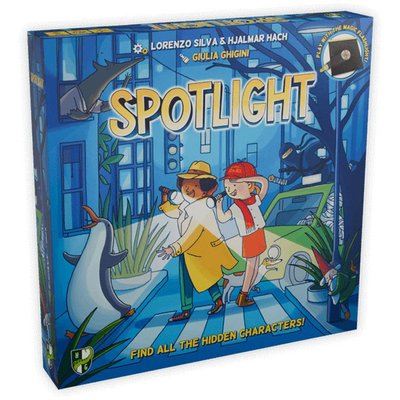
You're not going to score any points and it moves clockwise to the next player on the next team. However, if they decide that no, you didn't cheat. Or if it's a tie, then the active player continues on. Flip back up the sand timer because the goal is that you're not going to lose any time when someone calls a challenge. And it's important to mention that as soon as someone hears what they think is an illegal clue, they challenge right then. Either way, after you score your points or after you discard your card, cuz you don't get any points, you're going to move clockwise to the next team, assuming you haven't reached the allotted amount of rounds that you were planning on playing. Whoever has the most points at the end of that number of rounds will be the winners of the game. And if there's a tie, it's a shared victory. And that's how you play Ultimate Charades. All right. Next, we're going to teach you Spotlight. Now, this is a teambased game, and you're going to need to form teams of at least two, meaning you need at least four players. Now, each team is going to select a corresponding pawn color, place it onto the spark spot. Don't worry if your teams are slightly unbalanced. It's not the end of the world, but you do want them as balanced as you can. Next, you're going to shuffle up this deck right here, and you're going to deal 10 cards out to each team. These are going to be the cards that might potentially be in this game mode. Now, between those 10 cards, your team is going to decide which of the six cards they want to keep. And then you're going to put those six cards into the center face down. And then once you get done with that, every
team should have six cards face down the center. All the remaining cards, the ones you discarded and the cards that you didn't use could go back into the box. You won't need them for this game. You are going to decide who goes first. who uh by whoever most recently fell down a celebrity rabbit hole online. Or you can have a roll off to see which team is going to go first. And whoever the first player is, I'd recommend you hand them a handy dandy player reference card, is going to flip over the sand timer. And then they're going to draw the top card in the deck secretly so that your team can't see the card, but so that everyone else on the other teams can see the card. And now your goal is to get your team to name an actor or actress from this movie. And depending on what round you are, there are different rules. So in round one, it is free talk. Speak freely, but do not identify the movie directly. You can't use movie titles, actor names, character names from the target movie, plot details, quotes, iconic props, things like that you cannot mention about this movie. However, you can put other roles the actor has played. You can say that.
Awards, accents, public personas, things like that. And you're trying to get your team to guess any one actor from this movie. All the while, your team should be shouting out actors until one of them is correct. As soon as one of them is correct, you're going to set the card aside. You've gained one point this turn. And then you are going to move on to the next card. draw it so that everybody else except for your team can see it and try to get them to name an actor or actress from that one before the sand timer hopefully runs out. Now, if you're ever stuck, you have two options. You can switch or you can skip. If you say switch, that means that now everybody else knows you're changing the target actor from the same movie. But because before the clues that you were giving for one actor, you're essentially saying, "All right, you're not getting this actor. I'm going to switch." And now the descriptions I'm giving are for a different actor. Or you can skip and that means you just discard that card for now and draw yourself a new one.
However, there is a penalty for that. Not in points, but in time wasted and free information you're giving your opponents. Now, you're going to keep doing this basic process until the sand timer runs out. And there is no limit on how many cards you can go through. You could just be like skip skip to get to specific cards. However, if you do that once you've cleared out the whole deck, you do have to reshuffle your skips and carry straight on. Nothing scores twice in one turn. So, in this particular instance, let's say we got uh two. So, orange would go up two spaces. All these cards would get shuffled back into the deck and then they would be handed to the next team clockwise who's going to do the exact same thing. And let's just pretend blue does that and they get four points. Then it would go to white and they would finish out this round and let's say they scored three points. So now that every team has gotten a turn, this round is complete and you move on to round two. So this is where it gets a smidge bit tricky because in order to keep the game fair, the starting team rotates from round to round. So orange went first this round, then it was blue and white. So next round, blue would go first and then white and then orange second. And then on the final round three, white would go first and then orange and then blue. But speaking of rounds two and three, let's talk about what's different during those rounds.
Because round one, you're able to say a whole bunch of stuff. However, once you get to round two, you can say one word only. And then you get to act or make sounds, but not talk. And then round three is silent acting. No words and no sounds at all. Though you may still call, switch or skip. Gestures and faces are still on, though.
Also, there's no compound or hyphenated words. Still the same basic rules though. You flip over the sand timer, make sure everyone else except for your team can see it, and then try to get them to guess an actor or actress, but this time only with one word. Skips and switches work the exact same way in round two and in round three. So, for instance, if I said switch, I would still get to only say one word in round two, but you would know that I was talking about a different actor. But now let's talk about what happens when you're reading out a clue and someone that's not on your team thinks you broke a rule. First thing they do is they say, "Hey, no, you didn't do that right. You cheated." Well, in that case, you're going to flip the sand timer to the side. And then every other team that is not your team is going to vote on whether they not they think it was legal what you did or illegal based on the rule. And then it's majority rules. the other teams that are not your team decide if it was a legal clue. And if they agree and they vote yes that you cheated, then that card is now dead. You can't score points for this card this round and you draw a new card and continue. However, if they disagree or if it's tied, then it counts and it's a legal play. Either way the vote goes, make sure you flip the sand timer back up when you restart. After each team has had a turn over the course of three rounds, whoever is highest on the score track will win the game. And if there's
still a tie, the tied teams share the victory. And that is how you're going to play Spotlight. Right then, we're going to take a look at what you're going inside of one take. This is for three to eight players. It'll take you roughly 20 to 35 minutes to play. And in this game, you are going to be starting off by getting the playmat out and getting your corresponding colored pawn that you'd like and placing it onto the start spot. Each player is going to have one pawn. Next, you're going to take the entire movie deck. You're going to shuffle it all up and then you're going to deal out three cards for each player in the game. So, right now, I have 12 cards in this pile. If you'd like to play a shorter game, then make sure you have two movie cards for each player into your pile, but then you can set the cards off the side. you won't need them for the rest of the game. Next, player references.
Make sure they're out or people can grab them. They're super useful. And make sure that each player has a writing utensil and some scrap paper as you will be writing down clues in this game. The first player will be the person who most recently admitted to hating a film that everybody else seems to love. Or you could do a roll off to see who goes first. But when you are the active player and it's your turn, it's really quite simple what you're going to do. First and foremost, the player to your left actually draws a card for you. And then make sure everyone else except for you sees this card. Once everybody saw that, they're going to put it back face down. And then every other player at the table except for the active player is going to grab their scrap paper. They're going to grab a pencil or pen and they're going to write down a oneword clue that will follow some very specific rules that are you are not allowed to use any word from the title of the movie or a close variant of one which means you can't use the roots of words. So if you the movie was Pirates of the Caribbean, you couldn't have the word pirate or Caribbean and it can't have any madeup abbreviations or symbols.
However, you are allowed to put actors, directors, composers, character names, anything else you can fit as long as it is just one word. But eventually, all the players who are writing down one word will be complete. And when someone has noticed that all the players except for the active player have completed that, you're going to count down. Anybody can go three, two, one. And now at this point, the active player is still not going to be looking, but everybody else is now going to look at all the clues, and you're going to get rid of a couple of the clues. First, if any of them break the rules, toss them out. You don't get that clue as the active player. Also, if two clues happen to be duplicates or very very similar, then those are also both scrapped from the clues as well. And if every clue is cancelled, then the active player takes their one guess blind or passes with no replacement clues. So, the key is not necessarily to give the most obvious clues, but to try and sneak in clues that you think are going to stay there for when the guesser gets to guess, which is actually right now. So, now we go back to the active player and they are going to now take a look at these clues and they're trying to try and guess what the movie underneath the card is. They get one guess or if you'd like to, you can pass. Now, if you do happen to pass, the benefit to that is that nobody gets points. If you were able to successfully guess the faceown movie, you're going to get plus two points and everyone who has a surviving clue out here would get plus one point. So, in
this instance, let's say we got it correct. If we were blue, we would go up two points. Everybody else would get to go up one point. You discard that card and then you move clockwise to the next player who is once again going to rinse, wash, and repeat. And if you're ever not sure on whether or not a clue should be legally allowed, go check out your handydandy player references. These things are fantastic. Eventually though, you will get to the point where you try and draw a card from the movie deck and there's no cards in the deck. Well, at that point, whoever has the highest score is the winner. And if you happen to be tied, you share the victory. And that is how you're going to play one take. All right. Next, I'm going to teach you how to play Clue Rush. This is for three to eight players. Take you 25 to 40 minutes to play. First thing you're going to want to do, set the mat out in the center. Each player is then going to pick a color that they would like and a corresponding dial. And your pawns are all going to start down here on the start. Now, you're going to be racing to 50 points. Or, if you'd like to play a shorter game, race only to 30 points. Next, at the beginning of the game, agree on where you're going to go to the internet to get useful information. When you have to look up the directors and the cast and all that sort of stuff, agree at the beginning and then to decide whose first player, you're going to figure out who most recently looked up an actor or actress mid film to settle an argument. Or you can do a rolloff. But on your turn, when you're the active player, it's really quite simple. What you're going to do is you're going to secretly draw the top card. You're going to make sure that nobody else can see it. And then you're
going to read off the genres and the decade which this movie took place. This is called free information. And this free information is going to be read aloud to everyone else at the table. And then they are going to grab their dials and they're going to bid how many more clues they will need to successfully name this film. Now, if you're the person holding this card right now, you don't get to bid. So, we'll pretend that blue has the card, which means orange and white are the ones that bidding. They're going to secretly do that and then they are going to reveal. And you always must bid. Now, the person who bid the lowest number is going to get the first opportunity. And if there is a tie, so for instance, if two people had a two, then you would go clockwise, whoever's closest to holding this card.
But since there's not a tie in this instance, we say, "Arange, what two clues would you like to get?" So the orange player hopefully have the player reference card right now. They're going to be looking at the clues and they'll be like, "You know what? I want
my first clue to be who the director is."
But now the player with the card is going to have their phone and they're going to look who the director of the film is and they will announce that. That will be one of the two clues that Orange has got and they will get to ask one more clue. They might say, "You know what? I want cast one." So, [clears throat] they're going to go back to that website. This person will. And they are going to read the name of the person that is listed first. You don't get to decide who you want to tell them. Just like whoever is listed second would be cast two and third would be cast three. Once they've gotten those two additional clues, orange would then guess what is on this card. If they got it correct, you score 10 minus the number that you bid. So, if Orange were to get it correct after they got their two additional clues, they would get eight points. However, let's pretend that they didn't get it correct. Let's say I don't know what the answer is.
They make a wrong guess. Well, unfortunately, in that situation, they are out of this round. However, if you get it incorrect in this phase, you don't lose any points. So, Orange has got it incorrect, they are completely out of the round. But, we're going to set up a scenario where we actually have more players and explain how the jumpin phase works. So, now that orange has gotten it wrong, they were the person who bid the lowest. Everyone else is going to have an opportunity to potentially guess if they'd like to with no additional clues. How this works is the player who's secretly holding on to the card goes three, two, one, and if you want to try and jump in, you blurt out as quick as you can the answer that you think is correct. If more than one person speaks, whoever spoke first is the one that you're going to listen to.
So, for instance, let's just say that blue took a little bit longer and they got the answer right and and white was just boom, they they they answered it really quickly, but they were wrong. You only listen to white. And once you jump in and you're incorrect, you're going to lose three victory points.
You're out of this round. It then goes to the next lowest better, which means then blue would get to ask for two additional clues and then make a guess. You score the number of points when you jump in that you would have scored otherwise. It's also important to note that you can't jump in unless you have the three victory points to lose. You can never go below start. Now, if two players happen to say the same answer at exactly the same time during the jumpin phase, then you look at both of their bidding dials, and whoever had the lowest bidding dial is going to be the person that gets the answer. And if they both have the same number, then the player clockwise nearest to the player in that situation. Now, if you ever get to the situation where everybody got it completely wrong, then just read the name of the movie out loud and then move active players to the next clockwise player who will secretly get the card.
Read out the genres and the decade that it was released. And you will rinse, wash, and repeat. And when you're the active player, try to read out the genres and the decade as monotone as possible. No subtle hints. But that's how you're going to play Clue Rush. All righty. And next we're going to teach you credit crawl which is for three to eight players. Take a 30 to 60 minutes to play. First thing you're going to want to do is set out your scoring mat. Each player is going to take a colored pawn that they'd like and place it on the start spot right here. You're going to take the movie deck. You're going to shuffle them all up and make sure each player has nine cards. Then you're going to set out eight cards in a 3x3 grid just like this, but with a blank spot in the middle. You won't need any more of the movie cards. You can set them off to the side. Next, you got to make sure the sand timer isn't towards the center where everyone can reach it. And a couple player reference cards so everyone can take a look at those when they need to put them towards the center. And then the person who most recently set through the credits to the very end will get to start. Or you can have a roll off to see who gets to go first. Once you know who goes first, you can start the game. And what you do on your turn is really quite simple. First, you are going to flip the sand timer.
Next, you're going to get a card from your hand, one and only card, and you are going to add it to the grid. Now, in order to legally add something to the grid, you need to make sure it matches either a onepoint condition, a two-point condition, or a threepoint condition. Meaning, if you match all three of those, you can get six points per connected side. Now, connections only work up, down, left, right. There is no diagonal in this game. You could ever play a card diagonally like this. And this would not score. Even if, say, for instance, you placed it. Now, you would only be touching this and this card for scoring purposes. What this means is the person who takes the very first turn is only going to be able to connect to one card somewhere around the outside. Also, the center hole you create at the beginning of the game is going to stay empty all game, meaning they can only get six points at most on the first turn. So, let's talk about how you're going to score those points. First, you can look at the card face to score. What this means is if you match either the decade that a movie was released or the genre, you're going to score one point.
So, for instance, I might play this Martian card down right here while my sand timer is going. Say, I'm playing this because they both have the same genres, and that would be worth one point. However, if you'd like to go for more points, you could step it up and you can name a story element that takes place in both of these movies. But the catch is that story element cannot be in any other movies pictured. So, you might say, uh, they're both about things going to outer space. And you would say that out to everyone else playing. Now, someone else might disagree with you and think the clue that you gave isn't a legal one. In that case, they should immediately shout it out. We'll go over how that works, but we'll put a pin in that and come back to it later. The last way you can score points, and you can score three points, is with credits.
This means a shared actor, director, crew, Oscar win category. There's a wide variety of things which does mean, yes, you will need a phone in order to play this game. and decide at the beginning of the game whichever database you want to use for your movie knowledge. So, let's just show you how this mock turn would actually work because I would flip over the sand armor. I'd look at my hands and I'd say I'm going to play The Martian right here. They have the same genres. That's going to be worth one point, but they also involve spacey things, which means that's going to get me up to three points. And they were both directed by Martin Short and that's going to give me up to six points. And I'd say haha and I'm done. Now, the set timer isn't out, but it's important to still let it keep running because the other teams can actively still be thinking about whether or not the clues that were provided are legal clues cuz they can challenge at any point while this sand timer is running. If no one challenges and the sand timer runs out, we get to go to the challenge phase. So, whoever played down the card in the grin is going to say any challenges and goes five, four, three, two, one. And if no one says anything, then they score their points, which in this round would have been six since they connected tier one, tier two, and tier three, and they're on their merry way to the next player clockwise. However, what someone might do, especially considering I said something incorrect there, is challenge you. But now, let's talk about the challenges and how the different tiers of challenges are settled. So, first, you can't challenge a tier one because
you could just see it on the cards. You would just know it's wrong. So if you challenge a tier two that is settled by the table on one question only and that is is this true of another card already on the table? Does another card already on the table could you say that about that movie as well? And the challenger is going to make the case for this by pointing to the card that they believe also fits that story description. So how this works is they say I think this one also could fall into that category. Everyone except for the person who placed the card and the challenger is then going to vote on it if there is a tie. Then the challenger loses and the placer wins. And we'll talk about the ramifications of that after we explain how a tier three claim works because this one is actually done by a 20 second phone check. And if nobody can find any evidence in 20 seconds to prove that that tier three connection was accurate, then the connection does not work. Then the challenger is correct and the placer is wrong. So let's explain how all those situations play out. So first and foremost, if the challenger was right, then the challenger automatically gets two victory points and the person who placed the card loses two victory points. And you can't go underneath zero points in case you're curious.
And it's important to mention that challenges work per tier. So your tier 2 and your tier three could both be challenged separately. And if you lose a challenge, you forfeit every point at that tier for the whole turn, not just the claim that was beaten. Plus, you take minus two points for that tier. And if you challenge someone and you're wrong, you always lose two points, which means you can't make a challenge unless you have at least two points. The other thing is any points that they would have gotten for that claim, they don't get. So in this example where I said at the end that both of these were directed by Martin Short, that one would most likely get challenged. They would very quickly find out it was false. And instead of getting six points for this connection, I would get one point for the face. I would get two points for the story and then I would lose out on those additional three points because I didn't have a correct claim and I would lose two points. Meaning this would be a one-point turn for me. The card, however, does still stay put as long as at least one of the claims on each card it's touching is accurate. The other important thing to note is only the first person who challenges gets to challenge for that tier. Which means that they might have screwed up their challenge and somebody else might actually have a correct challenge. But it doesn't matter. Only the first person who challenges for a specific tier
gets their challenge heard. And after that, everything else is assumed to be correct on every connection
for that tier. Just make sure to always remember to set the timer on its side when you're settling a challenge and then flip it back up when you're done. Also, it's important to note if the sand timer runs out before you're done making your claims, you lose your turn entirely, take the card back into your hand and move on to the next player. So, make sure you don't get greedy. Also, if you quickly are realizing that you're not going to be able to play a card on a turn or have time or for whatever reason, you can just pass your turn. But now, let's show you how future rounds might go down. So on this player's turn, they flip over the sand timer. And now they have the potential to get 12 points if they were to play right here. And they say, "All right, so this is 1983, 2015." Well, we can't do decade necessarily for both of them. But we could put this 2005 here, and we can connect the decade there. Then we also see that this one has the fifth symbol.
So we have one point here, one point there. So let's move on to phase two. Let's see. Tier two. Uh, that's a tough one right there. Scarface, King Kong, the Martian. I can't think of any tier 2 connection. And that's fine. I've already made one tier one connection, which means this is going to be a legal placement. And now I can kind of just let out the timer. And if I happen to think of a connection
that is tier two or tier three,
then I can use it. But if not, that's fine. And normally you do the 5 4 3 2 1 challenge. But in this instance, you don't actually have to do that because all you did were two level one connections, which means this player would score two points and it would move clockwise to the next player. Now, the game is going to end when someone is able to successfully get all the way up to 50 points. Or if on your turn, you don't believe you can make a connection and you pass and every other player also passes. or if everyone has played all nine of their cards. If that happens, then whoever has the highest score is going to win the game. And if there's a tie, share the victory. But that's how you're going to play Credit Crawl. All righty then. The next game we have is Auction House. This one is for three to eight players. Take you 20 to 50 minutes to play. First thing you're going to want to do is set out your playmat in the center where everyone can reach it.
Then each player is going to pick a colored pawn and get that corresponding color dial as well. will then place their pawn up here at 50 because that is how much of the currency you're going to have to spend on your movie decks. Now, if you want a shorter game, you can start at 30 currency. They also recommend doing that if you happen to be at five or more players in your game. And if you don't like subtracting, you can start from zero and work your way up instead. The game can also end if you go through all of the movie cards, in which case you just enter the scoring phase if you can't draw a movie card at the beginning of a turn. So, you're going to need all the movie cards. You're going to shuffle them up. Make sure everyone can reach those. Grab your player reference cards as well. Make sure people can use those. Look at those when they want to. And now we're ready to learn how the game plays. Decide who's going to go first. You can go with the person who most recently spent too much money on something or just grab the dice and have yourself a roll off for the highest number. And then that person on their turn is going to do a very simple action. You're going to reveal the card.
Make sure everyone can see it. Now, what you're really trying to focus on in this game is the decade that it came out, which is down here in the bottom right center, and the genres, which is right here in the top left. Now, everyone's seen that everyone's going to secretly grab their spinner, and they're going to bid what they'd like to bid. And yes, the auctioneer should be bidding as well, too.
And then they're going to place it down to show that they are ready. So, let's just say those are the bids right there. We're going to then reveal and the winner with the highest bid is going to go down that number of spaces on the track. So in this instance, it was a really clean victory. There was no tie. So orange would go down 1 2 3 4. They would get their card and they would put it in front of them. This is public information. Everyone should be able to see this at all times. But as long as at least two people are not all the way down at the bottom of the score track, you continue playing the game. So the next player would be the most clockwise player who would flip over another card and then we would bid on it again. Now, this one actually has a pink tier, which is the highest tier in the game. So this one you might expect to be bringing in a good chunk of change. So everybody's seen it and now we'll go to the bidding phase. Now, let's discuss what happens when you reveal your bids and you're tied. First, if you're not one of the players with the highest bid, you are out of this round. We're only going to be focusing on the people that bid the highest. They are going to then rebid in secret. You can hold or raise, but you can never go lower. And then reveal the highest bid wins and pays. However, if you're still tied, you're going to do that one more time. And if you happen to get to a tie for a third time, be that at eight or a number lower than that, then all the players that are tied are just going to roll the dieice to see who
gets the highest roll and they will win the bid and pay the cost of their most recent tied bid and win the card. And if you're already tied at eight, you don't have to do the secret bidding again. Obviously, you're both going to be at eight. You just roll off. But eventually, what will happen is you'll start to go further and further down the track until someone has no money at all. When you have no money at all, you're just completely out of the game and you are waiting for the game to end. And if you don't spend all your money before the end of the game, then you don't get any bonus from it. So, make sure you're spending. But let's talk about why you're collecting these cards and how the game is eventually going to score when there's only one person with any money left to spend. Now, the main rule is you have to have a set of three. Sets cannot be more. Sets cannot be less. And when you're creating a set, they can either be the same decade, so 1980 to 1999 or 2000 to 2009, or the same genre, which are these symbols right here. So for instance, these three movies right here could be a set because they all have that symbol. So how much would they score? Now, every valid set you create is always going to start at at least three points. But now let's talk about how you can get bonus points on top of those three points. So, first, if all your cards are base cards, which means there's no blue and there's no pink in any of these numbers up here, this is just a threepoint set. Simple. Moving on. Now, if you have at least one pink or one blue in the set, you're going to get plus one bonus point. So, this one right here is a valid set. We have our
three symbols right there, and we have one blue. So, this one would be worth four points. Next, if you have only blue or pink cards in your set, you're going to score an additional three victory points, meaning that this set is worth six points. Last, the crown jewel. If you're able to get a set that has all three of the movies with pink, then you're going to get plus five victory points, meaning you're this set is worth eight points. The back of the player reference card also does a great job showcasing the scoring as well. So, the final scoring area for a player might look something like this. You might have some cards left off to the side that are going to be worth zero points because they couldn't be put into a set of three legally. Then this one would be worth three points because there's no blue or pink up here. This one having all three special cards that either have blue or pink is going to be worth six victory points, putting us up to nine. And this one having pink, pink, and pink is going to be worth eight points. Meaning our total score here would be 17. It's important to note that you can't use one card for more than one set. So, this gravity could not be like, "Oh yeah, I've got to put the Back to the Future and the Gravity and this together and I got a different set." Like, no, none of those shenanigans. Couple situational rules. Obviously, you can only bid as much as you have. So, for instance, if you only have three, you cannot bid four. And of course, all bids are final.
You cannot take back a bid. The player with the most points is the winner. But that is the movie decks movie theme park in a box. If it looks like it might be your cup of tea, be sure to check out the link in the description. Also, if you're enjoying this how to play content, please be sure to click on that subscribe button down below. Have yourselves a good one.