Kinfire Council: My Favorite Mechanism
Games in This Video
1 game is featured in this video — it unlocks as you watch.
Transcript
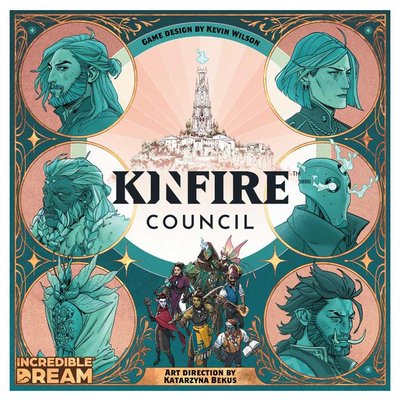
Hey, I'm Jamie from Stonemaier Games and today I'm going to talk about my favorite mechanism in the game Kinfire Council, which I had heard some people talk about as a um a leveled up Lords of Waterdeep, a game that I love. I really, really love Lords of Waterdeep. And I also enjoyed Kinfire Council. I played it at the full six-player count. I admire another game going all in for the the full six-player player count. And it took around 4 hours. It was a definitely a longer game at that player count. Here's what Kinfire Council looks like on the table. It's a really, really beautiful game. Um uh right there. Here we go. Here's what Kinfire Council In fact, this doesn't quite convey how much table space this board takes up. It is It is a commanding presence on the table to see this board, to see the tiny details in the city city, which also kind of look like the tiny details in Lords of Waterdeep.
Um it is a worker placement game where you're placing a worker on one of these actions and uh gaining one of the two bonuses there. So, in reality, even though there are 18 actions here, actually there's 20. These These two are actions as well. Uh 18 of the actions have two action choices on them that are often very different. And so, uh you have nearly 40 different potential benefits that you can gain on your turn. Um there's a lot going on in the game and I will say at six players uh a few of us were on the side of the table where the text was upside down. The game did And so, it made it made it very hard to read what any of any of these actions were. Fortunately, the game came with a couple player aids that you can pass pass around the table to see what the actions do. That was a huge benefit. Uh but we still had to kind of spatially figured out, okay, this is the action that we want to take, is it occupied or not because we're looking at this upside down. That was a little tricky. But I do appreciate the wide variety of actions and the choices on each action. You're not You're not just automatically gaining the thing on that action.
That and part of that I also enjoyed that makes even more complicated in a way, is that any of the buildings can be upgraded. Um, so unlike uh Lords of Waterdeep where you're adding new actions to the board through buildings, in Kinfire Council, you are making a each action better if you choose to upgrade it. They call it city planning. You're going city planning and depending on the tier of the action, tier one, two, or three, there's a a higher cost if you choose to do that. Um, I really like that. I like making actions better. I like that it's a form of positive player interaction in my opinion because I am making it better for all players, not just me, and I get a benefit I get a bonus whenever any other player uses that action from then on. However, I think my And so I do really enjoy that. I enjoy that in general. My favorite specific thing about Kinfire Council that I thought was clever and that I really enjoyed was the threat of the cultists. So, this certainly is not the first game where there is a bad thing happening or the potential for bad things to happen during the game. And in Kinfire Council, they all connect back to the cultists.
There are actually multiple bad things that the cultists can be doing. They're always kind of scheming. Each round they're adding some some problems to deal with. They're always trying to tear down this lighthouse that you're trying to rebuild. They are actively and yet autonomously making your life harder in this city. We've seen that before. I mean that that that is clever in itself, but we've seen that before. The thing that makes Kinfire Council particularly special in terms of the cultists is that the cultists can win. The cultists can win the game specifically in that they can have more points than any other player. And along with that, a player or players could choose to ally with the cultist. If you realize that your strategy just isn't working in Kinfire Council or the cultists are doing really really well, you can choose to put your influence tokens on the cult influence space and be allied with them. And so if the cultists have the most points at the at the end of the game, you win the game instead of another player.
In our game, this was definitely a ongoing tension throughout the game and an ongoing table talk table talk point. We saw multiple players jockeying for position of being the most influential of the cult. And I actually while I was paired with my my partner Megan, we ended up winning the game. We we shared a single character. But it wasn't far off. The cultists were not far off and there was another player with far fewer points who would have won if the cultist who had quite a few points had just had a few more points and had eclipsed our point total. So it was definitely a very big part of the game. And not only that, I would say one of the neat things about it is that a a player who allies with the cultist is then trying to ignore they're they're ignoring the bad things. They're actually trying to have the bad things happen. They're trying to they're also like not arresting the cultist as they they block actions each round.
So they're actively helping the cultist, but that might be hurting their own strategy. So they're kind of digging themselves in a hole and they don't necessarily know if they will even have the most influence at the end of the game of the cultist or the cultist will even win. There's just a lot of great dynamics going on with this autonomous party in the game that you're struggling against that a player can potentially or players can potentially ally with. So I thought that was really really clever. I'd love to hear your thoughts if you have a favorite mechanism in Kinfire Council or if that mechanism specific specifically the cultist reminds you of a mechanism in another in another game. Let me know about that in the comments below. Thanks.