NEW Ishtar Gardens of Babylon Board Game – What to Expect, Brief Overview
Games in This Video
1 game is featured in this video — it unlocks as you watch.
Transcript
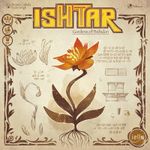
Legend has it that a long time ago on a starless night the Queen's gardener collapsed from exhaustion in the middle of the desert. He cried for hours. How could he grow anything in such an arid wasteland? One of his tears, however, passed through the sand to reach the other world. Goddess Ishtar, moved by the man's despair, collected his tear and sent it back to the surface, transforming it into a surging and inexhaustible water source. Eternally grateful, the gardener swore to do his best to create the most magnificent gardens of these lands. This is Ishtar: Gardens of Babylon. What is it about?
In this video, we're going to show you what to expect from Ishtar: Gardens of Babylon, and if you watch till the end, we hope we can help you get a feel for the game. Coming up.
Hi, it's Tarrant. And Stella from Meeple University. We bring you a variety of quality board game videos. So, if you're new here, please consider subscribing and do hit the bell to be notified when we post new videos. Now, let's find out more about Ishtar: Gardens of Babylon, designed by Bruno Cathala and Evan Singh, and published by Yellow. Released in 2019, Ishtar: Gardens of Babylon is a competitive tile placement game in which players tactically craft the most beautiful gardens they can in the deserts around Babylon. It was designed by Bruno Cathala and Evan Singh, and published by Yellow. The game plays two to four players competitively with an estimated duration of 45 minutes, and is of medium complexity. In Ishtar, players play as gardeners attempting to use what scarce water exists to craft the mightiest gardens in the desert of Babylon to win the favor of the king.
Players will place garden tiles, collect gems, plant trees, assign their assistants to tend the flower beds, and upgrade their skills, all in the pursuit of the most victory points. At the start of the game, the desert is seeded with three colors of gems, one fountain per tile, and this will change by player count, and no vegetation at all. On each turn, the player chooses one vegetation tile from this common rondel. Taking the next tile clockwise is free, or the player can move further around paying one gem for each tile skipped. The player then places the tile into the desert, avoiding any sacred tablet spaces, and collecting any gems covered.
The new tile must connect, either directly or through other vegetation tiles, to exactly one fountain, meaning players cannot join gardens from separate fountains together. After placing the tile, the player will take the bonus actions which drive most of their points. Placing a skill icon allows the player to spend two gems of any color to unlock a skill from the player board. The bottom row gives the player a one-off bonus action, and the top row unlocks a scoring objective. Players must activate a bottom row skill before activating the skill above it. Placing an assistant icon allows the player to place an assistant onto that space.
This assistant now controls that flower bed, which is that space and any of the dark green flower spaces which connects to it. And the flower bed will be worth one point per flower at the end of the game. Players begin the game with only two assistants, but can unlock a third and fourth using skills in the game. A wild icon can be used either to place an assistant or to unlock a skill. Finally, regardless of the icons played this round, players may spend gems that they've collected in order to take tree cards from this board, planting a tree token somewhere on the board for each card taken. Once at least two of the tile stacks are empty, the current round is finished and the game is over.
Players will score one point for each flower in flower beds that their assistants control. They'll score the points printed on any tree cards they've collected, and the points for any top row skill bonuses they've unlocked. Some of these score points for leftover gems or assistants, and others will score points based on flower bed placement, such as being near trees or sacred stones. Finally, players evaluate control of each of the fountains in the game. And the player whose assistants control the most flower bed spaces in gardens around a specific fountain controls that fountain and earns four, six, or eight points depending on the color of fountain. The player with the highest score wins. Tactical tile placement is the critical element of this game.
Players need to weigh up multiple considerations to do this well, optimizing which gems they'll be claiming, how to expand their existing flower beds without leaving too many flowers around for other opponents to later claim, and laying tiles in such a way that it blocks other players from expanding. Remembering that you cannot join two gardens together, and so by the end of the game, many tiles become quite difficult to place. The player who can best optimize all of these tile placement rules will be well placed to win the game. And that's what to expect from Ishtar: Gardens of Babylon. We hope you enjoyed this video, and we hope that it helps you. If you enjoyed this video, please let us know by hitting the like button. Write your questions or feedback in the comment sections below. You can also join our Facebook group, Meeple University community, to share your love of board games. And finally, if you'd like to be among the first ones notified of what's new from Meeple University, please consider subscribing to our channel. You can click on the meeple up in the corner to do so, and do hit the bell to be notified of our new videos.
Until next time.