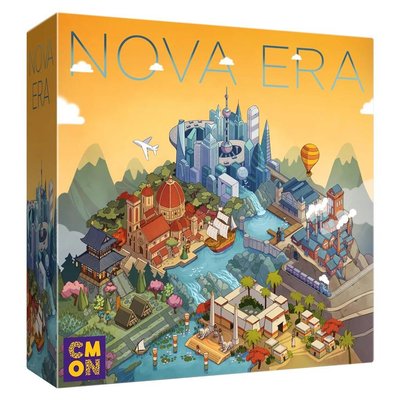
Nova Era - How To Play
[Music] hi and welcome to watch it played my name is Rodney Smith and in this video we're going to learn the two to four player game Nova era designed by Andrea cesio and published by Simon who helped sponsor this video history has shown us the growth of various civilizations but what if you could guide your own from its humble beginnings into a sprawling worldwide Empire could you survive the impending disasters and the threat of rival civilizations only one way to find out join me at the table and let's learn how to play to set up put this Central board in the middle of the play area on that board you'll find these five tracks and you'll set one of these matching colored markers onto the zero spaces at their tops above in the area here add this marker to the one space of the top row now separate the various decks of cards by their backs you'll find nine total distinguished by their color and these Roman numerals representing different eras there's also one Deck with the letter s on the back light color decks are known as Technologies and these are the personalities Shuffle each separately and then collect the technology deck labeled era one from it deal a number of face up four card columns to the right of the main board based on your number of players as shown in the rule book and here on screen in this video we'll assume we have two players so it'll look something like this when you're done any leftover cards from this deck you now return unseen back to the box now take the arrow one personality cards and deal a number of them face up to the left of the main board again based on your number of players as shown here in the rule book so a total of four in this case and these don't have to be arranged in any particular way any remaining arrow1 personality cards you return to the Box keeping all remaining decks nearby for use later also nearby set out a number of these dice zones equal to the number of players plus one so three in our case returning any extras back to the box then add all 15 of the game's dice to this included bag Within Reach of the players also create a reserve of these four types of resource tokens representing welfare military economy and knowledge and these come in denominations of one and five each player now collects one of these civilization boards and a scoring marker in their chosen color along with one of these unrest markers which they'll add to the zero space of their unrest track here then have everyone set their scoring marker onto the zero space of this scoring track found at the bottom of the main Central board each player also collects one resource of each type from the reserve adding them to these related Slots of their board now collect the deck of Technology cards we'd set aside earlier labeled with an S and deal two of them to each player returning any leftovers back to the box you can always examine your own cards but keep them a secret from the other players finally assign the oldest player this double-sided first player token or you can just pick someone randomly on one side you'll find two pictured figures and on the other you'll only see one and this is the side that you'll start with face up and that's the setup in Nova era you and the other players will each be growing your own civilizations by acquiring and playing cards that will shape its welfare military economy and knowledge while also expanding its territories and attracting influential personalities all while trying to weather incoming disasters and avoid falling into a dark age or two how you grow your civilization will earn you victory points and if you have the most by the end of the game you'll win the game is played over three eras divided into three rounds each and each round is broken into a series of steps you'll find detailed here on the back of the rule book if you need a reminder as well as on some player AIDS included in the game and we'll go through these steps together starting with rolling dice here the first player randomly draws three Dice from the bag roll rolling and placing them onto an empty die Zone and then repeating this process until there are three dice on each Zone but for the sake of the examples I want to show later I'll assume that we had these results we now move to the second step of the round picking dice as it shows on the first player marker beginning with the first player and going in clockwise Order each person picks any one unchosen zone and moves The Dice from it to the these spaces on their player board ensuring the values don't change how you arrange these doesn't matter but if their total value is greater than 10 you must now Advance your unrest marker by the difference here our total is 13 so we'd Advance unrest by three as we'll see later bad things happen when your marker reaches any of these spaces and worse things happen if you hit this space but those are problems for later as we'll see why you might pick a certain Zone of dice over another will make more sense as we learn more of the rules but for now just know the first player collects a die Zone and then in clockwise Order each other player also collects one which always leaves a single zone of dice left over unchosen bringing us to the third step of a round advancing disasters here you look at the dice on the unchosen zone and move the markers on the matching colored disaster tracks downward by their related value here we have a four black so we drop this marker four spaces these are both yellow so we add them together and move that marker a total of 11 spaces now as soon as a marker would reach this symbol at its bottom it just stops and you ignore any other spaces you should have moved it then once all the dice on this leftover zone are resolved you return them to the bag that ends the advanced disaster step and now we move on to the check for Dark Age step these are all known as disaster tracks but this one in particular is known as the Dark Age track as long as its marker isn't currently at this bottom space here then nothing happens and you just move on to the next step of the round but let's assume for a moment we came to this step and the marker was here we have now entered a dark age as you're reminded of here each player must now pick one die from their player board and return it back to the bag and then they must reduce the values of their remaining dice by one just know a die cannot be reduced below one so any already at one would just stay there we previously saw how the markers of the other disaster tracks can also reach the bottom but these do not resolve at this time those are dealt with a little later okay I've G and reset things so that there isn't into Dark Age but whether you had to resolve a dark age or not you now move to the next step of the round spending dice here you flip over the first player token where it reminds us that this step is taken in turns starting with the person seated to the right of the first player and going counterclockwise from there on a player's turn they'll perform an action and then the next player goes and around and around in a counterclockwise Direction turns will be taken and on your turn you perform one of seven possible actions so let's go through them together starting with developing technology in all of these examples we'll assume it's the blue player currently taking their turn and Technologies are the cards with these light colored backs and you start the game with two in your hand there will also be a certain number of them displayed to the right of the board based on your number of players and when taking this action you can develop any one technology either from your hand or the bottommost position of any one of these columns for example let's say we decided to develop this technology a technology shows its cost in the top leftand Corner which you must pay in order to develop it you pay this cost with a die from your board and or your resources matching its color here you'll find this color in a band along its bottom border as well remember this is the spending dice step of the round so on your turn you must always spend one die by taking it from your board if the die you spend matches the color of the technology you want to develop then you can use its value to help pay this cost in this case we must pay five in blue so we can pay four of it with this die and then each resource you spend from your personal Supply also in that color adds one more to the value you're paying the die you use goes back into the bag and any resources you spent go back to the General Supply you then move the card to the matching colored space for it by your board and during the game as you develop more Technologies from the same color you can overlap them like this to save space just ensure their bottom halves remain visible now I should point out if you pay the cost of a card by using a die with a value greater than the cost you just lose the extra value from the die you spent also let me go back back to the original philosophy card we were talking about developing because I want to point out you can even use a die that doesn't match the color of the card you developing in that case you ignore the D's value and you'll have to pay the entire cost in matching colored resources so as long as we had a value in five knowledge we could spend that to pay this cost and gain this philosophy card just keep in mind that although you must spend a die for any action you perform during this step you can't spend more than one at a time for example if I had no knowledge resources I couldn't pay this five cost by using two dice in an example like this I couldn't develop this technology because I'm not able to pay this cost some cards will show two colors along their bottom and in their cost area as well this means you can use either one of those colors to pay its cost but only one you can't combine the two different colors in this case we'd pay the cost with either a green Dy and or resources or blue depending on the color you pay with you'll then place that technology into that colored area of your board and for the rest of the game the card will be considered just that color now Remember When developing a technology it can come from any you're holding in your hand or the bottom cards from any column in the display this means once you've removed a technology from the display the one above it is now available to be developed in a future action so why do we want Technologies anyway great question the main reason is because these will always provide you with Benefits the benefits will be located in this area and they are resolved in various ways many times you'll see a variety of symbols and the player Aid will provide you with reminders of what they mean for example this is an instant symbol the effect that follows must be resolved once at the time the card is paid for in this case we see the symbol for the blue knowledge resource so we'd collect two from the supply and add them to our personal area for that resource this is the symbol for victory points so playing this gains you one anytime you earn victory points during the game Advance your marker on this track the related number of spaces when an effect shows this symbol it represents any resource so if you developed this technology on your turn then each of your components would return any two resources back to the supply they can be the same or different and if you have fewer than two resources you just return as many as you can now if an effect like this could Target more than one player you resolve it in clockwise order starting with the first player so even though we're resolving the spending dice step where we take actions in counterclockwise order all other situations during a round where turn order could matter are resolved clockwise if an effect starts with this production symbol ignore it for now it will be resolved later in the round sometimes technology will have an effect without an instant or production symbol at the start meaning its ability can be resolved any time it would apply as detailed within the effect itself when you see the effects of these icons they represent the different colored cards in the game in this case green there are symbols like that for each of the red yellow green blue and purple cards and we saw you can identify these cards because that color is showing along their bottom border except for purple which has it at the top personality cards which we'll learn about later have a Black Banner at the top some effects like the one we see here will put a card into the past this means you flip it face down and add it to a stack you'll keep in this area of your player board if an effect would ever instruct you to flip a die you flip the value on top to the bottom giving the die a new value on top we're not going to go through every effect you might find on cards in the game but from what you learn in this video and by referring to your player reference you should be able to resolve any you come across while playing and that's how you develop a technology during the spend dice step of a round you pick one from the bottom of any column in the display or from your hand pay its cost and add it to your personal area which represents your civiliz Iz ation and remember with each action you perform during this step you must spend exactly one die returning it from your board to the bag but developing technology is just one of the actions you have to pick from on your turn you may instead expand territory this is similar to developing a technology but territories have a purple Banner at their top they're found among the display of Technology cards to the right of the main board but will only appear there in later rounds there are costs are shown in this area displaying a certain combination of Technology card colors to play a territory you spend a die of any value and then need to ensure you have the number of related Technologies shown here face up in your civilization in this case two red and one yellow as we saw cards in your past are flipped face down but to pay the cost of a territory the related cards must be face up now you don't lose those cards you just have to have them and if you do you move the related territory from the display or your hand into this territory area and like other cards as you gain more you overlap them on top of each other Next Step let's learn a different action you can perform during this step researching a technology or territory as always you'll spend a single D from your board returning it to the bag but no matter its color or value you then pick any one available technology or territory card and add it to your hand now remember available cards are the ones in the lowest position of each column this action is a handy way to collect a card you don't have the ability to pay for yet and don't want your opponent to get adding it to your hand so that now in a future develop action once you have the necessary die or resources to pay for it you can play it in front of you okay moving on let's learn the enlist a personality action here you take one of the personalities on the left side of the board now unlike Technologies you can choose from any of them not just the bottommost ones personalities have a blackboard at the top and their cost is shown in the area here under what is known as the personality symbol in this case we see a cost of three as always to perform this action you must spend a die if the die is black and its value is higher than the cost of the personality any extra reduces your unrest that many spaces here the cost is three and we're using a die with a value of five so we move the unrest down by two if you would ever go past this leftmost space just stop there now let's pretend for a moment we had been using a die with a value of one when the value is less than the printed cost you must pay the amount you're missing by increasing your unrest by that number of spaces so in this case it would go up by two and if you don't have enough unrest to pay what you would owe if it would go past this last space then you can't enlist that personality if you instead used a dieye of any other color then you would fully pay the cost by increasing your unrest that number of spaces either way after paying the cost of the personality add it to the area for it here and you can have more than one overlapping these cards as you gain new ones some will have effects similar to what we saw on Technologies others will often have this symbol meaning their effect takes place during objective scoring which we'll learn about later others may have a combination of effects like we see here this personality is a bit unique as it comes with a token you'll only use when this card is played as it says here you place this on an opponent's personality card and then Cleopatra acts as if she has that cards ability as well and I'll mention whether you're developing or researching a technology or territory or in listing a personality the cards you take from beside the board are not replaced so as time goes on there will be fewer and fewer cards available okay before moving on to the next action I want to explain we should stop here and talk a bit about unrest as we've seen so far there are various actions that move your unrest marker to the left when it decreases and to the right when it increases these three spaces are specifically referred to as the unrest Zone and if your marker enters or is already in the unrest Zone then your entire civilization is said to be in a state of unrest when entering this unrest Zone as it says here all of your dice are immediately reduced by one to a minimum of one staying that way for the rest of the round even if you go out of this Zone later if your civilization is already in a state of unrest at the start of the pick dice step you first check the total value of the ones you collecting increasing unrest as usual by the amount their value is above 10 so in this case it would go up by one then after you immediately resolve the effect of starting the round in unrest by reducing each die value by one however unrest only affects you once per round after you've suffered the effects of unrest during a round even if you advance another unrest Zone space your dice are not changed again that said if your marker reaches the very end of the unrest track you enter a state of Civil War and as it says here you must then damage one card from each color you currently have not including person personalities so just Technologies and territories many effects in the game can damage cards and when damaged you flip the related card face down while face down it no longer has any effect on the game it doesn't count as a card of its color and all of its printed abilities are ignored there are ways to restore damaged cards but we'll learn about those later either way after damaging one card of each color you have around your board again not including personality you then reset your unrest track to zero you're allowed to look at your damaged cards at any time just return them face down to the same position when you're done this is probably a good time to explain the reduce unrest action a player can reduce the unrest of their civilization board by returning a black Dy of any value back to the bag and no matter what its value was their unrest is then reduced by one and be aware only a black d can be used for this action okay now let's learn the gaining resources action here you spend any one of your dice except for black to collect its value in matching colored resources from the supply you then add them to the related resource area of your board and as with all dice you use for actions you then put it back in the bag this brings us to the final type of action you can perform during the spend dice step repairing damaged cards here you return any one die of any color and value from your board to the bag and then repair up to two of your damaged cards by flipping them face up and those are all of the actions you have to choose from now remember as the flipped first player token reminds us during this spending dice step of the round the player seated to the right of the first player performs the first action and then after players continue taking turns performing one action in in a counterclockwise Direction and this will continue until every die has been spent from every player's boards and returned to the bag you'll find a reminder of all the possible actions here on the back of the rule book and when this step is complete it's time to check for disasters here you look to see if any of the markers from these four tracks have reached the bottom remember you resolve a marker reaching the bottom of this Dark Age track earlier in the round so we ignore it at this time for the sake of our example let's assume we had these markers here and here these are known as the disaster spaces of those tracks and you now resolve them from left to right to do this as you're reminded here each player must damage a face up card around their personal board from the same color as that disaster track so red in this case you must always do this if possible but then if it's not possible you must instead send one of your face up technology or territory cards of any other color into the past so if this was my civilization and I was resolving this effect it means I would have to damage this one red card that I have now if I had not had a red card to damage it means I would have had to have picked one of these other cards to instead put face down into the past and just be aware you cannot choose an already damaged card to go into the past instead if you have no face up cards at all when a disaster would resolve you just ignore the penalty from that disaster basically your civilization is already a disaster so one more wouldn't even be noticed after resolving a disaster return its marker to the top of the track and then continue resolving any remaining disasters in the same way just remember unlike these tracks the Dark Age track does not automatically reset once its marker hits the bottom it will stay there and you will suffer its effects during every check for Dark Ages step of future rounds its track is reset in a different way which we'll learn about later I should point out each of these disasters has a thematic name riots Invasion Decline and regression and this matters because some cards will provide you with an ability that means you completely ignore the effect of that disaster when it occurs either way with any required disasters resolved it's now time for the production step you can flip your start player token back over because once again starting with the first player and going clockwise each person may choose to resolve any of their production effects in the order of they're choosing from those face up in front of them these types of effects are shown on your cards following this symbol so here we can spend any two resources to gain any three resources and these can be in any combination of resources resources we like if an effect says You must have the most of something for example here we gain one resource of any type if we have the most red cards well this means being tied for the most is not enough once you've gone around the table giving everyone a single turn to resolve all the production effects they can or wish to it's time for the cleanup phase here you advance this marker one space to the right assuming you haven't reached this scoring phase space you now pass this first player Mark or clockwise and begin a new round starting with the roll dice step and be aware new cards will not be added to the main display between rounds also remember if you had entered a dark age in the previous round you'll remain in it during the next round so you'll apply its effects again during the check Dark Age step eventually during a cleanup phase you'll Advance this marker to this scoring phase in that case you do do not pass the first player marker or start a new round instead players gain victory points based on the state of their civilizations right now first you will score one point for each color found face up around your board not counting personalities here I have one two three different colors so I'd earn three points at most a player could earn Five Points by having one of each color next score one point for each color you have the most of compared compared to each other player again don't include personalities so if I have two green cards and we assume my opponent only has one then I would earn one point for this if we assume they have one red card and I have one red card that's a tie so no one has the most and that means neither of us score a point if I have one blue card and they have two blue cards then they'd score one point and again you do this for each of the other colors as well keeping in mind that face down damaged cards won't count finally check each of your face up personalities showing this icon these are known as scoring objectives you now earn their related points if you satisfy their requirements for example here you'd need to have at least one red and one green card face up damaged cards wouldn't count although this card indicates you need two green and two blue cards you also satisfy it if you have more than two of each sometimes a scoring objective needs you to have a specific face up card so to score Moses we'd need this religion card as well scoring objectives can also have requirements that need you to have the most of something and again tying for most is not enough and that's how scoring at the end of an era Works speaking of which after scoring it's time to enter a new era as indicated by this symbol where you'll follow these steps first you remove any remaining cards to the right and left of the main board returning them to the Box box next check every face up card around your board you're looking to see if any of them have a name within a banner in the area here these are known as Evolutions you now find the deck with the symbol on the back showing your current ERA and the one you're about to enter flip this deck face up and go through it looking for every evolution card showing on your face up cards like this one here add each of those cards to your hand these are Technologies or territories you'll be able to play during future rounds basically cards you play in previous eras can help you discover new advancements for your civilization that you'll then be able to play from your hand later after players have collected all the evolutions they are owed any remaining in this deck after are then returned to the Box just be aware you do not gain evolutions for cards showing them that are face down and if these are repaired and flipped face up later you still don't collect the related Evolutions they might show next each player sends every personality card they currently have into their past losing those abilities and scoring features now no matter where the Dark Ages marker is located you'll reset it to the zero space of its track leaving all of the disaster markers wherever they might currently be then collect the decks marked for the next era you're about to enter era two in this case dealing a number of them into the face up display equal to the amount used during the original setup based on your number of players so it looks something like this when you're done now Advance this marker to the first round of the next era passing the first player marker clockwise beginning a new round the second and third eras are played just like the first but one new element is introduced if you play a card that shows bannered names in this area these are cards that are made obsolete by the card you just played for example by playing feudalism the pillage and Acropolis cards are made obsolete the game calls this checking for obsolescence when a card can make others obsolete the person playing it must declare out loud which cards are affected then every player including that player moves those related cards face down into their past if the related Tech techology is in a player's hand it is instead returned to the Box be sure to check any of your face down cards as well because those can also be made obsolete if you happen to make any of your own cards obsolete with a new card you're playing then you earn one Victory point for each of those cards you send to the past as long as they were face up this represents upgrading an older technology you had rather than making it obsolete however you don't get this bonus point if the card you removed came from your hand okay with that you now know all the rules to complete the rest of the rounds eventually you'll get to and resolve the scoring phase of the third round just as you did in the previous eras but then as it shows here you total all the remaining resource tokens you have and for every 10 you earn one Victory point now the player with the most points wins and and in the case of a tie the tied player with the lowest unrest wins and if there's still a tie the tied players share the victory the game also includes rules for a fast play variant where you finish the game after the second era and I should mention there's also a frequently asked questions document and AATA that includes some minor updates to a few of the cards in this first printing of the game and I'll link to that in the description of this video otherwise that's everything you need to know to play Nova era if you have any questions about anything you saw here feel free to put them in the comments below and I'll gladly answer them as soon as I get a chance you'll also find forums for discussion pictures other videos and lots more over on the games page at Board Game Geek and I'll put a link to that in the description below and if you found this video helpful please consider giving it a like subscribing and clicking that little bell icon so you get notification anytime we post a new video and if you'd like to support us directly you can join our patreon team which I'll have linked below but until next time thanks for watching