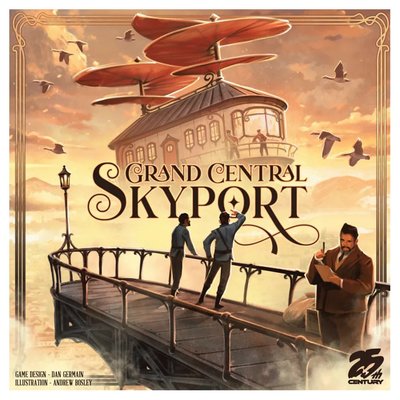
Grand Central Skyport
Hello. So, today I want to talk to you about the game Grand Central Skyport from 25th Century Games. And this game is surprisingly puzzly, but plays really quickly. I really like it. It's for two to four players. I do, of course, wish it had a solo mode. Maybe there will be a good fan-made one that I can try out.
But this game plays pretty, especially at the lower player counts once you know what you're doing. It's like a 30ish 40 minute game, so it's easy to play more than once, but it is surprisingly puzzly and almost a little bit brain burning sometimes. Or maybe I'm just an overinker. That is entirely possible.
So, in this game, you are trying to build out a skyport in front of you that is going to score the most points. So, you are going to get two starting airships and they come you either are New York, London, Paris or Tokyo. And the only reason that matters is because it determines your player color. So obviously I'm Tokyo because it is green.
So I get my two starting airships. Everybody else will get their starting cards, their player marker, and then their starting stations. So let's see. I am Tokyo. So I now have to decide how I want to lay out my starting. So, as you can see, each station has different colors on it. And in order to score, I have to have cards next to these colors with symbols on them in order to score.
So, this is where the puzzle and the brain burn comes. But, if you'll notice, I was conveniently in my starting given one of each color. So, nothing currently matches up. And I must put it every other. So, I can do it that way or I could do it this way. You get the idea. So, let's say that's how I'm going to start.
So, everybody will do the same. We have an airship deck that has all sorts of different cards in it. They are the different colors and there's some wilds and they have different text on the bottom. We are going to count out the last seven cards and we are then going to shuffle in our closing station card or maybe we put it on top.
I can't 100% remember. But basically, once the closing station card comes out, that means we're going to finish the round and everybody will get an equal number of turns. So, everyone will have an area in front of them like this that they are working on, but how they're acquiring things is through the central board.
So, let me show you that the central board is gorgeous. I love the artwork in this game. So, here is where we are going to have our cards laid out that we will be collecting as we move our token around the board. And the way that we move it is from the cards we play will tell us how many movement spots we can get.
Ah, and as you can see, in addition to spots for cards, there are things happening outside. So, when I place my airship on one of these areas, I can take the card or I can do what it says or sometimes I get to do both. So, I'm going to put it this way so we can kind of see a little bit of it. So, there will be these airship cards out there and some of them I might really want because it's going to work with what I'm building or it has a symbol that I want and others might be less desirable to me at any given time, which is totally fine.
None of the cards are inherently bad or punishing. It's just how they fit into your puzzle. Then you also have some tokens so that if you can collect sets of symbols and you're the first person to do so, you'll get a decent amount of points for that at a location over here. Or if you can collect um airship cards of all of the colors and you're the first to do that and get to that space, you can also get some pretty good bonus points.
And the people who do that later on will get points but will not get as many. So, you want to get there as soon as you can if possible. I'm a little distracted because my cat is in here. He is normally not allowed in here, but I was trying to film this and he was literally just like screaming at the door for attention.
So, pay no attention to the man behind the mirror. The other thing that is going on is in addition to just the regular airships that we're going to be adding, we can also add more stations to our to our our shipping lane. So, let's say we had some more cards out here like this. And maybe I want to get a station.
That's one of the options out here on the board. And the station, you see, has new colors. So, if I can play this right, potentially I'll be able to move some things around to where I can get my greens to line up next to the green on here. And at the end of the game, that's going to get me scoring points.
So, these things are constantly in flux and constantly moving. You have a couple of cards in your hand and then, as I said, when you're going around the board, you can get more cards. So, if I look at the cards in my hand and it's my turn, the first thing I'm going to do is I'm going to play a card.
And I'm going to play it onto one of the ends of my my routes. So, I could play this wild. And it's I put it down there. And then I do the action that it says. It says, "Play this airship onto any lane," which these are my lanes. And each other player may move a lane in their skyport by one space. So the wild cards help you and they help everyone else.
So play this airship onto any lane and each other player. So my green's looking really good. So I'm actually going to play it there because I want that benefit. And then it shows me a movement of two. So that means on the central board like I showed you, I get to move from wherever I'm at up to two spaces.
If I want to just move one, that's fine. I can totally move one. So essentially, I have a choice of one or two spaces ahead for the card that's there and or the action. I have to move. I cannot stay where I'm at. And cards go up to this one's a five. So that's going to give me a ton of choices. But as I'm adding things in, so like this card says swap with any lane.
So in this case, that's really helpful because I can swap that over there and move yellow to and we're lining things up. But sometimes what you have to do is not helpful. So you're going to do that move. You're going to go out on the table. You're going to do the thing. And like I said, you can pick up cards.
You can get those bonus discs. You can get new stations. And the last thing you can do is you can get tycoons. Now, when you place these tycoons out into your area, they're going to give you abilities that you can potentially trigger each turn. So, the explorer tycoon, for example, says after you play a card with, and it'll give you a symbol.
In this case, it's the box or a red airship. So, anytime I play red, if my skyport has at least one of these time symbols, then I can move any other lane by one to two spaces. Or if I have two of those symbols in my skyport, I can move any um other any two other lanes. So, these let you get a lot more movement.
So, this is where you can really start chaining actions to build up to score to get the things where you need them because sometimes when you're playing cards out, you're having to move things around in a way that is not advantageous. So, getting these tycoons can help you. But, there's only a certain number of of turns in this game.
You're going to see this deck go down because we're constantly refilling that central board. And like I said, once the closing station comes out, we are finishing the round and that is it. So, you're having to kind of see how much time do I have to really get things in line. Is it worth it to play an explorer instead of playing a sky ship this turn?
Because when you're playing a card, your your um excuse me, your tycoons, not just the explorer, any of the tycoons or the stations or the cards, they all count as your play card movement for that turn and you only get to do one of them. So, there's kind of this like, oh my gosh, I have to be able to do all the things I want to in the time I have.
And then at the end of the game, you are going to score by your stations that match color. You'll get one point for each card of the touching color. But if they have the star symbols on them like this, that's a multiplier. You'll get to score it by another one. So if you could get like multiple blue ports, I'm now going to score even more points for that.
So, you're paying attention to symbols. You're paying attention to sets of symbols, which is the clock, the box, and the ticket. Those are going to get you some points with the different discs. You want to have all of the colors to get points. So, there's a lot of ways to get points, and you kind of have to decide like, I'm going to go in really hard on just a couple lanes most likely to like really focus on those, and then I'm going to work on getting some subsequent points.
Chances are, you are not going to score every one of your lanes. At least I haven't been smart enough to figure out how to get every one of my lanes to score with a good multiplier. So, this game is really fun because you're constantly having to move stuff around and sometimes you're having to move it in a way that doesn't help you, but you're like, "Oh, I know because I have that explorer, I can get a red ship.
It's going to be fine because I can move it back." It's just a great time. I've taught it to some different people. They have loved it. The artwork is great. This is just such a fun, solid game. I find it approachable for newer people um as well as experienced gamers. So that is Grand Central Skyport, one of the newest from 25th Century Games.
I would love to know, have you played it? Are you interested in playing it? Give me a like and a follow and I'll keep bringing you more board game content. Thanks. Bye.