Burn The Witch
Games in This Video
1 game is featured in this video — it unlocks as you watch.
Transcript
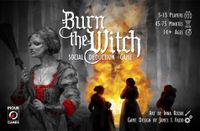
Hello. So, today I want to tell you about the game Burn the Witch by Peak Games. And I met the designers of this game and they talked me into buying it, but they did throw in some upgrades and the expansion for me. So, this is a really interesting social deduction game. It uses some of the basics of a game like Werewolf, but really turns it up in a much more interesting way. So, this plays five to 15 players. However, once you get above eight, your house will only have two um members to it instead of three. So, I prefer to cap it out at eight, but it does play up to 15. So, in this game, as you can imagine, burn the witch, you are trying to sus out all of the witches or people who have a witches witches in their house are trying to burn a certain number of innocents in order for them to win the game. So, there are two different teams in this game, but you don't know who's on what team. Unless you are the witches, you do know which team you are on. Now, in a lot of games, you only get one identity, and once you are taken out, you are out. However, in this game, you have a household. And so, in your household, like I said, you will have, if you are playing a five to eight player game, six to eight player game, you'll have three. In a five player game, you'll have four. And anything higher than that, you will have two members of your household. And then you will have the identity deck and it will be made up of three different types of identities and the number of which corresponds to player count. So you will have anywhere between two and four
witches that you are trying to find. You will also have a certain number of extra devoted people. And the people who are de devoted, if you take out one of them, you then go to this trial by fire where you're going to take out a second um person and everyone has to decide in a quick time period and you use a timer for that. And then everyone else is just your regular old villager. So if you are the witches, you need to take out a certain number of villagers or devouts in order to win. And if you are everybody else, you need to take out the number of witches. So if you have any witches in your house, you are on the witches team. If you have no witches in your house, then you are not. So you shuffle up the identities and then you simply deal them out to everybody and everybody gets to look and see what they have in their house. And then you'll say, "Okay, everybody eyes is closed. If you're the witch, open your eyes so they can kind of find each other. Everybody close them and then the game is going to begin. So the game comes with these red voting tokens that are just plastic, but the upgraded ones are these really cool metal coins. And so what happens is for however many people you have in your household, that's how many votes you get that round. So that's what I think is really cool. Then instead of just having one identity and having to like plead your case, you get votes based on the number in your household. So what's
going to happen is the person who is the accuser and that will rotate around the table. They are going to pick a trait that they want to say I think this is a little bit of a suspicious trait. So they probably want to pick a trait that's not on one of their cards. So maybe they want to pick a trait like being associated with the color yellow or let's see, do I have any? Maybe people who have freckles. Freckles are really suspicious. So they're going to say, "All right, I'm accusing anyone with freckles that one of them is potentially a witch." And then you have this ballot box. One side is that you are going to save the freckled people and one side is that you are going to take them out of the game.
You'll only take out one. So, you then get to take your voting tokens and secretly deposit them into the box. You can do it under the table, however you want. That gets passed all around the table. And when it gets to the person next to me before it gets to me, they vote and then they reveal if we are saving or we are burning. If we are saving, nothing happens. Everyone gets their voting tokens back. Nobody was taken out that round. and the accuser proceeds to the next person. If we decided that we are burning, then everyone who has someone with freckles is going to have to put that card forward and we are going to decide which person we are taking out. Now, you can also use the timer if you want to keep things moving along that this is the maximum amount of time we have to decide. So once we look at everyone with freckles and we decide on a person to take out, then they let's say it was this one. We take them out and the identity is revealed. Ooh, we got really lucky and that was a witch. So in that case that would be great because in most games you only have two witches, only one more to go. But let's say we just took out a regular villager. Okay, so that person is now out of the game. And if we take out a certain number of villagers, then the witches will win. So that person also who gets taken out has one less voting person in their household. If we were to take out someone who is devoted, then this is
where we go to trial by fire. And that means that immediately we have 2 minutes to decide on one other member in the household, any household that we are taking out, right? Then and we have to come to a consensus in that two minutes. Otherwise, there are ways that it happens. It's usually like the person with the most people left in their household, things like that. And when we say, "Okay, your household, you have to lose someone." They get to pick which person from their household they are going to lose. So then the game ends by either all of the witches are discovered and so then the towns folk win or a certain number of devotees and towns folks are taken out and the witches win. So, this, like I said, it has some of those kind of familiar things like werewolf that many people know, but it really takes it up a level because you have the secret voting. You have multiple votes. So, if you wanted, you could split it just to cause a little bit of chaos, especially if none of your people are at risk. You may have a witch, but you don't want to lose members of your household because that gives you less voting in the future. And just because you're the accuser who's picking what the trait is, it's actually the person next to you who then is the one that decides what is happening. So, it is super interesting that I may get to pick the trait, but they're actually going to pick the household of who's going to be eliminated. And we can talk about it and have a discussion, but ultimately it's the executioner next to
me who decides who is being taken out with that trait. So if at any point um a witch is revealed to you, then that household has a hex on it. And if you take another person out from there, then you become hex. So not great. If that wasn't enough, there is also the houses and heretics expansion that gives you even more of the house. It gives you these new house cards. And so different things are going to happen because of that. And it gives you even more varied roles that can happen within the game. You can play with some or all of them. So then there's even more things that happen when the role is revealed. This is a very clever game. Like I said, plays up to 15 players, five to 15 players. It's social deduction. I love that you have multiple roles. I love the secret voting. This is just a great one.
So go check out Burn the Witch from Peak Games. Give me a like and a follow and I'll keep bringing you more board game content. Thanks. Bye.