Timber Town - Board Game Review - Nice Beaver!
Nice, beaver. Thank you. I just had it stuffed. Let me help you with [Music] that. Hi everyone, I'm Luke Hector and this is the Broken Me, a show where I devote my time to ranting and raving about board games, but usually more the ranting part. You know me, I'm not usually one to have a lot of two-player only games around my house, but you'd be surprised.
I've got a few Cosmos games. I got some Bruna Kafala stuff downstairs. Seven Wonders Duel has been a staple in my collection for years. Star Wars Rebellion recently got a resurgence after playing that one a couple of times recently. So, you know, I do keep some around, but not that many. It's hard to get them played.
I live alone. Yeah, I know. Small violin. And it it means that they're reserved for special times. Like, you know, I go to a convention, I can play Rebellion. I've got some mates who really do like Seven Wonders Duel and I can play it solo with a print and play thing. I can do that. The other ones are typically there for when I meet someone who is new to the collect, you know, cuz they're generally quite simple two-player games.
Well, this is Alicat Games at a new one. Here we got here designed by Ryan Busher and who apparently has been involved in video games. And this is basically their new one that they're going to release in the summer from Alycat. Uh probably at the UK Games Expo as well, I'm hoping. And it's a two-player only game.
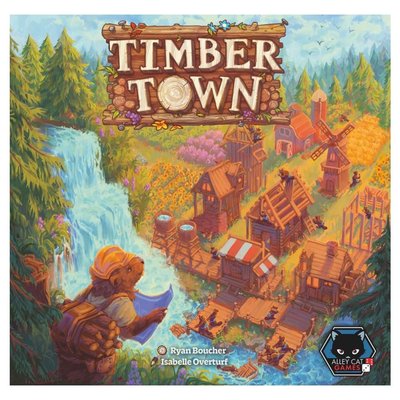
It's tile laying called Timber Town. You're basically beavers building up a little sort of city area of different tiles of different buildings that score in different ways based on your pre-selected cards at the start. Does that sound familiar to you? Um yes, it should do. There is a similarity here to things like Cascadia, which basically has been dominating the whole gateway game scene with its simplistic gameplay, but yet good for good for families, good for beginners, but also good for gamers.
And that one had a similar concept of, you know, here's some cards, here's all the here's the five animals, and they're going to score in a different way depending on what combination you pick at the start. Well, Timbertown has that same sort of deal, except you're building tiles, so you know, you don't have um animal tokens, per se, but tile lane games are fairly common.
And even though it does look very colorful from the outside, is this one going to stand out from the rest of the patch? Let's find out. So, in Timbertown, you are building a 4x4 grid of different buildings. A B CD 1 2 3 4. And your tiles will flow along this little river mechanic here. The idea is is that in the first round, you'll have three tiles to pick from, but then as each round goes on, and each round is just you and the other player taking a tile.
These will slide along the river and new ones will come out to fill in the first row. Players are going to be taking tiles from there. So, there's going to be differing amount of tiles flowing through the river at any one particular time. But the idea is is that before the game starts, you will have pre-selected from a bunch of different scoring conditions.
So, you've always got beavers and construction yards. We'll get on to those a little bit later, but you've got parks, markets, temples, homes, and workshops. Each one with four different cards that say they score in various ways, like put parks in the corners of your grid. Surround oranges, uh orthogonally without putting oranges next to them.
Uh temples, um they score four points, but if you get more than your opponent, score six. Homes, each one's worth five points. If you get them in a trio of three. And workshops, each blue tile scores two, as long as you shove it, you know, with a load of other blues. You know, there's a lot of different ways that they will score and they vary, but you will pick one of each of the different colors as well as the two for beavers and construction yards.
And then each player takes a turn for each round. So the boards tell you whose turn it is. You take a tile and the restrictions for placement are basically twofold. You have to place the tile from whichever numbered column you took it from onto your board. So I took it from the first column. It must go on column one.
You can rotate them how you like. But the other restriction is that any boardwalks on there, so essentially the equivalent of roads if you were playing a city game for example, must connect to a legal place if they can. Edges are fine. Town edges are fine, but if you've got tiles next to each other, you can't create dead ends.
So this is illegal, but I could rotate it to make it so that the boardwalk connects down there. You want to be aiming to try and draw a route from left to right, but we'll get on to that a bit later. And essentially, on top of being able to take a tile, you also have a raft token. So every player's got one each and you can get more.
These allow you to reserve a tile on here. So as they flow down the river, you'll be able to pick it up later because obviously you might want the tile, but it might be on the wrong column. You want to wait till later. Or you can even pass. You don't have to take a tile every turn. You can decide, you know what, what's there is not very good.
I'll just wait and buy my time. So players are going at different rates. Um, as you build these various tiles, obviously spaces are going to become more limited. you're going to have to think more about where slots are going. But you've got construction tiles which are worth points each, but they give you these different tokens.
You've got cranes, beavers, dams, and more rafts. So, well, the beavers are a separate thing. We'll get on to those. Um, you know, rafts, we've already explained, they can reserve tiles. Cranes, they allow you to ignore the column restriction, and dams allow you to put, you know, collect two tiles in a round, you know, useful things like that.
The beavers are a separate thing where they don't give you any points at front, but once you put the beaver on your map, if you can create a route that goes from left to right throughout whatever combination you like, think the old Blockbusters TV show in that sense, then each one will score five points.
So, that's kind of like a a rundown of what the tiles can do and the mechanics, but players basically continue going back and forth with the turn order alternating each round until somebody has filled up all 16 slots on their grid. But that's not necessarily the end of the game because at that point that player has to pass until the opposing player gets to a stage where they filled up their entire grid or they can't legally place a tile anywhere.
So it's not necessarily always the best thing to finish early. Although you will get a nice five point bonus for your trouble. Once you've got that, you then total up your victory points based on the cards you've selected and the one with the most. Of course, you can already tell from just looking at this that this is well produced.
I mean, Alicat Games are usually kind of like hit and miss when it comes to their production quality, but somebody splashed out on this one. I mean, you have got screen printed different little wooden pieces and meeples for like the beavers and the construction tiles. These tiles themselves, I mean, there's more in the bag here.
So, this isn't even like all of them on the table, but there is a lot. And I swear I'd break my teeth on these if I tried to chew them. Not that I do that often, but seriously, these are thick. These are solid planks of tiles with gorgeous artwork on them. Your playerboards again, the thickness, they are super strong.
These are not going to warp. These are not going to bend ever. Decent card stock for these as well. I mean, they're just scoring cards, but it's nice that they're not flimsy. A, you know, partially sort of linen finish feel rule book. Yeah, this thing is, you know, really nicely produced. It looks gorgeous.
It's colorful and nothing feels cheap. And you're probably expecting me to go, "Ah." Uh, but then it's expensive. No, this thing is retailing for about£2324. I think it's even going to be slightly cheaper than that when they release it at the expo or like their first thing or maybe on their website.
So, you're talking between 20 to£25 to pick up this level of quality. A What's that? Is that El Paso having a little cry over there in the corner? Yeah. People who decided to get on my case saying El Paso was fine for £25. I'm sorry. Um, your argument is null and void at this point. This is less than £25 and I swear it is better produced than some games that cost twice as much.
This is really gorgeous. But of course, looks aren't everything. It's got to play well. Well, that being said, that works as well because, you know, you might think, well, okay, it's just putting tiles on a grid and trying to make the walks connect. Well, firstly, you don't get that a lot often in tile laying games.
Sometimes it's just put terrain next to each other. Or you can just put, yeah, I can put this desert next to a forest. Doesn't matter. Whatever. Maybe it won't get you as many points, but it's still legal. It's nice and refreshing to actually get a tile lane game that actually cares about making connections now because it means that it's a lot harder to put these tiles on your grid than you might first think, particularly when you've started to fill up spaces, especially if you want to be point sufficient as well.
But this whole river mechanic is kind of what makes this game because it's one thing to say, I want this tile, but you need it to be in the right column. So if it's in column one, which is likely to fill up quite quick, then fine, you can take it straight away, but you're going to need stuff in two, three, and four.
So soon you're going to need these tiles to flow a little bit further for you, but all that while the opponent could still take the tile. So you've got to pay attention to what they want. you know, it's like, "Oh, I do fancy this market tile here, but what's the likelihood you're going to take the market tile if I'm going to leave it there for ages?
Maybe I should take a turn from not taking the tile to just reserve it with a raft and then later on I can take that along with something else." But there's all sorts of different like little mini forward planning opportunities that you got to do because you got to think about where the tile's going to be at what time before you take it.
And that's just a nice little extra sort of thinky element to the game without being too brainy. This is still marketed as a two-player casual game and it certainly is casual in feel. Most games like Seond's Dawn and maybe like you know well actually let's go over belly. That's probably a bad example cuz that's too heavy.
But a lot of two-player games are usually about stitching each other up. So you know I do this which hurts you. You do this which hurts me. I take your money. I take your stuff. This one isn't a dual style game. This one is yes, it's two players and you might take a tile that the other person wants, but you're not doing anything to outright screw each other over.
You're just trying to be more efficient than the other player is. So, yes, you need to be aware that they might take a tile that you want, but nothing I do says, "Right, I screw you. I take your beaver. I take your raft. If I take your beaver, that's not something that's in a lot of games, is it?" But, you know, so it does play more casually.
You're having fun with the second player there, which granted means that there isn't necessarily a huge amount of interaction in the sense of the game, but it's casual. It's meant to be a fun game that two players can just play with each other. And I do really enjoy the, you know, this whole river mechanic of it sliding down.
You know, you you finish a round and then these will slide there, these slide there, these slide there, or whichever. You know, the eventually these will have to get discarded. You bring the water tile back around here. Fill it up with new tiles. And suddenly you got to look at this and think, "Oh, okay.
Well, that would be good over here, but I I need it over there. Maybe if I take this one first, well, if I don't take it now, it's going to fall off and then I'll never see it again cuz these tiles don't refresh." There's just lots of little nuances that come into play. You don't realize until you actually start playing it and trying to figure out where things are going to go.
The variety in this game is off the chain. I mean, these scoring cards, you always have construction yards and you always have beavers. They're the same no matter what, but then you've got five other colors in the game with four cards a piece. And yeah, they tend to be similar variations to each other, but still you can create some weird setups.
Particularly, I find with the temples, these tend to throw a bit of a spanner in the works when it comes to deciding whether you should go for them or not. I mean, we had a game the other day where the purples uh, you know, didn't want I can't remember what it was. Yeah, purples did not want certain colors next door to them.
combined with a couple of other tiles that wanted them next door to certain other ones. It meant that the it was very tricky to actually get a temple on your board without it screwing something over. So, you had to be really careful with taking those. And that's just one example. You can have a lot of different combinations for this.
And I think it says like thousand plus or whatever on here. I'm not going to do the maths, but suffice to say, yeah, you're not going to run out of these. And if they ever wanted to expand it, they could just throw in a few more. It wouldn't actually be that tricky. But this is great because it means that each game feels slightly different and based on how these things are going to score.
You're going to approach the tiles that you take a little differently as well. All balanced wouldn't have a clue. There's too many of them to find out. I do find that maybe I mean first impressions from the games I've played. There's one here that says it scores each blue tile scores two points for each other blue tile in the same row and column.
Most of these cards tend to cap at around 20 something points. There's a couple that do like 40, but you have to work really hard for those. This one seemed very easy to just grab a bunch of blues and then end up with a packet or load of points, but maybe that was just because I let the opponent get away with too many blues.
I mean, that could have been on me, but as I say that, I played with a bunch of these, but not every single combination that exists. So, I don't know if there's an overpowered one or not. Doesn't really matter because everybody knows what the scoring's like, so you react to it just like everybody else.
But it's great that they brought in this amount of variety from just basically a few extra cards. The rule book fairly straightforward, although one or two little blemishes. Um, it's great that they got an appendix at the back, although the appendix doesn't really explain much more than what the actual card says.
So, there there's only so much extra use. Most of the rules in the examples are generally quite easy to follow. The only time I had a little bit of an issue was when I was reading the building placement rules. They explain it in a way that leaves it a little bit ambiguous. You know, like you might ask a couple of questions.
And I've even put a BG Fred online to like clarify the point more. But basically, regardless of what it says in here, basically know that the building placement rules are as I explained earlier, you have to place the tile on the same column as where you took it from. First restriction. Second restriction, boardwalks must connect to each other if they can from tiles.
You can't create dead ends. Other than that, you have total freedom where to put a tile. If you teach the game like that, it's easy to understand. But I think the book was just a little bit ambiguous on that. And it's, you know, this has had been agreed with other people. So, it's not just me thinking this.
One little blemish is that I know this is meant to be like a a casual game for two players, so you don't want it to be too punishing or anything like that, but the whole idea of connecting the boardwalks together is it's fun and all. I like it. I mean, it is definitely an extra bit you got to think about, but it doesn't necessarily feel like the hardest task to do, especially to connect one side from left to right.
I feel that that's pretty easy to accomplish. So, it's not difficult to get the five points for the beavers every time you grab them. And it's not necessarily helped by the fact that they've got this rule that I think could have been trimmed out the game called the scuttling rule. You can scuttle any construction token you have on your board to create an artificial connection between two tiles.
Now, you got to be careful not to nudge your board because otherwise you might not realize that the token is actually a connection or something to be scuttled. So, there is that little bit of an annoyance, but also with that rule in the game, it makes it feel just maybe a little bit too easy to create the boardwalk connections.
Yeah, you may have the occasion where one tile just simply will not fit where you want it to go and you just don't happen to have a construction token anywhere, but those those opportun those times come up less often than the alternative. Now, you can actually house rule this to an extent to fix that.
If you're a gamer, say you want to keep it in there for, you know, it's one extra rule you got to teach, but it's not that difficult. But, you know, you want to keep it in there for casual gamers, great. As a gamer, I think I could trust out house ruling that you can't do that. That that rule just simply doesn't exist.
You can't scuttle a token to create an artificial connection between tiles. That is one less rule to teach. And also for gamers or people that you are a bit more used to games, it means that the game is just that little bit of extra challenge involved because now you have to be more careful about trying to create the boardwalk connections that I think works better for someone like me, but not necessarily for the kids and families and like casual players who are going to be playing this more often.
So, you've got a little bit of leeway. But yeah, maybe the game just could have been just a tiny little bit more challenging. But it's more of a personal gripe than anything else. Most negatives with this are going to be fairly small nitpicks. You know, I mentioned like some of the bits on the cards, maybe trim out one or two of the rules, explain the building placements a little bit better.
I suppose the tiles themselves, I mean, they are gorgeous and they're thick and that, but sometimes I think maybe the icon on the card should have been a little bit bigger because especially if you're color blind, you're not going to recognize that some of these are temples or homes or that just necessarily at first glance.
So, you're going to be looking for this icon. And the icon is a little bit on the small side, you know, when you're looking at these tiles, particularly when they're rotated in all sorts of different ways. So, maybe it, you know, that could have just been made bigger, you know, take up a decent amount of the tile.
Why not? You've got all the space, you know, especially when most of it is just green forest land. So, there's a few nitpicks here and there, but it's a 30-minute game that's well produced, that's nice and cheap, that can be taught in five minutes, that's played for casual two players, great for new gamers.
New gamers could happily be shown this game and they wouldn't struggle. You know, you just vary up the cards or maybe just pick a bunch that are easy to work out their scoring. Good amount of variety. You know, just a few little nitpicks here and there, but this is an excellent title and I'm giving this a seal of distinction cuz it needs it.
This is again a 9 out of 10. It's excellent and I think that Alleycat are going to have a hit with this. If it's at the Games Expo, definitely recommend giving it a try. If you know you've got families, kids, new gamers, you know, new people to the hobby, game cafes, this is a must grab for your cafe because it's, you know, you want games that somebody could pick up themselves and learn in a short space of time.
But if you're at the cafe showing them how to play a game, again, you can show them this in less than five minutes. It really is a quick teach and a quick play. You know, it just ticks the boxes for what it's set out to do. very little to fault other than a few nitpicks and personal gripes. But yeah, it really is a sound game.
Get a look for Timbertown. That's it for me on this episode of The Broken Mele. If you like what you see, then please thumb it up on YouTube and thumbs up on board game when it goes live on the page. Don't forget to check out the rest of the content I've been doing. There's been a few little speed reviews lately, and hopefully I'll get round to doing another top 10 soon.
But until next time, remember, regardless of how many beaver jokes you've secretly been making as you watch this video, it's still only a game. So, bye for now. [Music]