Kinfire Council | How to Play | Learn to Play in 17 Minutes!
Games in This Video
1 game is featured in this video — it unlocks as you watch.
Transcript
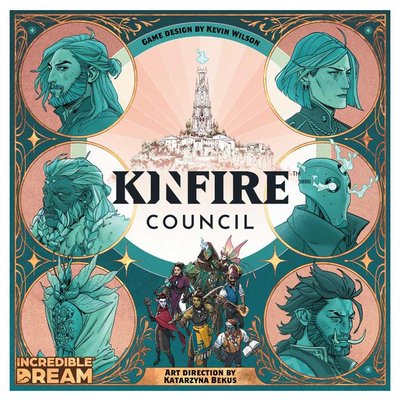
Hello everybody. My name is Ia and my name is Tyler. Together we make up Coffrey, a couple that loves to play board games. And today we'll be teaching you how to play Kinfire Council. Kinfire Council is a design by Kevin Wilson and it's published by Incredible Dream. Let's go to the table and let's learn how to play. As always, you'll begin by setting up. You'll place a two city board trays next to one another in the middle of the table and place a tiered boards in the corresponding spaces. You'll then fill the boards with the district tiles matching the numbers. Additionally, you'll add the shady dealer special tile in the space at the bottom of the city board, ensuring the shady dealer side is face up. Next, you'll make a supply of all the resource tokens below the city board, ensuring they're within reach of all players. You'll then place the coffer's bowl next to the resources. You'll place a status board next to the city boards. You'll shuffle the research and decree deck separately and place them face down in their indicated spaces. You'll separate the skill tiles to three different stacks and place them on the status board either side up. You'll prepare the city needs track by placing three food resources from the supply in the top three spaces. Finally, you'll place the cult score marker on the zero space on the score track. Next, you'll prepare the threats and the cult. You'll place a threat board near the city boards and shuffle the threat deck and place it to the side along with a supply of trouble tokens. Without revealing them, draw the top three cards of the threat deck and put them near the play area in a face down pile. You'll place a hidden thread tile on top to mark these as hidden threats. You'll set aside any special thread tiles off to the side and proceed
to place all 20 cultist chits into the cultist bag. Make sure to mix them well. You'll now prepare the lighouses. You'll take the lighthouse tracker and place it near the city boards, placing the progress marker on the bottom space. You'll then shuffle the five lighthouse sheets and reveal the first lighthouse next to the lighthouse tracker, keeping the remaining lighouses nearby. Lastly, you'll place the sentry tokens face up within reach of all players. You're now ready for player setup. You'll randomly assign worker sheets to counselor sheets, which will create six combinations players can choose from. You'll randomly select a first player. They'll receive the speaker's medallion and select a counselor and its assigned worker sheet of their choice. You'll proceed choosing in turn order until everyone has a counselor and a worker sheet combo in front of them. You'll return any unchosen worker and counselor sheets to the box. Each player will then receive a seeker stande worker chits influence tokens, a score marker, and a plus 50 plus 100 token matching their worker sheet. In player order, you'll place your score markers on the score track with the first player placing on one, second on two, and so on. Each player will then place their seeker in its space on their worker board. You'll then place a set amount of worker chips on your player board depending on your player count. You'll return any unused workers back to the box. Additionally, you'll place four influence tokens on your worker sheet. The rest will be kept to the side. Now, some counselors will have an additional setup step. Vath, for example, begins the game with eight
influence and a random sentry token. If playing with Elias, when setting up, you'll train all of your workers in your seeker's skill. Finally, Sen will begin the game with six coins. Each other player will receive three coins from the supply, and you're now ready to play. In Kinfire Council, you'll take the role of a counselor of Denlux, aiming to make an impact and go down in history as one of the greatest leaders the city has seen. Over the course of the five rounds, you'll utilize your workers to do your bidding throughout the city and beyond, aiming to gather the most victory points. To do so, you'll collect resources, arrest cultists, deal with dangerous threats, upgrade districtiles, and of course, work to build kinfire lighouses. However, there is a catch.
The cult of Altan will be lurking in the shadows attempting to gain power and could overtake all players in victory points, especially with the hidden threats in play. As an alternative victory path, you could choose to support the cult and betray your fellow counselors to win through the cult conspirator victory. Before we get started, I encourage you to take a look at your counselor and worker sheet combo. Your counselor ability and your seeker skill can support an initial strategy which you can choose to pursue. Keep this in mind as you watch and learn how the game is played. Now, on to the round structure. Each round will consist of three phases: suns rise, days light, and nights fall. You can follow along by taking a look at the back of your rule book. Sun's rise. Here you'll first prep the docket. You'll draw two decree cards and place them face up side by side above the status board. These decrees you'll be voted on in this round. Now there's four different types of decrees you'll see. Laws, which will change the rules of the game, order, which is the immediate effect after which the decree is discarded. an election which benefits one counselor when one and a crisis in which you'll need to gather votes in order to prevent it. We'll discuss these further in a moment. The next step in Sun's Rise is to unleash the cult.
You'll draw three cultist chips from the bag and add them to the hideout area of the status board. You'll now resolve the cultist drawn in numerical order. When resolving, you'll first place the cultist on the corresponding district in the city board matching its number. This essentially blocks players from placing workers in that district. Then you'll take a look at the threat board. If there's no threat corresponding to the cultist number, you'll draw a card from the threat deck and add it to the threat board. If there is a threat already present in the space matching the number, you'll instead add a trouble token. Now, once the number of trouble tokens matches the number on your thread card, the effect of the card is triggered and resolved. The thread card is then discarded unless otherwise stated. Thread cards will often hinder your collective game and give the cult a bit of a boost in their own pursuit of victory. However, thwarting threats is a great way to obtain a significant number of victory points for yourself and your cause. Last thing I'll mention is you will see threats that remain until thwarted and others that are triggered immediately when drawn. These are identified with a zero. Now, if you draw a cult leader, all three slots on the threat board will be affected left to right, meaning that any slot without a card will receive one, and each slot with a card will receive a trouble token. After resolving the cult leader, you'll discard it to one of the two cult leader spaces on the status board. If both are occupied, the cult bag immediately resets. You'll collect all the arrested cultists from players, any that have been discarded, and the two
cult leaders. The only cultist chits that stay are the ones already placed in the city, and that's Sun's Rise. We can now move on to Days Light. Here, players will take turns dispatching workers and running errands until everyone has no workers remaining on their worker sheets. Let's go over the specifics of each player's turn. On your turn, you'll do the following in order. You must place a worker, and then you may run one errand. Placing a worker. You'll choose any of your worker chits or your seeker and move them to an available space on the city board or outside of the city. You'll have two different types of workers, your seeker or your regular workers. Seekers can be placed anywhere as long as the space is unoccupied, including outside the city to deal with threats or take the lighthouse actions.
Seekers will also come with abilities that may not be exchanged. Regular workers may only be placed in the city and they may additionally acquire abilities throughout the game to strengthen their actions. Those will be done through various actions in the city. You can take a look at your player aid to learn more about the worker abilities. Now, when placing a worker in the city, you may at times be required to pay taxes depending on the tier in which you place. You'll pay taxes from your supply to the city coffers bowl. Only taxes will go into the city coffers bowl. The remainder of the coins when paid will be returned to the supply. Sen as a counselor ability may utilize the coins in the city coffers. After paying taxes, you may now take the action of the district you're in or arrest a cultist. Actions in districts will vary.
Some districts will have two locations. You must choose one of these to take the action in. Through these actions, you'll generate variety of resources, trade resources, cast votes utilizing your influence, obtain more influence, gain research cards, and much more. We'll highlight a few key mechanisms here. Voting. When taking an action location with this symbol, you're able to cast a vote on one or more of the decrees present. For each thumb icon, you can place one of your influence on your worker sheet next to one of the decree cards. Collectively, you're working to pass one of the decrees by the end of the round. Casting votes can give you a strategic lead if the decree is in your favor. Research cards. Some districts will grant you the ability to gain research cards. You'll draw the amount listed from the deck and keep them to use on a later turn. These all range in their effects and will be explained on each card. You may use multiple research cards on your turn and timing of these will be essential. Additionally, Talos as a counselor ability can discard a research card from their hand instead of spending a magic, which is a wild resource. They may also draw a card instead of casting a vote, having access to plenty of variety of resources.
Sentries will award additional victory points when performing certain actions or helping specific requirements. These can supplement your strategy, and gaining them early can help you in the long term. Finally, magic is a wild resource. You can use it as a substitute for any resource token. Additionally, city districts can become upgraded through the city planning action. You'll place a worker and pay the cost depicted for the corresponding district you wish to upgrade. You'll then receive victory points and flip the district tile to its other side. Not only is the action now improved, but you'll additionally be able to place your influence on the upgraded tile, earning a bonus if other players visit the district. As long as your influence is still present, you can refer to the location reference guide throughout the game if you need a reminder of the existing actions you can take or what the upgraded side of the tile will look like. Instead of taking actions, you can arrest a cultist. When placing your worker, instead of taking the action, you can collect an adjacent cultist. Diagonal agency does not count, and adjacency only counts for the same tier unless there's a staircase present.
Now, Vath has a counselor ability that every time he arrests a cultist, he'll either gain two coins or cast a vote. Now, once arrested, you can utilize cultist for information as a resource in various districts, as well as when thwarting threats. You can also place workers outside the city. These will primarily be your seekers or any workers if you're playing as LRA due to her counselor ability. Now, you can use the action spaces on your lighthouse, either performing the specific lighthouse action or running three errands, which we'll talk about in a moment. Additionally, you can thwart threats. You'll place a worker, pay the cost of the threat, and receive the corresponding victory points on the card. Cards will additionally be collected to your supply as they can be traded in in various districts. Now, that's the worker actions. After placing a worker and completing the action, you may choose to run one errand. You have two options. Meeting a city need or sending a supply shipment to the lighthouse site. To meet a city need, you'll need to choose which you wish to meet. Pay the corresponding resource or resources back to the supply and place your influence token to indicate that you have fulfilled the city need. Unmet city needs will be a detriment to every player as more cultists will arrive in the various districts in the city in the following round. City needs will be added throughout the game. If the track is ever full, it'll wrap, meaning the first space will now need two specific resources to be fulfilled. Now, instead of meeting a city need, you can send a supply shipment to the lighthouse site.
You'll choose to build either one, two, or three floors. You'll return the corresponding resources to supply and place one of your influence markers next to the amount of floors you've built that round. Then, you'll adjust the progress marker up by the number of floors you've built. As you can see, the taller the lighthouse you build, the more points each of the floors you've built will be worth and the less points the cult will score. If the top is reached, you can still build floors, but the progress marker will simply stay in the top space. Now, that's the errands. Let's take a look at a couple of counselors who have errand counselor abilities. For example, Sigra as an errand can use the city planning space, essentially meaning you can upgrade districts without having to use workers in the city planning space. As Lero as an errand, you can make one of the following traits. And finally, Elias will have an extra errand to run. And as an errand, he can train one of his workers in a skill of his choice. You'll also be able to obtain additional errands throughout the game. Simply look for this symbol. You'll keep taking turns until everyone has placed all of their workers. You'll now move on to the third phase, Knights Fall. You'll first resolve the city needs. For every met city need, the corresponding player will score two points. For each unmet city need, a cultist will be drawn and placed in the cultist hideout. If this is the end of the last round, these cultists will be resolved immediately. Otherwise, they'll be resolved when the cult is unleashed in the following round. Each counselor will take back their influence
token after resolving city needs. You'll then resolve the docket. The decree with the most influence will pass. If there is a tie, the player who's holding the speaker's medallion will break the tie, even if they're not part of the vote. In the case of an election, the player with the most votes, the lead sponsor and the decree will become the cards holder. If there is a tie, it's broken the same way, but the player with the speaker's medallion. Then all the players will take back their influence tokens from the decrees. Next, you'll resolve the cult. You'll see if any cultist chits remain on the board. If they do, you'll resolve them a second time on the threat board. Then the cultist will be discarded. You'll then resolve any damage on the lighthouse. For every trouble token, you'll adjust the progress marker down a space. Once resolved, the cult will now score victory points adjacent to the space of the progress marker. Now, if damage is dealt to the lighthouse and the progress marker is already at the lowest space, you'll receive a grievous damage, meaning you'll add one additional threat card face down to the hidden threats.
Regardless of how much damage is dealt below the bottom of the track, you'll only ever add one card per round. Next, you'll build the lighthouse. The number to the left of the lighthouse progress marker will be the points earned for each floor each player has contributed. Once all points have been awarded, you'll discard the lighthouse sheet and draw the new one for the next round. You'll then collect all the workers, place them back into your worker sheet, pass the first player token, and remove any coins from the city coffers back to the supply. You're now ready for the next round. You'll keep playing building a lighthouse per round until the end of the fifth round. Again, at the end of this round, when drawing cultist for any unmet city needs, they'll be resolved immediately. After the end of the round, you're now ready for final scoring.
First, you'll check for any laws that granted victory points and resolve those. Then, you'll reveal the hidden threats. For each hidden threat, you'll add the victory point value on the bottom right of the card to the cult of Altan score. At this point, the counselor with the most points wins. However, if the cult has the most victory points, the player who's a current cult conspirator wins instead. If the cult has the most points and no players a cult conspirator, the cult wins the game and all players will lose. Now, you may be curious, how do you become the cult conspirator? Well, it's simple. Anytime you gain cult influence, you'll place one of your unused influence tokens, if possible, into the cult influence section on the status board. The cult conspirator is always the player with the most cult influence here. If tied, the tied player who most recently contributed a cult influence is the cult conspirator. Meaning, you may not want to jump in here too early, as other players will catch on to what you're doing. Additionally, once pursuing the cult route, you may help the cult gain points by going to spaces with this icon. Lastly, if playing with two players, the only rule change is neither player may become the cult conspirator. Now, what this means is instead this symbol will allow a counselor to remove a trouble token from the thread card in play. And this symbol will cause the cult to lose the indicated victory point instead of gaining it. And there you have it. Can fire council.
Thank you so much for watching this video. If you have any questions, you can leave them in the comments down below and I'll be delighted to get back to you because I was one of the lead play testers for this game. Fancy. Very fun. And of course, if you found this video helpful, make sure you hit that thumbs up button. Hit that subscribe button if you're new here, cuz we love talking and teaching board games to folks just like you. Now, if you were Now for a question of the day. Yeah, back up. Back up for a question of the day. If you wanted to become a counselor of a city in a fantasy world, what would you do to get elected? What would you do to get elected? Would you take the shady route? Shady business. Or would you earn people's trust? Would you be the man of the people, the woman of the people, the person of the people? Power to the people. Power to the people. Until next time though, we will see you later. Bye.