Nature - Board Game Review - Apex Predator or Easy Prey?
Games in This Video
1 game is featured in this video — it unlocks as you watch.
Transcript
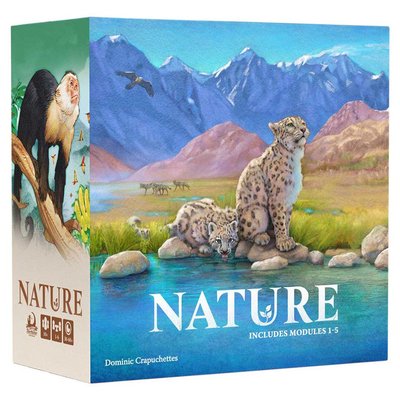
Hi everyone, I'm Luke Hector and this is the Book of Melee, a show where I devote my time to ranting and raving about board games, but usually more the latter of part, let's be honest. This is kind of almost a bit of an exclusive one actually. There's not a lot of people in the world who have a copy of this right now. And this is Nature from Northstar Games. Now, Nature is basically what you could probably call as evolution 3.0. Originally, they did a game called Evolution. You were basically building up species of animals and you could make them predators to go hunt for food like meat or you they were herbivores or omnivores where they basically tried to get food from a watering hole. and you had trait cards that you played in order to sort of turn your species into something unique in order to try and eat the most food possible while also keeping your population alive, not eaten, that sort of thing. And it was a neat little game. It had some, you know, issues with it, but it was generally a fine like game. They have expanded it over time and then they released a spin-off one called Oceans, which was effectively kind of like O Evolution 2.0 in a sense. and they've been tweaking the system with both of those every now and again with expansions and other content. Well, nature is now their effectively their third iteration, hence I say 3.0. It is effectively the evolution game except they've changed a few things here. There's a few rules here and there that are different from the original base game. And whereas the base game kind of like threw everything in the base game or did major expansions for this, this set is now modular. So, you can play the base set on its own or you can insert any number of modules
into the game with some restrictions. We'll get on to those. Um, and basically tweak the system for you. So, do you want to have birds? Well, you can put in the flight module, for example. Do you want to be in the Amazon rainforest? Well, you can use the biome Amazon rainforest module and use that instead. And maybe even combine that with Jurassic so that you can have really big dinosaur species. You know, you can basically tailor the game now to your heart's content. But this is now the third iteration of this. So, you know, there's less room to forgive for any problems at this stage because you've been working on it for so long. And this is the big box, you know, big box version. There was a retail version on the Kickstarter. There was this version on the Kickstarter, and there was a deluxe version with upgraded components. This one does not have that. This effectively is the big box that has the base game support for up to six players and the first five modules of which we have no idea how many modules are going to do in the, you know, total in the future, but they suggest that they're going to release a couple each year for the next decade. I have thoughts about that. We'll get on to that. But first things first, how does this play?
Super easy. Barely an inconvenience.
Despite the big box, nature is still a very straightforward game. You are essentially building up different species in front of you. Each will be represented by a dial. The dial goes from size one to five because you can make the species bigger, but they will also be represented by population tokens. Now, these population tokens is different from the size. I mean, you could have a size one species like a I don't know a fish or something and it just happens to have a lot of population or it could be size five. It could be the size of an African elephant and you might only have one or two population. But in each round, you will get a new set of cards. These cards are trait cards and they come in various different guises although there are some duplicates and these will add stats to your species like maybe make it e like harder you know more defense harder to get hunted or it might give it more you know more claws so it makes it you know worse a nastier predator shall we say but typically they will give them some kind of ability like after a species hunts it gets to eat some meat like scavenging. Uh it could be that when it takes food from the watering hole it gets more food from the watering hole.
It could be that, you know, when somebody takes a turn, it gets to take one food from someone else. You know, there's various different like abilities that they have, but you are limited to free. Instead of using them as traits, though, you can instead discard them in order to gain more population or increase the size of your species. So, you have a little bit of flexibility here and there. And unlike the original game, you can freely turn your species into a hunter. there a hunter card where basically you just say as a free action, right, I'm going to put the hunter trait on my species. It's now a hunter and it will now have to hunt animals for food. Previously, it was a bit more finicity to try and do that. Now, you can freely do it, you know, at your whim. So, there's a good little decision space there. But as you start each round, you will play cards in such a way to increase your population, species, or add traits. And then it comes to the eating phase where there is a certain amount of food in the watering hole to begin with and players will take it in turns to eat the food that's in there.
They pick one of their species and they eat. If it's a predator, it hunts other players species in order to basically eat them for meat. And depending how big the species is or whether they've got like, you know, natural defense armor or whatever or whether the predator's got claws will determine what it can and can't eat. But the hunters have to go after other species. They can't eat plants. If it's a herbivore or an omnivore, then it can go for the food in the watering hole and it will eat a certain amount of food based on its size and population. And of course, other traits besides you could have a, you know, a social trait that gives you plus two food when eating. So great, but it just means that you're going to drain the watering hole faster. And the watering hole only has a finite amount of food each round. It's repopulated as each round goes on, but there's only so much. And of course, everybody wants a chunk of it. So, you know, you're having to make decisions to try and feed as much of your species as you can. If you can't feed some of your population, they'll starve and effectively go away.
Should your species go extinct, then you'll basically get like a a kind of like buffed up species in the next round. So, even if you do get hurt in some way, you do come back a little bit stronger, which is quite a cool sort of catch-up mechanism in itself. But obviously you're trying to feed as much as you can because all the population that you can feed. The food that you have used to feed them gets converted into victory points for the end of the game. And of course you go on for four rounds in the base game. Six if you add modules and tot up the amount of victory points you've got overall for the food you've managed to eat.
Beef cake. Beef cake.
Now componentwise, nature is kind of built to a bit of a budget because it's trying to be eco-friendly in all its regard. It's a bit like what Daybreak did. You remember that game that I kind of wailed on? So, the components here are for the most part pretty cheap. You know, nothing in here particularly stands out other than the dials. I think the dials are pretty decent for the price point. I mean, they do a nice job and you do get quite a lot of them. I mean, this box is full of them and yet there's another box with this and another two boxes to count for the Jurassic modules. So, there's quite a few dials available. You've got, you know, rule books of all the different modules in the game as well as the solo mode. And you've got, you know, these different tubs which you have stickers in order to put on top so you can easily tell what goes in what spot. But then all the tokens are held in these little trays, you know, these kind of like polyyreene trays and you can sticker on top of these in order to know what's in each tray. Yes, nothing out here is jumping to say this is a stellar component, but it's very very functional. You know, the the setup of this game is disturbingly fast. Yeah, it's a light game, but I was surprised how quick it is because in the box you have a full guide as to how to set the, you know, how to put it back in the box.
I mean, you can kind of work it out for the most part, but it gives you a very, very comprehensive, you know, system of how what goes in what tray, how the trays go in the box, and how it stacks together. And when you come to get the game out, you mainly just have to get a bunch of these trays out and a few cards from the other trays, and that's kind of it. You're set up and ready to go. very very quick setup. Time taken 30 to 60 minutes. Pretty accurate. This game is not a long game. It is meant to be I mean 30 minutes is kind of pushing it. You know, you might be able to do 30 minutes maybe with a two-player game if you're playing only the base set, but still you're probably talking about an hour to play this game, which is not long. It's a pretty nice condensed game. Goes from one to six players. I will stress I have not played this with five or six players. I've only played this with one to four. And you know, five and six, I don't know. I feel like five and six might get a little bit chaotic, you know, if you add that many players, but the support is there if you want it. But I will stress, I have not been able to play it with five or six. And in any case, you can only play it with five or six if you get the big box anyway if you get the base set only to begin with. You only have support for one to four players. So, you know, there is that.
And the rule book does say that if you're playing with five to six players, you should play with the quick play variant. So even it acknowledges that five to six might take a bit longer than your advertised hour. But you know, one to four players, you know, it works pretty fine at all the player counts, two, three, and four. I enjoyed all those counts. And the solo mode particularly good in this as well, actually. It's a very easy to pilot AI that kind of has its own little like deck of flowchart cards. And when it gets a new species, that one of those trait cards goes on the species and it kind of dictates the sort of trait cards that it's going after. like one particular trait card might mean that the species is going to try and build up its population as fast as possible or it's going to grab as many of the trait cards that focus on defense. So, it's going to be a really hardy species that you're not going to be able to hunt as well. It's a pretty neat system and honestly, as I say, normally I confess as to which one I prefer. They're kind of on par. I think multiplayer and the solo are on par with each other, but solo players rejoice. The mode is pretty decent.
So, the core gameplay, is the core gameplay of the base set good enough? It's fine. Yes, I think it's a decent game, but it's not groundbreaking. I mean, this is basically evolution 3.0. So, if you liked Evolution and if you liked Oceans, you're going to like this one by default, cuz I don't think there's enough differences to say, "Oh, I hate this one and I like the other." But the differences here are definitely, I think, improvements. You know, there is a lot more flexibility with these cards because now you get like five every single round and you don't have to use them all. You can save them from round to round. Like I've got an easy round. Let's just use a couple of cards. Now I've got eight cards in the next round. This is pretty nice. But you also have more flexibility with, you know, things like turning your species into a hunter. You can do it as a free action and you can just do it. You don't have to, you know, find a specific card to do that. Yes, it takes up one of your free trait slots, but you are able to do it when you feel you need to do it. Um, I like the fact that the cards can also be discarded to increase size and population instead of using it for the trait. So, yeah, you might draw some duplicate traits that you don't need.
Well, fine. I'll discard those to up population and size because that's still useful to do. You know, you want to eat a lot of food and you want your species to be big so that predators find it harder to hunt them. you know, the, you know, your size three species wolf over there is going to struggle to hunt my size five elephant, for example. But the traits themselves are still pretty cool. You know, clawed, avid forager, scavenging, uh, what we got here, plated, opportunistic, horned, fast, uh, tusked, social. Uh, you know, there is quite a decent amount of duplication, it must be said, despite the fact that this deck is quite big, but there's only so many traits you need, and the modules do add more. or I am going just from the base set only. Four rounds. It's a pretty nifty system. I like how the, you know, when you place the traits out initially, you're doing it in turn order. So, the traits come out face down so that your opponents don't know what you're playing. So, you can there's not so much bluff, but you can kind of like, you know, go what some people might be doing, but the hunter is face up. So, if somebody decides to turn their species into a hunter, the other players after them will know that the hunter is there and can use their turn to prepare for that. So, it's not a complete surprise.
Uh, you know, little tweaks like that compared to the original, which was maybe a little bit more rigid or maybe a little bit more luck dependent on the deck are definitely improvements to the system. This is definitely, I think, like from a core perspective, my way to play this evolution system, but the core game still doesn't have a huge amount to it. Yes, you've got some interesting little decision spaces, and yes, you have got, you know, you know, like what am I going to do with the species? Make it bigger? make it, you know, make it large, you know, make it make it more population, make it larger. What traits am I going to give it? You know, turn order compared to other players. What are they doing? Do I become a hunter? There is some good decision space, but the core game's only going to get you so far. And it is the cheapest option. It was only $40 on the Kickstarter for the base set alone, which is a pretty good price for a Kickstarter base game. I got to give it props. But I don't think the base game is going to be enough to last forever. I mean, certainly if I only had the base game and that was it, I'd kind of be like, well, it's fine, but maybe I'm kind of done with it after a bit.
Now, obviously, now the modular system, the idea being that you can now plug and play different modules into the game. Not the cheapest system, I must admit. I mean, the big box version I've got here on the Kickstarter was $119, and that is apparently discounted from MSRP. That's a jump from 40 to 119 just for five mini modules. And I do mean mini modules. They mostly just add a few cards and maybe like a couple of rules. They're not exactly major expansions. I mean, you could have all five modules from this big box set as one big box expansion that you would otherwise release for another game. It just feels like that's a bit of a price hike for this.
Is bread free? Yeah, we'll split an order. Now, that being said, the modules themselves, so you know, I'm not going to get like all the modules out in terms of cards in that, but you basically have one tray devoted entirely to four of them, and then there's another tray there with the natural disasters one. But it's pretty easy to separate them out. Basically, each quadrant has the relevant cards, and they do, you know, add some cool like new traits. Like if I take the Amazon one for example, you've got climbing, fertile, omn omniferous, poisonous, powerful jaws, you know, a few extra traits that you, you know, have as a separate deck that you can decide which ones you want to draw from. So it is cool that they do add a bit of variety. So what are these modules? Well, they range in complexity and oddly you've got a complexity one, a complexity 2, and three complexity fours. It's kind of weird. What happened to complexity three and five? Why didn't you just have one of each of your first five modules? kind of seems weird, but you got five modules here. Two of them are biome expansions, modules, and the other three are typical modules, you know, like new cards. You can mix and match these types of ones to your heart's content. The biome ones, you can only have one at a time because they come with their own watering hole, and they do change up the game a bit more than these ones do. So, just to sort of go over very basic what they are, the Jurassic one, the easiest one here, is a very straightforward one. You basically get new dials which allow you to basically have species that are double the size of before. Like you can have a size like 10 species or something ridiculous or size eight species, you know, kind of insane. But other than
that, you just basically get some new, you know, trait cards to go with it and you can make bigger creatures. That's kind of all Jurassic is. It's a pretty minor expansion. You could almost throw it in all the time and not really care. But if you like, you know, you want to say that I've got dinosaurs and have, you know, Jurassic style, you know, creatures, then fine. But it's a pretty minor expansion. Uh, flight is for those, and I do like the fact that they do tell you kind of briefly, what is this expansion for? Like this one for players who prefer to avoid conflict. So, if you're a bit annoyed that you get eaten by hunters every now and again, but flight is good for you because now you've got birds, you've got all their different traits, but this allows you to migrate birds to like a sort of separate area, score points with them, and it's harder for predators to attack flying creatures. I mean, you know, they can only reach so high, shall we say, but it's a pretty neat expansion. I quite like using flight. I enjoyed flight in the previous like iterations of the game, and it does add another way of getting species for people who aren't too keen on the whole of being hunted thing. So, you know, flight is a pretty neat one to use. Uh, natural disasters complexity 2 is essentially an event deck. So, you've got these cards, which are very gorgeous. I mean, I will admit, you know, they've um actually, can I get the uh disasters out? Where are they?
Here we go. Come on. Come on. Normally the trays are a little bit easier to open. There we go. So, you've got these pretty sizable cards here and they've got gorgeous artwork on them. But the thing like hurricane season, lightning storm, radioactive meter shower, one gets re one gets revealed each round and basically it affects the game in some way. So, it is a glorified event deck, but I think it's a decent event deck. You know, nothing completely destroys a round. It's thematic to the game and the cards really look good. I mean, they use a a mixture of artists here. You're looking at a lot of sort of Vincent Dut Trade style art here. But each of these modules has got a different artist doing them. You know, I can't remember the full like list of them, but just looking at these three that we've got here. So, uh, we got illustrations. Vincent Dutri did that one. Uh, illustrations. Daniel Fiddler.
I'm not sure if that's pronounced correctly, but you know, he did that one. Uh this one illustrations uh Apha Can Cananani. Again, I might be butchering these names, but you know, there's a good mix of art here, and it's all good art. You know, no art in here sucks. I think it all looks very pretty at the end of the day. Uh getting back to the expansions though, and then we got the biome ones. So, we got Amazon rainforest and Arctic Tundra. Both Complexity 4. Amazon rainforest is basically for people who like sort of bluffing and surprises. It's easier to get population in this game. you can basically get it twice as fast, but when the population is lost, it's kind of lost. So, it's like, oh, okay, that's a little bit problematic here. But you do not reveal your traits at the end of the adapting phase. Instead, you choose to reveal your traits at any time, but you've got to reveal it in order to get this benefit. So, you can, you know, bluff with the trait cards. you can reveal them to get like nasty surprises and stuff. But this one is good if you want to have, you know, the poison trait or just like an easier way to get population or if you like being crafty with the card system. It's a neat one. I don't know if it's my favorite of the two. It's hard to hard for me to gauge which one I like the most, but this one is pretty solid. This one is solid if you like a challenge. Arctic Tundra.
This is for people who basically want it to be hard to get a species going. Like, you know, you want you want basically Bolto the movie put into the board game or so where basically everything bad just happens to this dog. Well, this is kind of like it. It's like twice as hard to get population with this expansion. And you've got different traits that are all about trying to resist the cold. You know, you um you have to discard two cards instead of one to get population. Uh you only get, you know, you only when you lose population to the cold, you know, it's another way to lose population. So, it's harder to actually keep a species living. It's definitely a challenge. Like I wouldn't recommend you start with this one. You want to get used to the game first and then throw this one in. But again, it's nice to have a challenging one that is pretty.
So you have got these five modules which are for the most part pretty good. I like three of them in particular. Natural disasters. I can take a lead, but it's fine. And Jurassic is maybe just a little bit weak because it's just a bit too simplistic. Like there's not a huge amount to it. These are cool and they elevate the game. And I think without the modules, you're not getting a lot of replay value out of this. You really do want these modules, but if they're going to be as expensive as that, it's a little bit of a worry. I really would be interested to see what the pricing structure of this is going to be as it gets released on retail. I also think you need to release more of these more modules quicker. I think two a year is going to be a little bit too infrequent if they're as small as something like Jurassic. If they're biome stuff like Amazon rainforest and tundra, that might not be too bad. But, you know, will they hang on to this game for 10 years? I'm not so sure about that. You know, 10 years is a long time to wait. So, again, we don't know all the details as to what they want to do in terms of releasing stuff, but I would be very interested to know. That's going to be a newsletter that I will tune into when they give more details on that. So, overall, what do I think of Nature and its system? It is a decent game. I like Devolution. I didn't think it was groundbreaking, but I enjoyed it. This is 3.0 effectively, and I do think that this is the the better iteration. It's not by no means perfect. You know, there's only so much in the game in its base set form. The modules are really needed in order to elevate what's going on, but it is a good system nonetheless.
But I just think you are going to need those modules, you know, and then you're going to be paying quite a bit, and you have to accept that the components are built to a budget. Yes, it's functional and the artwork is fantastic, but you are using, you know, basic tokens. And if you want the fancy tokens, you've got to put even more money into the game. And do you really want to do that? And this is quite a big box to have on your shelf for essentially like a few extra modules. And of course, it'd be interesting to know how easy future modules are going to fit in here. You know, they fit fine with the first five modules, but is this big box going to be able to cater for another five modules on there? I don't know. It's really going to depend. I'm not going to want to have a second box for storage, you know, when you've already given me a box this big. It's like, you know, a bit weird there. But, you know, all in all, it's a good system. It's a good game. It just doesn't really blow my mind in its base form. When you throw in the modules, the game is elevated. The solo mode pretty solid as well. And, you know, I look forward to seeing how much more can come out for this game, but the game is definitely hinch hing like sort of it's definitely holding on to these modules. like the modules are going to make or break this game for you. If you like the modules and the system and how it works, you're probably going to get a kick out of this. But if the modules don't really do it for you, then I don't think the base game has enough to keep you going for too long. For me, I would say that in its base form, I'd give Nature a seven out of 10. Like seven out of 10 for its base game. It's good.
Nothing amazing, but it will keep you going for a bit. It's short, quick, nice and easy. he does want to, you know, does two to four players nice and balanced and that, but it's only going to last you so long. It's an 8 out of 10. When you start throwing in the modules, you know, particularly the ones that, you know, you grasp on and really like, then I think the game elevates to the next level, you know, the next point as a result. Could the game go even higher with more modules? Potentially, but it's going to depend highly on what those modules are. For now though, a seven out of 10, potentially an eight out of 10 with the modules if you're willing to pay the extra money for the modules. That is a thing. I think this game is going to get get quite pricey as a result. But overall, a good, very clean system for a nice, quick, snappy game that's easy to pick up, easy to play, and good fun with a bit of extra flexibility and decision space compared to its older iterations.
Who wants a piece of me? I'll try our bites.
So, that's it for me on this episode of the Broken Me. If you like what you see, then please thumb it up on YouTube and thumb up on Board Game Geek when it goes live on the page. Don't forget to check out the rest of my content. I recently did a review for uh oh my god, I even forgot. No, sorry, Embelief. I did a review for that one recently. And of course, I will be doing a review for Luffier in Good Time and some digital plays of the King Domino digital edition. So, you know, that content is to come. My throat is getting better every day. So, uh you know, more and more I'm able to do content, so that is a good thing. Um, and obviously check out the Patreon if you want to help support the channel. You know, I've recently, you know, the Patreons have helped me to get a copy of Vantage, you know, on route, you know, from Stonemire. So, thanks to them, thanks to them supporting the channel. I'm able to grab a copy of that game and review it for you, you know, because I didn't get a review copy of it. And it's thanks to the Patreons and your support that this channel keeps going the way it does.
Until next time, remember, regardless of whether you prefer to be an omnivore or a predator, it's still only a game. So take care and have fun. Bye for now.