Ada's Dream in about 3 minutes
Games in This Video
1 game is featured in this video — it unlocks as you watch.
Transcript
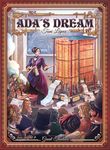
This video is brought to you by the three minute board game patrons. Keep us independent by supporting us on Patreon. Kira Koto and welcome to Ada's Dream in about three minutes. Review copy used. It has a solo mode. It's a game for one to four players. Playing time is long and it's a reasonably complex game. You are a boffin working alongside Ada Lovelace to help build the world's first supercomputer. Can you publish program punch cards and play your way to victory? The game ends shortly after any player's board is full of dice. The winner is the player with the most points and you get those from many places, but mostly it's how you place your punch cards, dice, and operations on your player board. Dice, you will draft dice and take actions with them. Card management, you'll have a hand of partner cards. Engine building, your dice and programs will build a big scoring engine for you. Player turn, the game board consists of five main areas, four of which match one of the dice colors, and a final one where you draft dice. Let's look at that workshop first.
On your turn, you may push one die optionally spending gold to increase its value and distance moved. That die will move onto a platform and displace a die of equal or lower value. Claim that die and the bonus shown on the board. Place a die on your player board and optionally play a partner card. Some require certain values to play, whereas this one costs one gold per die value. If you already have a die, you may instead place it on your board to take an action on the main board matching its color or any action with a gray die. Purple actions get you programming tiles which score you points as well as books, additional cogs, and assignments. Assignments slot under your player board and give you a boost when you draft that color die. Yellow actions are meetings and they let you collect new partners. There's also a set collection game here based on the meeting rooms and the partners you collect. Blue actions let you travel the board placing tokens and picking up university tiles which score points and give boosts. And green actions let you place your marker in this institution for points and bonuses.
After taking an action, you may spend a book to publish, taking the extra special action for each area. The workshop one is important because it caps your scoring on your player board. Instead of publishing, you may construct, building gears that go into your player board. And this is the game's key as punch cards will give scoring rules for the row or column they're placed in. And each row will score points based on the mathematical operations in it, capped by your steam limit, which is enforced for each row and column. Why would you like this game? My goodness, there's a lot happening in Ada's dream. But remarkably, the majority of the game can be summed up on this handy player reference guide. So for all the busyness of the board, it comes down to take a die or use a die. Alley Cat Games keep putting out exceptionally good-looking games, and Ada's dream is no exception. All the components feel great, and I especially love the punch cards. It's a nice way to take a thematic element from the game about early computing and make it into a real fun and tactile experience for the players. I really like how the advisor cards work as well, giving you rewards for taking lower value dice. And the workshop dice selection puzzle is nice as well. And while it has some of the most complex scoring of any game I've ever played, all those points feel earned, which is great. This is a game I recommend to people who like big, expansive, and complex modern Euro games. The best thing about this game is the player board. I love this part of the game and the puzzle it presents. However, as much as I like the central puzzle, I find the rest of the game quite over-engineered with so many different actions, tracks, set bonuses, and other things to keep track of. Each of them is good enough in their own right, but all together, the game just feels a little too sprawling.
For another complex modern Euro game with lots happening, try Teotihuacan. And for a simpler, more interactive dice drafting game, try Troyes. Ada's dream, punch cards, but not a knockout. And if you enjoyed this video, hit the notification button, like, share, and subscribe to the channel.