Kinfire Council review (review copy provided)
Games in This Video
1 game is featured in this video — it unlocks as you watch.
Transcript
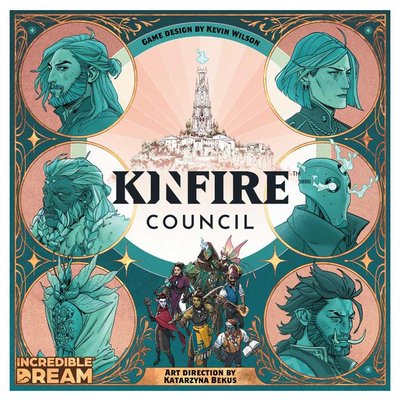
Hey everybody, this is Mike with the Onetop Co-op Shop and today I'm reviewing Kinfire Council. Both a competitive play in the base game as well as a solo and cooperative play in the expansion. A disclaimer that I got a review copy of this one. Kinfire Council is a worker placement game for two to five players or one to five if you get the solo co-op expansion. You going to different worker placement spots in this town. Some of them at higher tiers requiring taxes to even access them to earn a variety of resource types. And you can use those to earn victory points by improving the buildings in the town for everybody. fulfilling the needs of the city, combating threats posed by an evil cult, or building up lighouses to keep the entire land safe from darkness. So, let's discuss five key things to know about Kinfire Council. So, my number five point, the least important to know, but still important or I wouldn't have it on the list, are the decrees in the game. So, at the beginning of each round, you get these two decrees flipped up from this big deck. And they can have laws that'll have an ongoing effect for the rest of the game. They could be bonus cards that the person who votes for it the most gets to keep. Crises you have to avoid.
And in the Solo co-op expansion, they add these cult decrees that if you don't pass enough votes for your own chosen decree, trigger instead. And these can be pretty interesting in their varied effects. They give you something to worry about, especially in competitive play as you try to win the ones that will most benefit you. But in my experience, they aren't quite as exciting as I had hoped because often you'll get two cards that don't matter as much as they could, and you don't care as much which one wins. And while the cult decrees for solo co-op are interesting, it's usually pretty easy to defeat them, so you don't have to worry about them that much. My number four point is focused on the characters and counselors in the game. This is a full pro. So in each game you get to pick one of the leaders of the city and they each have gamebreaking effects that are incredibly powerful and quite varied. It'll really change up your entire strategy and tactical landscape. And then on top of that, your counselor gets paired with a different set of workers.
Now this doesn't change things as much cuz you just get a seeker with a single skill. But in a very cool touch, you can level up your other workers with skills as well, which make them much more powerful, especially for certain tasks. So you get a feeling of growth throughout the game and again the variety of strategy is really good. Although one caveat to that, there are some counselors that feel way better for the solo co-op mode. And similarly, there are some skills that are indispensable for solo co-op. So I think all this becomes a lot less interesting when playing in that mode. And speaking of solo co-op mode, the balance of that mode is my number three point. And this is unfortunately a full con for me. So the basic idea of solo co-op is the cult successes and your failures build up the cult's victory points. And every player by the end of the game has to beat the cult score for the players to win. And the main difficulty modifier for that is to give the cult more free victory points from these threat cards. So they just get a big bump at the end of the game. But in my experience, especially with certain counselors and especially at lower player counts, you just have way too many actions. So you can pretty easily deal with the threats that come out and the cult tokens that need to be arrested. You can often shut down the cult entirely. If you look at my solo co-op playthrough on the channel, you'll see this in action. Though a lot of that is very swingy because which threat cards come out can drastically change, especially if you get a lot of the ones that trigger immediately and make the game harder to win. Same thing with the cult decrees. Some of them are just way worse and way harder to deal with than others. So unfortunately, at least in my plays, this is one of those solo co-op modes where it feels a little underested. It feels a little too easy.
There are probably some house rules you can put in to make it more of a challenge, but I wish the player didn't have to do that. Now, that same cult is my focus. My number two point, and this is a mix for my taste. I generally like the core mechanics of how the cult messes with players, especially in competitive play. At the beginning of each round, you get three cult tokens, and they block some of the action spaces while also putting out and advancing those threat cards I mentioned. And these both offer dangers that'll affect the entire game for the players while also giving them major ways to score victory points. So again, in competitive play, this all works great. What I don't love as much, and this is partially a personal thing, is that in competitive three to five player play, players can side with the cult and give influence to the cult and then just try to sort of tank the game and let the cult get the most victory points instead of any of the players. But again, that might be a personal preference cuz I don't tend to like semi-ooperative mechanics in games.
But let's end with a very strong pro for number one, because I do really like this game, except maybe not so much a solo co-op mode. And here I'm talking about the worker placement. I think it is great whether it's solo co-op or competitive. I think figuring out which spaces you want to go to, how you want to chain together, getting that resource, then using another space to turn it into that resource to allow you to defeat big threat cards, build up the lighthouse, all these cool things. I think that core gameplay loop is excellent. And I love the taxes system where the more powerful spots cost more money. I love that you can upgrade locations for everyone, and with the expansion, you can even swap out locations to change their abilities. And if you have the right resources, you can take these little errand actions to fulfill the city needs to build the lighthouse. It's just a great resource and worker puzzle. Although, one design decision that's not going to work for everybody, I'm still not sure if it works for me, is that as the player count goes up, they take away your workers. So, with three players, you only have five. With four players, you only have four. With five players, you only have three. So, you're doing a lot less each round. There's only five rounds in the game. Now, on the positive side, that means the gameplay timer is tight at all player counts. It never stays welcome. But players might feel frustrated at those high player counts with such limited workers to go around.
And this is a pretty big part of that questionable balance in the solo co-op mode because things get so changed at different player counts. So overall, you might want to check out Kinfire Council if you like competitive worker placement games. I think this one has some fun spins on it. I think the art and components are great and the core gameplay is pretty tense and interesting. But on the other hand, I can't strongly recommend the solo co-op expansion and solo co-op mode unless you are willing to house rule it, especially with co-op. Solo is a little bit more challenging, but unless you're going to house roll it to take away some workers or something to make the game more of a challenge, I think they honestly botched the cooperative balance on this one, and I don't think it works very well without some tinkering on the player side. But if you want to see the game in action and judge for yourself, check out my playthrough from a few weeks ago. Thanks for watching everybody. Good gaming at LC with the next