The Hungry Gamer Reviews Nature with Climate
Games in This Video
1 game is featured in this video — it unlocks as you watch.
Transcript
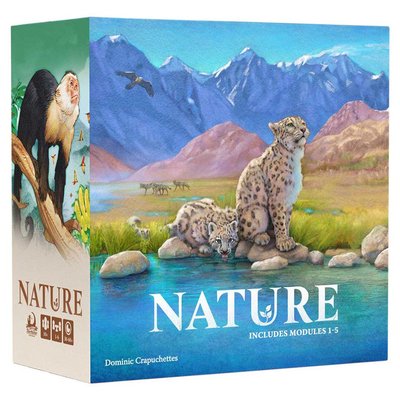
Ooh, that looks tasty. Welcome folks. Today the Hungry Gamer is back with another game review. And today we are talking about nature, and specifically nature with their newest module climate. And thank you to North Star Games for sending me this copy of nature with all of the modules so I can make this video. Now, what nature is is this is a game about creating different species and evolving them in order to survive. And survival will beget you points. It is a basically how it's going to go. Now, and to do that you are kind of sort of making a tableau. Each of your creatures will come out and they will be of a certain size based on this, and you will start giving them various traits that they are going to have. And by giving them traits, they will gain various abilities and powers and so on. But each round of the game, which is four or five rounds depending on how many modules you're playing with, you'll be adding new creatures.
And your new creatures will be gaining their own various traits. And perhaps you might decide you're going to make them a hunter, and then it'll have to eat meat. And then after and each round after players have played their cards, you will get to go foraging in the water hole and perhaps eat each other and so on. And you'll get points for every piece of food that you eat in the round, basically. Now, the climate is going to add this climate board, which is going to mix things up just a little bit. Now, with that being said, if you are not interested in how this game is played and want to jump to my final thoughts, then you want to go to the time stamp on the screen right now. For those of us still here, let's talk about how this game is played. And I'm just going to talk about it from the top and it will be as I said a little bit different than regular nature.
But even by just learning this, you will understand nature as well. So, first thing that's going to happen is you are going to be rolling some dice at the beginning of the round to see how the climate is going. And for that, you have these two dice. You'll roll this one here and this says it's going to send it hotter and you'll roll this one here and that tells you how many spaces. So, in this case it would go one, two. And then we see that there is a heat index, I guess you would call it, of two and there will be five food placed into the watering hole like so. Yum, yum. Then you'll move into the adapting phase. And just like a normal nature, every round you will get one new creature at a size and population of one. And And just like in the original game, if in a previous round you had a species go extinct, you would then add whatever their size was or any leftover population that as well would be added to your new creature.
Then you will get to draw your cards and in this particular variant, you'll notice you have this other deck of nature cards. These are the climate cards and these are going to help you adapt to the heat or the cold as you go through. So, you get to choose where you want to draw your cards from. But then you go on to time to play cards. And you can use cards in three ways. You can take a card and basically just discard that card to either add another population to your species or to increase its size. One of the other two things you can use cards for is you can give them adaptations. And in the core game, you can have three adaptations per species. In climate, you can actually now have four. So, perhaps I decide I'm going to play on this one, scavenging.
So, after any species does a hunt, I'll get two food from there. And then I'm also going to play clawed on it. So, when I eat, I'm going to actually wind up getting extra food. And then I'm going to go ahead and add from this new deck, seasonal migration. You'll see it has a plus two and plus two. And I'll talk about those in just a moment. And so I will go ahead and add that as well. And I have a bunch of other cards in my hand here for examples, but we'll just say I'm not going to play my last card. And we would go back and forth playing cards face down on our species. Then we would flip them all up and then we would hit the feeding phase. And then in the feeding phase, the way that's going to work, you choose one of your creatures and you'll be getting four or five throughout the game, and they're going to go feed. And they are able to eat as many food as is their size. So, in this case, this species could eat two food. So, I'd go, I'd eat one and two.
Then I would look over here, and I actually get two more because of my claws. And then I feed my creatures. And since those last two were actually overage, I would actually leave them there. The next player would get their chance to do any feeding here. Now, I mentioned that there is another use for your cards that you may keep in your hand. And let's just say that it came to my turn and there was no food left. So, now I'm at risk of starvation. What I can do is I can take a card from my hand and I can discard it. And if we look down the bottom, we'll see four. What that means is this card, when I discard this, it will get me four food back into the watering hole. The The thing that could happen is you can and you can always choose to make a creature a hunter. It counts as one of their traits, and you would wind up flipping your tile over like so, and we will just say, for the sake of argument, that we have a scavenging hunter that has two population and is a size four.
So, the way that works is when they're hungry, you have to hunt, and sometimes that means you will actually hunt your own creatures. And the way it works is you're going to look at the size of your creature, in this case four, and you need to be equal to or greater than the defense rating of the other creature. The defense rating is based on their size, in this case two, and then I look at all their stuff. Because they are clawed, I actually have plus one, so it is actually a three. So, in this case, it would attack there, and it would eat, and it would start killing various species like so, and I would be feed myself like that. Then, in the climate version of the game, after all and all the starving is done, because it is possible to have starvation if you don't feed enough, in which case you would simply lose a creature like so. Then, you have to suffer potential extinction due to the climate. In this case, you'll notice it is two right there. So, I want to look at all my adaptations and see, do I have at least two sun adaptation? In this case, my seasonal migration would give me the two defense that I need there, and but my hunter has a value of zero, so I would be losing two population.
However, there is some protection based off of the size of your creature. So, a size one creature actually has four sun protection. Well, my size four creature only has one sun protection. And you'll notice the inverse, smaller creatures are able to handle the heat better, while larger creatures are able to handle the cold better. Then, once that's done, we would draw five cards, and you get a choice of drawing from any of the decks that you would like. And then you would start over. You play through five rounds, and whoever has the most points is going to win. Now, as I mentioned points, as a reminder, at the end of the round you will take all of the food that you successfully fed to somebody and put it behind your player screen, and that will determine how many points you've earned for that round. And you additionally get more points for having species that are alive at the end of each round. Then beginning next round, you'll draw your cards, get a new creature, rinse and repeat. And I will just point out on the climate, this is going to change every round. So, the first round we may have gotten a little bit warmer.
The next round, we're actually getting colder and going back to the start. But, that's how this game works. So, with that said, what do I like about this game? The first thing is, and I have to highlight this is, this game is environmentally as sound as a board game can be. Everything is made with renewables, even the the centers of the little dials is made with some kind of acid, which makes it environmentally sound. Box is all biodegradable, all that stuff. And that's awesome. That is just awesome. I love that. If you don't care about that, don't come at me. I think it's fantastic. So, there's that.
Also, it's pretty. You know, it just it's just a nice-looking game, and it fits with this cuz nice pleasant feel. It's just an enjoyable thing to do, to play, to look at. I love the chunky dice. All that, super cool. Anyhow, moving into the gameplay itself, first thing I'm going to say is, the game is intentionally modular. And so, you have the core game, which I showed you a little bit of, and then I chose to highlight the climate module because that was the specific one that is the most challenging module as far as difficulty, and also when North Star sent this to me to cover, they did specifically say, "Hey, please cover the climate module." So, that's why I focused on that one. But, that said, there are another four or five modules, and it's really easy to toss in whatever you want.
You want to have creatures that fly? Put the flight module in. You want to deal with natural disasters? Put the natural disasters in. You want to deal with Amazon? Put the Amazon in. You want dinosaurs? Gosh darn it, you can have dinosaurs. So, I guess you can have flying dinosaurs that deal with natural disasters if you want. So, all of those things, it's really easy to put them in. Each of the modules, it's not a lot of stuff. Maybe it's another deck of cards that you have the choice to pull from. Maybe it's just one card that flips over. The climate happened to have that big board, but you get the idea. It's not hard to add these things in. They don't add a lot of complexity to the game, but they do add a lot of interesting options as you go through. And I haven't done it cuz I feel like it's crazy pants, but you can put them all in at once if you want. So, that's really cool. I like it plays a lot of players. I also have to say, the solo's pretty darn good.
It's relatively easy to operate, and you are playing against somebody else, or the bot as it were. And it's not the easiest one I've ever played to operate, but it's pretty simple to operate. It's a little kind of You flip a card out. It's going to go on this creature based on its little solo cards it has. Very, very simple. I like it. It's fun. Works well. It really is a great way to kind of try out these modules. That's been my favorite part is actually just playing the solo in each one, just kind of learn how these modules work. Really, really clever the way that works. Anyhow, next I'll say is the game itself is very simple to understand. There's just a few things that are going on. You're going to evolve, you're going to feed, maybe you're attacking the other player, or maybe you're attacking yourself if you done messed up, and then rinse and repeat. The climate adds a little bit more to it, and I'll talk about that in just a bit, but it's very easy to understand, which makes adding the new modules not daunting, just fun.
So, I like the way that works. I also really kind of enjoy making the species. It is something very fun about putting these critters together, like, "Hmm, I really think that this one has heavy plating, so it would be really silly if I made it fly." And or whatever it is. You get to kind of make these creatures that are you find interesting, and it can be fun and thematic to do it that way. Also, if you're just making them fun and thematic, they tend to die, which to me also feels very thematic, right? Cuz it's survival of the fittest, so not survival of the coolest. So, all of that I think comes together in a fun little package of theme and enjoyment. Next thing is I'm going to oversimplify this. It has a little bit of a kind of a paper rock scissors vibe to it. What I mean by that is you're definitely putting cards out that can counter other cards specifically. Oh, they got a hunter.
Well, I'm going to be fast. Or, oh, they got a hunter. Well, now I'm nocturnal. Or whatever it might be. And that's really kind of a fun dynamic. Again, it keeps the game simple, but there's that kind of trying to figure out what your opponent is thinking. What are they going to do? What are they going to lean into? And I think that's actually a lot of fun with this game. That also goes right into the kind of outthinking each other with the food. Who are you going to feed first? In general, you're going to feed the ones that are going to take the most plant life. Usually is what you start with, but but maybe not. Maybe there's something else going on. Maybe there's another reason why you're not going to do that. Maybe you have the certain evolutions that looks like, "Oh, I should do this one, but I'm going to do the smaller one." What cards you're going to hold back? All of that, again, like with that paper rock scissors thing I mentioned, is also a lot of fun as you're trying to outthink whoever it is that you're playing. Next thing I'll say is it's very fast game. You play in four rounds unless you've added certain modules and you play five rounds and even a five rounds is just not a long game. It is a quick game and I always always appreciate that. And then I'm just going to lean into the climate module.
I think it's great. I really love the way that it's doing a few things at once. One, you get this kind of raising and lowering of the temperature and there is a variant where you can kind of choose which direction things are going, but sometimes there's a long period of time where it's hotter. Sometimes there's a period of time when it's colder. Sometimes it's going to get colder colder colder and it's just going to do that each round, but to tie into it the danger to the creatures, which adds on to that survival of the fittest, right? It's going to be really really cold or really really hot. Well, that's going to mean that bigger creatures are going to survive. Whereas the smaller creatures are going to go away or vice versa. That's amazing. I love that that is in the game. It's very simple, but it really works well and then obviously you have all the new traits that you're going to get and all the new powers that they're going to be able to give and along with that it's going to make you more or less resistant to different climate changes.
It's just really really good. Other than introducing the game to somebody for the first time, I don't think I ever want to play without the climate in the game. I just think that's just great and it's just thematically complexity, all those things, I think it just really really nails it. So, with that said, what are my quibbles with the game? First thing is there's a lot of box that comes with all this. Now, as I said, they were kind enough to send me the whole collection, the whole shebang and take a look at what Meeple just the Board Game got. That's a lot of stuff. However, all of that condenses down into two boxes and I got space for more. So, I was able to condense it all down into two boxes, made some little dividers myself for the different cards, and I could probably get the next two or three sets in there.
So, it's a lot of box for not a ton of stuff in the box. I think there's a ton of gameplay in the box, but there's not a ton of stuff. So, all that condensed down to just two boxes. Next thing I'll say is the arc is going to be the same every time you play in that. I say this a lot in reviews in my quibbles. It doesn't bother me, but I know how important the idea of discovery and those things are. And and I know there are gamers that just want the experience to just feel wildly different every time. This is not that game. And this is the same game every time with different flavors as you're playing through. And so, if that bothers you, this isn't going to be the game for you. But, that said, there's a lot of flavors. And talking about a lot of flavors, I don't think you're going to be satisfied with just the core box with this. This is one of those games that obviously need the core.
In my opinion, get climate, without a doubt. Then, I feel like you need one more at least. And so, that's kind of you know, choose what you're interested in. Are you interested in flight? Are you interested in Amazon? Are you interested in dinosaurs? Or what's the other one that you're interested in? But, you probably are going to want one more to have that variety of traits in there. And then, suddenly you have a lot of options that you're going to have. But, that does mean game plus two expansions. So, that makes it a little bit more expensive than maybe you're looking just to throw down at once. But, there you have it, folks. That is Nature, specifically highlighting the climate expansion. I enjoy this game. This is an evolution, haha, of evolution, and I think it's for the better. It plays very similar to what Evolution did. It's just the way the modules work that really make this significantly more interesting, I think.
I will also I would also be remiss if I didn't point out that this is a try before you buy. Now, you can't try the climate yet, I don't think, but you can play nature on your phone or your tablet, and I could be wrong, but I believe it is free for just the core game. I'm not sure if that's right, but I think so. And I spent a lot of time before it even got to me just playing it on my phone, reminding myself how the game works. So, I love that that's an option, and if you're curious, I definitely recommend that you do that. This is a really pleasant game for solo or not. Yeah, I I I I can't really complain about it because I just enjoy it. And I enjoy it more than I think I'm going to every single time that I play. So, there you have it, folks. As always, if I made any mistakes in the rules overview, please let me know in the comments with the timestamps on get that in the clean up subtitles. If you found this video useful, please like, subscribe, share, and maybe become a channel member. As always, thank you so much for watching.
Have a wonderful, wonderful day.