How to Design a NATURE themed Board Game
Games in This Video
1 game is featured in this video — it unlocks as you watch.
Transcript
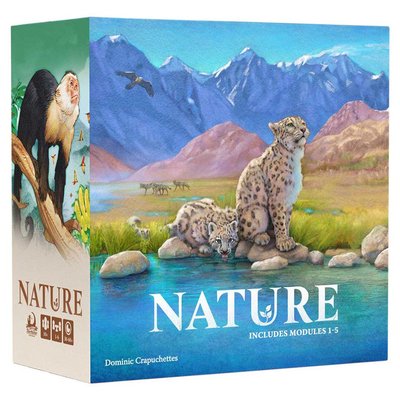
Finsspan is a beautiful engine building game packed with hundreds of cards depicting the rich diversity of species found in our rivers and oceans. It's the oceanic sibling to the mega hit Wingspan from Stonemire Games. Back on land, or rather into the treetops, Primates by Green Butterfly Games is a roll and move game with a strong educational bent. Players move through the branches of the evolutionary tree, collecting different primates along the way. Meanwhile, nature from Northstar Games uses hand management and tactical cardplay to simulate natural selection as players guide constantly adapting animal species. Its modular design, featuring different biomes and time periods, lets players customize the experience to suit their preferences. These three titles are just a sample of the ever growing wave of nature themed board games on the market. I received review copies of each for the purpose of making this video.
So, thank you to Stonemire Games, Green Butterfly Games, and Northstar Games. Nature themed games are everywhere right now. Since Wingspan burst onto the scene in 2019, selling millions of copies and becoming one of the hobbies most recognizable titles, designers and publishers around the world have been eager to recapture its magic. What Wingspan showed us is that board games don't need swords and sorcery or sprawling economic systems to attract players. Sometimes spending an hour arranging beautifully illustrated cards of birds, fish, or trees is more than enough. Wingspan wasn't the first game to explore the natural world, but it proved that nature wasn't a niche. It was a thriving genre waiting to be discovered. So, in this video, I want to explore what makes a great nature themed board game and what elements you might want to consider if you're designing one yourself.
I'm Adam Porter. I'm a board game designer from Wales, and this episode is a bit of a departure from the rest of my how to design series. While previous videos focus on mechanisms, this one dives into one of my favorite themes, the natural world. Together, we'll unpack what makes this setting so rich for game design with a focus on mechanisms, components, common tropes, and other recurring elements. Think of this video as a toolbox. It's a distillation of what's come before, lessons learned, patterns observed, and possibilities still waiting to be explored. You can adopt these patterns, subvert them, or combine them in new ways. Ask yourself what mechanism best suits your chosen theme. So, as a starting point, let's look at four common design pillars found in many nature themed games. Beauty, simulation, education, and fantasy. Choose one or two of these and keep them in your mind throughout your design process. They can serve as guideposts, helping you to stay grounded when your design hits a bump or starts drifting from its original vision. So, number one, beauty. If your goal is to create a visually stunning board game, a piece of playable art, a nature theme is an excellent place to start. While visuals are important in all games, in nature themed games, they really are make or break. These games sell themselves through table presents.
Think Wingspan with its soft pastel playerboards, delicate bird eggs, and stunning handdrawn illustrations. Or consider Plums, a small card game with beautiful illustrations of a wide variety of different fruits. Or Arboritum, which presents a botanical rainbow of different tree species. These games are designed to attract players who aren't necessarily drawn to trains or warfare or trading in the Mediterranean. Instead, they offer a quiet invitation into the natural world. While high-end illustration is often expected, it's not the only path. Ark Nova, one of the most successful recent nature games, uses stock photography, proof that compelling content and a clean layout is sometimes enough. Nature games should get more beautiful as they unfold. So, in Forest Shuffle, you tuck animal cards around trees to create little vignettes of an evolving ecosystem. In photosynthesis, players literally build a forest, planting 3D trees that grow and cast shadows across the board. These games don't just start pretty, they become more beautiful as you play. I was frustrated by rustling leaves, a really enjoyable role and write, which starts with attractive player sheets that unfortunately become increasingly cluttered and chaotic as the game progresses, undermining the calm aesthetic. If you're designing a game rooted in beauty, you can often get away with more abstract gameplay. Or think of it the other way round. If your mechanisms are fairly abstract, a nature theme with beautiful artwork can elevate
the whole experience. Plums has very little to do with fruit cultivation. Cascadia is at heart an abstract tile laying puzzle, but the nature theme makes it come alive. While we're discussing the physical presentation of these games, it's also worth noting that many titles in this genre have moved towards ecologically friendly components. Forest Shuffle, for example, is delivered without shrink wrap and the cards themselves are contained within paper envelopes. If your game is based around ecology and especially if it has environmental themes, it might be something of a disconnect or even a disappointment if the game contains a lot of plastic components. Number two, simulation. While games in the beauty category often lean towards abstraction, simulationdriven titles aim to model reality. While far from an ugly game, Dominant Species Marine is far more focused on simulation than beauty with cubes representing different species competing for dominance in a variety of different habitats across the globe.
Species live or die based on the resource tokens available to them at each habitat and the actions of the other players moving their own species into the territory upsetting the fine balance of the ecosystem. Dominant species marine and its predecessor dominant species model a wide variety of natural phenomena adaptation regression speciation migration and competition. Evolution from Northstar Games is a game which models natural selection among animal species. Its follow-up, Oceans, dives into underwater adaptation. And now, Nature, their upcoming modular game, builds on these systems to create an ever evolving toolkit of scenarios and ecosystems. At the time of filming, Nature is due for release within the next few months. So, what I'm showing you here is a pre-production copy, and some of the final components will be different. Notably, the wooden stacks of tiles representing body size will be replaced with cardboard dials, but the core of the game is intact in this version. The game nature is designed to be a system which can itself evolve just like the animals featured in the game.
Players strive to feed their species with growing population competing over plant food from the central watering hole. Each round, you apply new traits to your species to enable them to access more food more quickly or from different sources than their competitors. But some species will inevitably turn carnivore and forego the limited supply of plants at the center of the table, instead taking chunks out of their opponents. So you might want to build some defenses into your animals, horns, speed, armored plates, and tusks to make your species harder to attack. Nature is a modular system. My set includes five modules, rainforest, jurassic, flight, arctic tundra, and natural disasters. And you can use any two modules in any given game, providing a wide variety of different combinations and experiences with many more modules planned for coming months and years. Number three, education. If your goal is to educate your players about your chosen theme, simulation, as in dominant species or nature, is one way to do it. But it does come at a cost. The natural world is complex and so are these games. Dominant species has a lot of rules to learn up front which will be a barrier to a lot of players and it takes a long time to play. Nature, evolution, and oceans have far fewer rules to learn up front, but the depth of these games is vast. There is significant emergent complexity here.
If you want to play competitively, it takes a lot of strategic thought. If you want to educate your players without overwhelming them, then facts can go a long way. Fauna is a trivia game all about animals, featuring 360 of them in the oversized deck of cards. And when an animal card is revealed at the start of each round, all players take turns making guesses as to its length, weight, tail size, and where in the world the animal is native. The twist in the game is that you don't need to be correct in order to score points. If you're close, that's good enough, and you can learn from your opponent's answers and let them guide your own. Finsspan includes 135 fish cards, each with a fun fact. These facts have no gameplay effect. They're just there for flavor and learning. Same with Wingspan's 170 bird cards. The trivia adds value and encourages curiosity.
Primates goes further and seems to prioritize education. Primates isn't a straightup simulation. Evolution is represented as a tree of life and players move their primate tokens up the branches of the tree as their species adapt and develop towards some of the recognizable species we know today. But at other times, the game treats the evolutionary tree as a literal tree with certain primates having specific abilities which allow them to jump from branch to branch. Each card in the game has been thoughtfully considered to teach us a little more about primates, their abilities, their unique anatomies, their relationships to each other, the plants and insects that they eat, extinct species, and even their complicated relationships with a modern world occupied by humans. On your turn, you either roll three dice, moving each of your three primate tokens according to one of the dice rolled, or roll two dice and move a single token according to the total of the two dice, or rest and take a bonus card. While moving along the various paths, you can gather food, which is distributed in a way which corresponds to the actual diets of primates in their natural habitat. For example, tacia diets consist of meat and insects. So, the tacia spaces are populated with only brown food tokens representing such a diet. Food can be spent to use special abilities or to purchase extinct primate cards. When you reach the top of a path, you take the relevant primate card and any associated ability cards. When the deck is exhausted, players total their points
from the various cards they've gathered, any food in their supply, and the health and welfare of their primates, and the highest scorer wins. Number four, fantasy. So, we've discussed games focusing on beauty. We've talked about simulations of the natural world and educational games. And the fourth pillar I mentioned earlier was fantasy. There are many games available which utilize the natural world as a backdrop for a fantastical story. either incorporating an element of magic with fairies hopping from mushroom to mushroom or enchanted animals fighting forest fires in a living forest or imagining a world of anthropomorphic woodland creatures coexisting in their own little civilizations closely mirroring the human world. Not all nature games strive for realism. Some build entirely new worlds, magical forests, talking animals, fairy tales come to life. Cozy is a term widely used to describe a broad range of video games which feature nonviolent themes. Unlike other video game genres like first-person shooters or turn-based strategy, cozy doesn't describe a mechanism, but instead reflects a feeling that you get while playing. Wholesome, warm, friendly, stressfree. Now, I was torn on whether to include fantasy games in this video because maybe woodland civilizations stray too far from reality to be considered part of the same genre as a game featuring realistic depictions of natural habitats. But Finsspan, Wingspan, and their peers do feel like they belong in the same category as
Everel and Honeybuzz purely because they're cozy, at least through my eyes, and I think they appeal to a lot of the same consumers. Regardless, I think it's worth considering what makes a good cozy game because this could stand you in goodstead when designing a nature themed board game. So, let's turn once again to video games like Animal Crossing, Stardew Valley, or My Time at Porsche. Cozy games are low on stress. They prioritize cooperation. There are many characters to meet, but socialization is uncomplicated. Non-player characters are generally warm, kind, and pleased to meet you. Cozy games do not feature violence or destruction. They tend to focus on crafting and building and provide the players with a wealth of options for personalization and creativity. Often you can choose how to play, ignoring entire strategies and plot lines to carve your own path through the game. Nurturing generosity and self-expression are core to a cozy experience. Players are never forced to do anything under time pressure. Indeed, such games are often never ending. Now, some of that may seem difficult to achieve in a board game. I found the time pressure to complete objectives in Stardew Valley, the board game, a little jarring after the totally open-ended experience of playing the video game.
But broad concepts or vibes like nurturing, generosity, and self-expression might be good reference points for developing a satisfying, cozy board game. Now, of course, not all fantasy games are gentle. Root is a war game with adorable animal factions. More red wall than Wind in the Willows. The contrast between cute visuals and sharp gameplay creates a unique tension that's hugely appealing to many players. So, with our four pillars, beauty, simulation, education, and fantasy established, we probably need to start thinking about mechanisms. What sort of rule set works well for a nature themed game? But before we explore that question, I've got a short message I'd like to share with you. Over the last decade, I've been passionate about sharing my experiences in the world of game design with other designers out there. I've produced hundreds of videos on this channel, focusing on all aspects of design, many of which you've probably seen. But more recently, I've also been collecting that learning into a series of books. To date, I've written four of them, and I hope they'll be of use to you. The board game designer journal helps you to develop as a designer. Play testing covers the sort of questions you might want to ask when testing your game. Getting published explains the process of approaching publishers and getting your game on the market. And product design explores what makes a strong commercial product. All are available on Amazon worldwide. Just search for Adam and Wales board game
design or follow the links in the description below. Now, back to the video. Number five, set collection. Animals and plants come in so many varieties. so much diversity that set collection is a natural fit for the genre. In plums, you can combine cards into different fruit mixes, either mixing different varieties of fruit or multiple copies of the same variety. In Arboritum, the goal is to create long paths of tree cards with increasing values. But importantly, a path must start and end with the same color. There are bonus points if every tree in the path is matching and additional points if the path begins with a one or ends with an eight. However, only some players get to score. For each color, it's only the player with the highest total value in that color held in their hands that scores a path. In Cascadia, players place habitat tiles in a growing display and position wildlife tokens on the habitat tiles if they have a matching symbol. At the end of the game, players score points for large connected areas of matching habitats and for sets and patterns of wildlife tokens as indicated on scoring cards chosen at the start of the game. You might score for pairs of bears or chains of salmon or specific patterns of elk. There are 21 such cards and only five used in each game. So, the variety of different combinations is huge. Number six, drafting. Many set collection games feature clever drafting systems.
Drafting being the word we use to describe each player selecting a card or resource in turn from a shared pool. In plums, players each play a card in turn order, and the player who played the highest number then selects one of the played cards to add to their sets. The player with the second highest number selects next, and so on until everyone has selected a card. In Cascadia, players take turns to select habitat tiles and wildlife tokens from a central display, but the two different types of component are paired, so you must take both. Now, of course, you're looking for the perfect combination which will help you out with growing your highest scoring habitats while also helping you to complete sets of animals. In Savanac Forest, players each form a grid of cards trying to create paths which connect woodland creatures to their preferred food. On your turn, you simply select one of the cards from the table, but you also gain a bonus depending on the card's location in the display. If the card is taken from the first slot, you'll be starting player next round. If it comes from the second slot, you take a water token, which increases the points value of one food source for one of your animals. If it comes from the third slot, you'll also gain a lair token, which increases the storage capacity of one of your other cards. And the cards in the fourth slot are all animals to add to your display. The game ends when everyone completes their 4x4 grid. Then each animal scores points for the various foods in the same path. The highest scorer wins. In the two-player game Fungi, a display of mushrooms is placed between the players. The mushrooms at one end sit next to a shoe,
and these cards can be selected from for free. To take cards further along the row, you must spend sticks. And how do you get sticks? By combining sets of matching mushrooms and selling them. The goal of the game is to cook sets of mushrooms. Sometimes adding butter and cider to score additional points. Taking baskets increases your hand size, and taking moon cards allows you to draw a random card from the night deck, and these count as two mushrooms, but only take up one space in your hand. Meadow has a particularly engaging drafting system. A central board holds 16 cards, and on your turn, you place a token into one of the slots around the grid. The number on your token tells you which card you then take, and this card can be added to your own personal display. But once a slot has been taken, no other player can use that slot until the next round. Alternatively, you can place one of your tokens around a separate campfire board and instead use the special action indicated on the token, allowing you to take a card of your choice from the central grid or take cards from the deck or play additional cards into your display. Number seven, tableau building.
So, if the goal of your nature game is to highlight the beauty of the natural world, you're going to want to get components on the table and fast. Nature themed games are at their best when cards aren't held in hand or hidden in decks, but displayed openly on the table, as in meadow and arboritum. Tableau building is probably the most utilized mechanism in nature themed games right now, precisely because it lays out the stunning card art for all to see. So, I should briefly describe what I mean by tableau building. I previously made a whole video about this genre of games, but here's a quick recap. Traditionally, a tableau is a static visual scene, like a dramatic pose in the theater or a diarama of miniatures. In gaming, the term has been adapted to describe the array of cards, tiles, or tokens that each player builds up in front of them. The term Tableau builder usually refers to games where that array of components becomes a dynamic evolving engine of in-game effects. Unlike the static display of trees in Arboritum, a tableau builder like Windspan features cards that do something, generate resources, trigger actions, or interact with each other in a variety of ways. Tableau builders vary widely in how and when the components activate. So, some feature ongoing effects or immediate abilities when played. Others require you to pay to activate effects or award spatial adjacency. For the purposes of this video, the precise definition of a
tableau game isn't important. The key thing is getting the cards on the table so that all players can appreciate their artistry. In Meadow, you start the game with a single ground card in your tableau. Ground cards indicate a type of habitat. grass, sand, rocks, and another symbol which can then be used to chain cards. So, for example, if your ground card shows a beetle, you can then place any card on top of it which requires a beetle. And this new card will present a new symbol on it, which you can then place another card on top of that. And once you've collected all required symbols, you can place landscape cards into your tableau. And if you have the correct landscape cards, you can place observed items on top of them. So, as the game progresses, it tells a story of an evolving ecosystem with each new species taking up residence, providing an opportunity for additional animals and plants to thrive. In Finsspan, the board represents three different depths of the ocean, the sunlight, twilight, and midnight zones. When you place a fish into your tableau, they can only go into one of the zones indicated on their card. Each fish has additional requirements which must also be fulfilled. So, for example, they might require you to discard cards from your supply or discard egg tokens or young fish tokens or schools of fish. They might even require you to consume another fish by covering it so long as the new fish is larger than the one you're consuming. Many fish cards offer up immediate benefits when they're
played. So, for example, allowing you to draw new cards from the deck or from the discard pile or place new egg or young fish tokens or take another turn. As an alternative to placing a fish, you may dive down one of the columns of your tableau. And when you do this, you resolve each card with a when activated bonus in that column and each benefit printed on the board, starting from the top of the column and descending towards the bottom. At the end of each round, players score points for achieving certain objectives, which change for each new round. So, for example, you might score points for each full row on your board or score points for each predator in your tableau. Some fish also have endgame scoring effects printed on the cards. And at the end of the game, players score for points printed on their fish cards, their eggs, their young fish, schools of fish, and consumed fish. Now, Finsspan has several elements which fit really neatly into our cozy categorization. Notably, anytime there's an interaction with other players is positive. Players often resolve abilities on their own fish, which provide benefits to all players.
If there's a tie for majorities when resolving scoring criteria, well, all tied players get the benefit. And the benefits offered by the fish are generally made as generous as possible, too. So, if a card offers up egg tokens and allows you to convert egg tokens into young, you can do this in whatever order is most beneficial to you. The game makes every effort to get out of the way of the players and not to present any hurdles, making the game more accessible even than the original Wingspan game. So, we're back to that word cozy again. But, as I indicated earlier, nature isn't always cute and fluffy. Sometimes it's mean. Compare the two box covers to dominant species marine and meadow. Sometimes nature is red in tooth and claw. and Dominant Species Marine and its predecessor, Dominant Species, revel in that. Area control. Area control describes board games where players compete to dominate specific regions or spaces on the game board in order to earn points or gain advantages. Risk is a notable example.
Players place pieces onto different areas of the board, and at set times, either during the game or at the end, control of an area is determined by who has the strongest presence in that region. The player with control typically scores points, gains resources, or receives other in-game rewards. Sometimes second or third place can also score, usually gaining a lesser bonus. Despite its origin in games themed around war and conquest, area control feels like a very natural fit for the natural world, where animals and plants also compete for resources and seek out the most beneficial territories, which they defend fiercely. Dominant Species is full of tension. Players fight for the same spaces with frequent shifting of control. The game requires you to decide when and where to commit your resources and adapt to displacement or destruction following combat with your opponents. In dominant species, there are two different forms of control. Having the most species on a tile will score you points, but a tile can sometimes be dominated even with fewer species on the tile if those species are particularly well adapted to survive in that environment. Waggle Dance is a worker placement game where your workers are bees and each of them is represented by a six-sided die.
Action spaces have exactly one space for each dice result. So players can only place their dice there if the corresponding space is still empty, leading to lots of competition for the various actions. Flowers, on the other hand, can hold any number of dice, but the dice faces must show the number corresponding to that shown on the flower. And utilizing an area control mechanism, dice placed onto flower spaces are resolved at the end of each round with the player with the most dice receiving two nectar and the player with the second highest number receiving one nectar. Take a look at the box cover to reach a game where players are tasked with reintroducing plants and animals into a polluted valley. The box cover suggests a calm, serene experience. But in reality, this is an area control game with all the tension and competition that brings. Reature is far more abstracted than dominant species. Here we're placing dominoes with images of animals in order to surround each of the area spaces illustrated on the board.
And when you place a domino, you can also place a wooden plant token into the adjacent area. And ultimately, these will be scored based on who has the strongest collections of plants in each area. Now, while I've focused on four examples of game systems, set collection, drafting, tableau building, and area control, we've actually covered quite a wide variety of different mechanisms here. The nature games we've discussed so far include hand management games, roll and rights, tile laying, worker placement, roll and move, action programming, and trivia. The truth is a nature theme could probably work in any mechanism. Perhaps the real trick is to look for a mechanism which hasn't been utilized much and build a nature game around that. Where are the nature themed deck builders, the realtime games or negotiation games? Kelp: Shark Versus Octopus was a huge hit recently precisely because it applied the nature theme effectively to an underutilized mechanism of hidden movement. Number nine, animal and plant characteristics.
The natural world is complex and a board game is always going to be a gross simplification with many compromises and abstractions. But the wildly diverse characteristics of different species can offer up inspiration for special abilities or opportunities for asymmetric play. So for example, in dominant species, each player represents a different class of animal, mammals, reptiles, birds, amphibians, arachnids, or insects. And each can break the rules of the game in one particular way in keeping with what we know about that animal type. So, insects get to place additional species on the board each round to keep their numbers high. Bird species can traverse two tiles in a single move, while all other species can only move one. Arachnids are quick to act when it comes to eliminating other species from tiles. In Wingspan, predatory birds can tuck other bird cards beneath them to score endame points. Whenever another player lays eggs, the cuckoo can lay eggs on a different card to its own. One of the cards in Primeates tells us that red shranked ds are known for sharing food with each other. So when you have the relevant card, you give a food token to another player each time you take the rest action. Another card tells us that a Japanese macak in the 1950s took a sweet potato to the water in order to wash it. And the behavior was picked up by other monkeys and passed from generation to generation. So if you have the culture card, you can copy the power of an ability on another player's mat.
In forest shuffle, the brown bear allows you to take cards from the clearing and then place them in your cave for scoring. The lynx only scores points if you also have some road deer, presumably to feed it with. The little nods to the behaviors of real creatures helps players to immerse themselves in the theme, even when the mechanisms and competition with other players might be at the forefront of their mind. But they also give direction to the designer. If you're looking for a variety of special abilities or scoring options for your cards, researching the traits of real creatures might offer up some inspiration. So, number 10, who are we? Player avatars. A consideration which I think is often overlooked in nature themed games is the player identity. Who do we represent in the game? And what is our goal? So, in kelp, shark versus octopus, it's pretty clear what the players represent. You're either the shark hunting the octopus or the octopus evading the shark. In many other games, it's not so clear. Forest Shuffle makes no attempt at a narrative.
We are an abstract force shaping an ecosystem. Does that make us ecologists, observers, forest spirits, or gods? Meadow makes it a little clearer. We are wanderers taking in the sights. In Fungi, we are cooks gathering mushrooms to fry up with butter and cider. Now, to my eye, this has always been one of the weaker points of wingspan. The rule book tells us that we are all mythologists collecting birds for our aviary. Now, that's a pretty odd narrative for a game with such a diverse variety of birds from across the globe and not really in keeping with the gameplay, which seems to focus on birds coexisting in their natural habitats. Finsspan makes a little more sense. Something about those diver tokens descending through the three depths of the ocean, observing fish as they go, feels satisfyingly thematic. Nature is a brilliant recreation of natural selection with one huge caveat. Natural selection is by definition unguided. By introducing human players to make their decisions about how our species adapt, the designers have actually modeled something akin to intelligent design.
The same applies in the game Primates. I'm not sure what the players represent here. The selfish gene, the concept of evolution. It's a little fuzzy. If you intend to design a nature game, I think this is worth consideration. As successful as the examples I've given have been, player engagement is often enhanced when players are able to identify with an in-game identity or avatar. So, if you're a game designer, I hope this video has given you some inspiration for areas to explore in your own design. Let's summarize with a few questions to consider. What is the primary purpose of your game? Is it to educate about ecosystems? Is it to simulate nature? Is your goal to represent the beauty of the natural world, or is it to use nature as a backdrop for your own fantasy setting? Table presence is important in a nature themed game. How can you make your game stand out? Are your components eye-catching? Are they environmentally friendly in their construction? A nature themed game should get more beautiful as you play. How can you get cards and components out of decks, out of players hands, and onto the table so everyone can appreciate them? Are you aiming for a cozy experience? And if so, how can you make your game more generous, less stressful? How can you enhance emotional resonance with the game? Are you aiming for a stressful, cutthroat experience?
Which mechanisms would make the game feel strategic and tight and tense? Set collecting, drafting, tableau building, and area control are all popular mechanisms in this genre. Could you utilize one of these mechanisms in an innovative new way, or do you want to buck the trend and go for something a little more unusual? What aspect of nature are you going to focus on? Plants, fungi, animals? Which type? We have games about birds, fish, apes, butterflies, bees, ants. Is there an underrepresented class of animals which deserves its own game? What inspiration can you take from the characteristics of your chosen species? How can their behaviors inform any in-game actions and abilities? And finally, who do we, the players, represent in your game? Are we the animals or the plants themselves? or are we growing the plants or caring for the animals? Are we developing an ecosystem or are we observing it? And how does this change the game play? So, that concludes my deep dive into the world of nature games. If you enjoyed it, please watch one of my other how to design videos by following the link.