Kinfire Council is the best game of 2025 (so far) - TCbH Review
Games in This Video
1 game is featured in this video — it unlocks as you watch.
Transcript
In auspicious timing, Kinfire Council, the third title in the Titular series, is releasing in close proximity to Builders of Balders's Gate, a game that is frequently compared to and often inquired upon as a spiritual successor to the beloved classic Lords of Water Deep. Now, typically, I refrain from direct game shoutouts and title gymnastics and comparisons in videos. In fact, if you want a more in-depth analysis of either of those games, then you're welcome to go check out reviews that we have on this channel for you, including a review of Builders of Balders's Gate that Eric did last week. So, I'm not going to do a comparison really, but the discussion was in the air. And the reason why I bring all this up is that from the time that I opened this game to each successive play that I've had since, I couldn't help but feel that it's a deliberate successor, an expansion upon the concepts that make Water Deep so great. The city is in peril. And while there are general fantasy shenanigans largely of the doomsday cult and encroaching darkness variety, you are not the hero vanquishing the beast and bringing a new dawn. Nope, you're an administrator. And together with your team of workers, which yes, does include one of the iconic warriors from the Kinfire series, you're going to run the best dang local government you can, which is also very
hard to do. Over five rounds, players take turns placing workers. accumulating resources from food and stone to magical resources and captured cultists. Then after placement actions, you complete errands ranging from constructing one of the five lighouses that keep the oppressive darkness outside the city at bay and fulfill the city's material needs. Both of which get you points the more you contribute to, but just as important stalls out the cult, which is a very real presence in this game. At the start of every round, cultists are drawn and placed throughout the city, setting up and adding to vile plot cards that if left unattended, result in some pretty bad stuff for everyone. And like a bad day getting worse, unattended cultists generally cause a snowballing problem as they take up valuable worker placement slots until arrested by placing a worker in adjacent locations, though normally forgoing the benefits of the location in favor of said arrest. At the end of five rounds, if the cult has accumulated the most points between some secret points set aside at the beginning of the game and there are various minations, all players lose. Though, in a three or more player game, a player can ally themsself with the cult and still manage to win if the cult wins.
Though, that's generally just a backdoor to produce some extra pressure and viable strategies to pivot to if needed. Otherwise, through public works, administration, tower construction, vanquishing of ill deeds, and of good old resource conversion, the player with the most points at the end of the game's five rounds wins. Okay. Okay. Okay. I I needed to talk about this game and there's so much that I want to say, but I think a great place to start is just that my first play of this was one of the best first impressions of a meteor worker placement game that I've had in a long time and subsequent plays have held up, which is awesome. As someone who covers a lot of games, it just feels great to have a game come along in a genre that you love, but maybe that genre feels like it's been pretty thoroughly explored and that game just gives you unbridled joy. It's just nice.
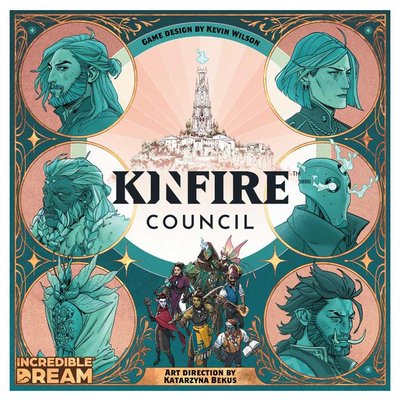
Starts popping all the mind bubbles that makes you love games in the first place. And yeah, relief is an appropriate word here because when I first got this game, I didn't know what to expect. And then I cracked it open, set it up on the table, and I was really loving what I was seeing, except for the three tiered board that makes up the tiers of the city, and they're not aligned all perfectly. But if you're going for a progressively smaller and smaller set of tiers, why isn't tier three on a slightly smaller board than tier 2? It's just why? But anyway, aside from that, I loved how it looked. It just has this great austere presentation and uh economic promise of depths to plum. But when I got to reading the rule book, I started seeing things like voting, and I was like, uh-oh. And then I saw that there was a semi-ooperative element and I started going, "Oh no, is this one of those games that's folding in social elements into an otherwise strategic game? It's just going to become a squishy mess." Don't get me wrong, I generally consider games to be a social thing, even strategy games. But too often it takes what's otherwise a nice crisp, clear game and devolves it into that squishy sadness. And you know what?
I shouldn't have been worried. Not because those social elements are so gracefully implemented and presented here in contrast to games that I didn't like in the past. No, it's because those elements, the cult, the voting, the semi-ooperative nature are actually just levers of cold, hard economical mechanics. Two cards are put on display at the beginning of the round and players through worker placement can add votes to them with the law most voted on with ties decided by the rotating lead player passing. These can have directly beneficial effects for the voters or just global effects that change rules of the game. Like a concept in the game is paying a tax to use worker placement spots higher up in the city which goes to city coffers. Well, why not pass a vote for the card that makes it so the taxed money can be used in place of personal finances to upgrade the buildings throughout the city and reward the landlords for their ownership. Now, the cult is similar. It represents the general opposition that the players are going to face, the gumming up the works that are going to be real bad if left unattended. and you can arrest them and intervene with their plots and that's going to be all well and good and get you some points. But those cult tokens that you arrest and the plot cards which you vanquish and get points from doing
so actually become expendable resources, bounties that can then be traded for other resources or used as intelligence to complete some other plots that the cultists have propped up. Even aligning yourself with the cult requires direct observable action. This isn't a game of hidden traitors. It's not like you're some shadow puppet master. It's more like you're an indulgent aristocrat who can take actions that directly contribute to their means and ends. And everyone at the table is going to see you doing that. And they may also compete with you to contribute even more to the cult if they want to. These are all highly contentious and very impactful parts of the game that are so smartly integrated, but I need to roll it back a little bit because I'm drifting kind of far from my thesis. I really think that there's a through line from Water Deep to here that bears examination and goes beyond just simply being a worker placement game of governmental administration in their respective fantasy worlds.
A key part of Water Deep, which helps it retain its all-time classic status, is the simple infrastructure paired with the developing landscape as players take ownership of constructed buildings that benefit owners and other players alike. While Council doesn't have a river of new buildings just begging to be constructed within its beautifully slotted boards, every existing location can be upgraded for points and allow you to become its patron, receiving patron rewards when other players go to that slot. Except unlike the older game, upgrading can be done as many times per round as workers and resources and time are available. Because key to the whole thing is that you can and will be pulled in many directions at once. Additionally, Water Deep smartly paired placement actions with quest completion.
No more than one quest optionally completed after fulfilling a placement action. This meant that tempo and the sheer number of objectives you aim to complete had to be measured and council is the same. Though there are no personal quests, every placement is followed by an optional errand, which is generally fulfilling some city need. And speaking of need, the sense of populace is here, too. Water Deep felt alive, lived in, even if you aren't knowledgeable about the Forgotten Realm setting through intrigue cards, building names, and the quests you beset adventurers on. The fantasy metropolis came to life. And Kimfire Council asks, "What if the fantasy nature was part of the game's pressure that players contend against that lighthouse you're constructing? That's not just points.
That's a beacon of safety in this bastion against encroaching darkness, though distilled into a suitably believably bureaucratic setting and a bunch of public works. In general, independent of its relationship or comparison to any prior game, this is just a really great worker placement game with some really novel concepts from having your workers each have individual artwork, which is cool for flavor. Yeah. But more importantly, that means they have a unique spot on your tableau. And that specific worker can be upgraded with one of six jobs that modifies their ability to place in certain ways, generally giving you some sort of benefit or ability to circumvent the standard rules of worker placement in a game. Once you see it in action, it feels so obvious and yet so cool and you just want to explore that further. And then your player powers, your asymmetry that we all love in games, is a combination of your counselor, that's you as the broader concept of the person who's doing all the political minations, and you have your own passive ability that may give you access to certain things, may affect your workers, how you can do placement, whatever it is. And then that's combined with your player color, which has the leader worker who can go to unique spots outside of the city or work as a normal worker within
the city, but they already come pre-equipped and permanently equipped with one of those job trainings. And the combinations of the two allow you to do some really interesting things that when you're playing the game, you're like, "Wow, my power really is awesome." like this is so foundational. And then you see someone else and you're like, whoa, that would be so incredibly helpful if I could be doing what they're doing. And in general in games, I tend to like when the asymmetry doesn't feel broken, but it's just on the precipice. Everything feels like, oh god, that would be such a relief to have access to that ability. And clearly, I like this game. I mean, I'm talking this is probably my favorite game so far of 2025, and it's hard to imagine something eclipsing that, but I'm always down to play and see what comes my way. But it is important to mention that this game is just a lot, like not insurmountable. My first game was with a compliment of four players, each with our varying degree of interest and preference for different levels of game depth. And by the end of it, we all felt confident and like we knew how to navigate the game. We understood the mechanics and how cultists were going to be divvied out and what we needed to do to engage with the different pressures.
And we all looked forward to playing again. And it's not overly long either. Like it never overstayed its welcome. We definitely played 2 and 1/2 hours during our first game. But I also played a two-player game that was knocked out in an hour and 15 minutes. And I see typical games hovering somewhere in between all of that. But it is not a laidback game by any means, even when the original Lords of Water Deep could kind of sometimes feel that way. But that's the thing. This feels like a really smart elevated response to the essential experience of that original game. taking 10 years of design doctrine since its original release and applying that to the overall concept of what it is to do city management in a fantasy world and deal with the political minations, the quest givers themselves and really run with that as far as you can go. And I think it absolutely succeeds. And that's our review, but let me know what has been your favorite game of 2025 so far. or put it in the comments below. And as always, thanks for watching, thanks for supporting, thanks for being such a curious community. You know, I've been Jack for the cardboard Harold.