

...and then, we held hands. Deep Dive
What the Community Thinks About ...and then, we held hands.
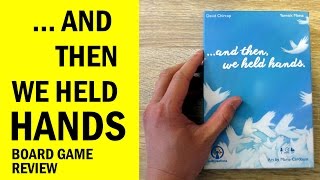
Board Game Sanctuary treats ...and then, we held hands. as a small, unusual two-player game that rewards close attention to a partner. Host Danny describes it as a fully cooperative abstract board game in which two players try to restore a broken relationship by moving into sync with each other's thoughts, perspectives, and emotions. The praise centers on the puzzle itself: the channel's reviews return again and again to the satisfaction of thinking on the same wavelength as a partner. The criticism is narrower. The reviews question whether a game about repairing a relationship works well when the rules forbid talking about the play, and they note that the abstract style and cooperative design will not suit every table.
Core Mechanics That Define ...and then, we held hands.
Emotion Cards and Color-Matched Movement
Designed by David Chircop and Yannick Massa and published by LudiCreations, the game places two beads on a set of concentric rings of colored nodes. To step a bead onto a node, a player must play an emotion card with a colored band that matches that node. Danny explains that each card represents a complex emotion and carries a positive band (blue and green in that example) on one side and negative bands (black and red) on the other. Players normally draw from their own emotion row, but when they lack the card they need, they can draw from their partner's row instead. That option creates a tradeoff, because a partner who falls off balance may lose the ability to draw extra cards. Danny also stresses that ending a turn on zero is important, because it lets a player refill their hand to full.
Balance Tracking and Perspective Shifts
Every move pushes the pair's shared balance toward either the positive or negative side, and reviewers consistently describe this as the central tension of the game. Danny notes that a balance beyond positive or negative two ends the game immediately, so staying near zero is essential. The second mechanic is perspective. Which edge of a card a player can read depends on where their bead sits. If the bead is on the left side of the board, only the left edge of the card counts, and a bead on the right uses the right edge. When a bead enters the center, players may choose either perspective, and Danny observes that this makes it "always really interesting to see things from a completely different perspective." The result is that the same card can mean different things depending on where each partner stands.
The ...and then, we held hands. Experience
A Quiet, Meditative Puzzle
Reviewers describe the silent version as calm and reflective. Danny says the game has a zen quality and a meditative feel that it delivers well, even though the restriction on discussing gameplay runs against normal table talk. Players must rely on what they can see of each other's card rows and on how their partner has played earlier turns. Danny observes that preempting and observing how a partner plays "really gains you an insight into what they're thinking." The experience is less about reacting to the board and more about reading another person across a small table, which is why several reviewers describe it as intimate despite the quiet.
Shared Focus and the Pull to Try Again
Beneath the calm, reviewers describe a tight and motivating challenge. The win condition requires both beads to reach the center on consecutive turns, and Danny has reportedly managed this only once in the time spent owning the game. Because the balance can tip into a loss at any moment, players stay alert throughout. Danny also praises the way near misses keep people playing: every failure reveals how close the pair came to the goal, which makes players want to reset and try again. Board Game Sanctuary frames this as the game's strongest emotional hook, a puzzle that players feel compelled to finish together.
What Makes ...and then, we held hands. Stand Out
Perspective Changing Through Card Edges
Danny calls the perspective concept distinctive, saying it is "a very interesting concept and theme. One that I actually haven't really seen before." Reviewers see it as a fresh way to use card management, because the same hand of cards can be read differently depending on positioning. The design also offers a color-blind side with shapes and symbols alongside the standard side, and Danny notes that either side plays fine. Reviewers who favor unusual designs say this kind of combination is exactly what they look for in left-of-field games that challenge how they think about board games in general.
A Small, Affordable Package
Reviewers repeatedly highlight the game's compact footprint. Danny describes it as "very small, very light," with rules that are easy to teach and a setup that takes little time, placing it at a low price point and recommending it as a filler to add to a collection alongside larger titles. The slim box is also part of the appeal for players who want a two-player game that can travel easily. Danny's conclusion is that the game delivers a tight puzzle without a large investment in time or money.
Potential Drawbacks
A Theme That Clashes With the Silent Play
The most consistent criticism is that the theme and the mechanics pull in different directions. Danny observes that the gameplay "really does feel quite abstract," and that the restriction on speaking sits uneasily with a game about repairing a relationship, since talking things through is usually the better way to resolve a conflict. Danny still acknowledges that the zen mood is deliberate and well executed. Reviewers who value immersive theme may find the gap between story and play distracting, even though the game's abstract design is part of its identity.
A Narrow Audience and Easy-to-Miss Details
Danny expects the game to appeal to a limited group because some players dislike cooperative games and others are put off by abstract designs. Danny also points out that the card art by Marie Cardou is hard to appreciate in play, since the cards stack on top of each other and hide much of the illustrated detail, recommending that players spread their cards out so the artwork can be seen. Danny's review also notes that one rule was unclear on that first play, and that the official FAQ on BoardGameGeek clarified that a player does not have to complete an objective on every turn. Reviewers suggest that new groups read that clarification before starting.
If You Enjoy ...and then, we held hands.
Reviewers at Board Game Sanctuary point to several designs that share the same appeal of cooperative reasoning without spoken strategy. Danny recommends Quirky Circuits for players who enjoy inferring a partner's intent, because each action card suggests a move that the group must interpret together. For a two-player cooperative experience built on limited information, Danny highlights SkyTeam, in which partners roll dice they cannot see and must hint at what they need. Codenames Duet, which Danny calls one of their favorite word games, offers a fully cooperative two-player challenge built on carefully chosen clues. Players who enjoy the tension of a hard shared challenge may also appreciate Grizzled, which Danny describes as a punishing cooperative experience in which players cannot explain their cards to one another.
What Reviewers Are Saying
"One of the highlights I like to mention about the game is that this game really brings out the completion aspect to you. Every time you fail at the game and you see how close you get to the final goal, you really want to set this game back up and really give it another crack."
— Danny, Board Game Sanctuary
"Now, what I really like is that everything that you do in this game creates this off balance effect. You'll shift towards being happy, but then you'll move towards being sad."
— Danny, Board Game Sanctuary
"What I really like about ...and then, we held hands is that it's a fun interactive puzzle that players are kind of cooperatively completing. Players need to try and think on the same wavelength, because that's really the crucial element to winning."
— Danny, Board Game Sanctuary