/pic7858263.png)
/pic7858263.png)













































20 Strong Deep Dive
What the Community Thinks About 20 Strong
20 Strong has earned enthusiastic praise from the board gaming community as a standout compact solo experience. Channels like BoardGameCo and Board Game Hangover highlight the clever deck-as-clock mechanic and tight resource management that resonate with players seeking a complete, satisfying solo adventure in a small box. Published by Chip Theory Games, it pairs accessibility with surprising strategic depth, appealing both to players new to solo gaming and to seasoned enthusiasts who want a full arc in a short sitting.
Core Mechanics That Define 20 Strong
The 20-Card Deck as Timer and Play Surface
The core constraint of 20 Strong is also its cleverest idea: exactly twenty cards form both your turn limit and the tableau where actions unfold. Each card you draw doubles as a passage of time and a set of slots for placing dice. This creates tension from the very first draw, since players must decide whether to commit limited resources now or risk running out of turns. The countdown is absolute and unforgiving, so every decision matters. Unlike games where you can pursue a strategy indefinitely, here the deck itself is the clock, which is what lets the game deliver a big, narrative-feeling experience from a tiny box.
Dice Rolling and Threat Resolution Under Pressure
Combat and threat resolution revolve around strategic dice allocation. Players choose which dice to roll against each threat, and committed dice become exhausted, leaving the pool until earned back through quest completion or character abilities. This makes each roll a calculated gamble: rolling many dice clears the current threat but leaves fewer tools for the boss ahead, while rolling too few risks a failure that burns a precious turn. Defeating a scenario's minions and quests before the final boss shapes how hard that climax will be, so the path you take through the deck directly determines your odds at the end.
The 20 Strong Experience
Relentless Tension in Compact Form
What emerges from these mechanics is a game of constant, exquisite tension. Players describe 20 Strong as delivering a genuine adventure despite its small footprint, each session a race against a clock that ticks with every card drawn. The game paces naturally from minion encounters to quests, building toward a final confrontation with a scenario boss. Because the pressure never relents, even a quick sitting feels significant, making the game ideal for anyone craving meaningful choices and narrative payoff without a multi-hour commitment.
Replayability and Character Expression
Multiple deck configurations and scenario types encourage players to return repeatedly. Each hero option presents different powers and strategic priorities, so the optimal path through a scenario changes with your loadout. Even with just the base box, players report getting many plays in quickly, finding the brevity a feature rather than a limitation. The unique powers tied to each defeated minion create branching decision trees, since what you have collected shapes how you handle future threats, rewarding mastery and exploration without demanding a sprawling campaign.
What Makes 20 Strong Stand Out
Elegance in Constraint
20 Strong exemplifies the power of elegant design. By capping the game at exactly twenty turns, the design forces every mechanic to justify its presence and every decision to carry weight. The result proves that "small box" and "satisfying" are not mutually exclusive; the tight constraint amplifies both strategy and drama. Players often compare the decision-making to much larger strategy games, noting that the forced scarcity of time makes each choice feel consequential, with no filler turns spent merely going through the motions.
Solo Purity With Expandable Options
While built for solo play, 20 Strong offers a complete, self-contained experience in a single box. It does not feel like a compromise or a campaign waiting to happen; it is the whole experience. Yet the modular scenario decks let players expand with themed content and additional heroes, so the game can grow with a collector's interest without making the base game feel incomplete. That balance respects player agency, letting those who want more seek it out without pressure.
Potential Drawbacks
Dice Luck and Swinginess
The dice-driven resolution can create variance in outcomes. Sometimes a scenario feels impossibly tight due to unlucky rolls, while other runs feel too forgiving. Players who prefer guaranteed mechanics over probability may find the variance frustrating, particularly when a critical moment hinges on dice rather than pure decision-making. This swinginess is thematic and manageable for most players, but it does mean not every run feels perfectly balanced.
Solo-Only Focus
20 Strong is built for solo play, which makes it wonderful for solo enthusiasts but excludes those seeking a shared experience. Some players prefer games that bring people together around a table, and this design fundamentally prioritizes the single-player journey. For households where gaming is a group activity, 20 Strong remains a personal indulgence rather than a shared memory-maker, which may limit its appeal within a broader collection.
If You Enjoy 20 Strong
Players who love 20 Strong often gravitate toward other tight, decision-heavy experiences. Lost Cities shares the push-your-luck tension and lean card play, where every choice feels consequential and the game ends before it overstays its welcome. Watergate, a two-player tug-of-war, delivers the same intense decision-making under pressure that makes 20 Strong compelling. For more dice-driven solo adventures, Final Girl offers thematic, scenario-based solo play with card and dice mechanics and high replayability, while Spirit Island rewards mastery and variable powers, making each session feel like a fresh puzzle despite a tight system.
What Reviewers Are Saying
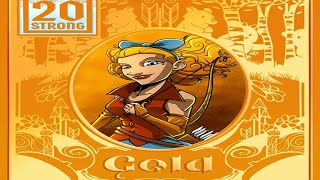
"You play a hero, a character that needs to defeat a villain. Depending on the deck you choose, you're either a cute little hero or maybe a robot. You can always win by defeating the boss, but before you get to the boss you have to defeat its minions or some quests, and how well you do with those determines how easy a time you'll have with the boss."
— Board Game Hangover
"There are a lot of decisions, because all these cards are unique. Even though we just got this game, I managed to get a lot of plays in, and I think it's one of my favorite solo games ever."
— Board Game Hangover
"It's a really popular little solo game called 20 Strong, and they come out with a few promos and other card decks that you can play, which is pretty cool. It's a nice little solo game that has been on the BoardGameGeek hotness for a while."
— Our Family Plays Games