/pic2945432.jpg)
/pic1149172.jpg)
/pic1106275.jpg)

The world you know no longer exists. There is no government. No army. No civilization. The United States has collapsed, and now thirty years after the war started, new powers finally try to take control over the ruined country, try to establish a new order, try to control others and create a new country, a new state: the 51st State.
51st State is a card game in which players control one of four powers trying to build a new country. Players put new locations into play, hire leaders, and send people to work in buildings to gain resources and new skills. To do this, every card in 51st State can be used in three different ways:
Raze a location to gain many resources once.
Deal with this location to gain one resource every turn.
Build the location so that you can use its skill each turn.
51st State: Master Set marks the rebirth of the 51st State line, with this set containing 88 cards from the original base game, and 50 cards each from both the New Era and Winter expansions; one of these expansions can be mixed with the cards of the base game, but not both at the same time. The entire set has been rebalanced to offer a cohesive experience no matter which expansion you choose to use.
Part of the 51st State family — see 51st State for the combined view.
/pic2945432.jpg)


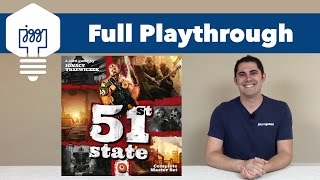
51st State: Master Set Full Playthrough

- Best version due to inclusion of all expansions and wooden tokens.
- Plays well solo.
- Appealing dark, gritty theme.
- Less popular and harder to get to the table than Imperial Settlers.
- Original version was tedious.
- Factions vying for superpower status after a major war
- Post-apocalyptic United States
- Imperial Settlers
- Empires of the North
Mechanics (from transcript analysis)
- Area Control — Building out a narrow board with things on the left or right as you're building out.
- Set Collection — Signing contracts with other people.
- Worker Placement — Invading locations, similar to rating.
Video topics + discussion points
Quotes (from this video)
- this Ultimate Edition has all the expansion materials you know everything out for it and also really nice wooden you know tokens and stuff so it makes it it's this is the best version like if you can find this this is this is the best
- it has one of the best senses of exploration
- this is a super unique worker placement game where your cards your workers are cards
- this is just this is just a classic
- this one for all intents of purposes killed Firefly because you're pretty much doing the same thing but it's a smaller smaller footprint like and it's doesn't take nearly as long
References (from this video)
- Love this game.
- Prefer it over Imperial Settlers.
- Simple enough to learn on the first play.
- The engine building and ramp-up mechanic is enjoyable.
- Great artwork and theme.
- Plays fast.
- Love the speed of play.
- No cons, everything is a pro.
- Includes two expansions in the master set.
- Multiple ways to play with variants and additional locations.
- A frantic race to the end.
- Always ready to play again.
- Easy to teach.
- The contact mechanic is different and requires thinking outside the box.
- Both hosts want it on their shelves.
- A game that can be taught easily.
- The master set is very satisfying.
- Requires reading glasses for the font size.
- The game can feel slow at the beginning due to engine building.
- Attacking and generating red contact tokens can be difficult and costly.
- Early game can be slow if card draw is unfavorable.
- The reliance on card draw can put players behind early on.
- Building a faction in a post-apocalyptic world
- Post-apocalyptic world of New Carthage
- Imperial Settlers
- Three is the Magic Number
Mechanics (from transcript analysis)
- Card Drafting — Players draft cards from a common pool after selecting factions.
- Combat/Attack — Players can use red contact tokens to attack and destroy opponents' buildings.
- Resource Management — Manage resources (guns, fuel, bricks, gears) to acquire contact tokens and build locations.
- Set Collection (Implicit) — While not explicit set collection, generating specific colored contact tokens (grey, red, blue) is crucial for building.
- Tableau Building — Players build a tableau of cards (locations) to generate resources and actions.
- Variable player powers — Each faction board provides unique starting elements or strategic leanings.
- Worker Placement (modified) — Uses 'workers' to take actions and can place workers on opponent's cards for 'open production'.
Video topics + discussion points
Quotes (from this video)
- the whole goal of this game is to try to finish first in a race
- the wackiness of not being able to see what your opponent done to your opponent what your teammate is picking is the crazy part of the game
- I love the artwork I love the artwork it's totally different than imperial settlers
- the franticness I enjoy that
- there are no cons for me in this game
- if you're playing Imperial settlers you need to check this one out
- there is a place on your shelf for both
- I love this game
- 51st state people seriously go out play it you're gonna fall in love with it
References (from this video)

- variety of cards and engine-building potential
- expansions add replayability
- Euro-style tableau/engine with card-based actions
- Imperial Settlers
Mechanics (from transcript analysis)
- multi-expansion setup — box includes two expansions that can be shuffled into the game
- Tableau Building — cards are played to build a personal engine; cards provide resources and VP
- variable deck interaction — as in Imperial Settlers lineage, with card-based actions and engine building
Video topics + discussion points
Quotes (from this video)
- This is a really great worker placement game that came out of the blue for me.
- I think it's a very goofy theme and it's a beautiful looking game.
- This is a neat little game where you have a bunch of simple decisions that have really complex results.
- There are a ton of neat stuff going on here and I've been impressed with the game.
References (from this video)
- Straightforward engine builder
- Simple core mechanics
- Easy to learn with depth
- Nice art and components
- Good expansion content
- Excellent, funny rulebook
- Multi-use cards offer many options
- Ends just as the game gears up
- Theme feels typical post-apocalypse
- Humanity attempts to rise from the ashes of North America.
- Aftermath of an apocalypse
- Scythe
- Arctic Scavengers
Mechanics (from transcript analysis)
- Card Drafting — Players draft cards from an open pole.
- Engine Building — Your state must work efficiently and effectively.
- Multi-Use Cards — The multi-use card system where cards can be used for different actions.
Video topics + discussion points
Quotes (from this video)
References (from this video)
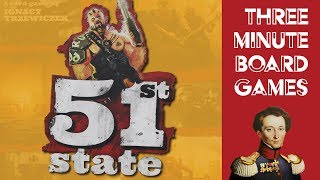
- Straightforward engine builder with a simple card-based core system
- Easy to learn with depth
- Nice looking cards and nifty resource tokens
- Excellent and funny English-language rulebook
- Excellent multi-use card system providing many options
- Game ends just as you feel it's gearing up
- Typical post-apocalypse theme and setting
- Humanity attempting to rise from the ashes and create a domain within ruins.
- North America in the aftermath of an apocalypse, 30 years after the war ended.
- Imperial Settlers
- Arctic Scavengers
Mechanics (from transcript analysis)
- action selection — Players then alternate taking actions until they all pass.
- Area development — Developing requires brick or a development token and allows you to upgrade a region and score of a victory point.
- Card Drafting — Players draft cards from an open pool.
- Engine Building — Your state must work efficiently and effectively.
- Resource Management — The main resources are iron, guns, fuel and bricks with ammo being a wild card resource.
Video topics + discussion points
Quotes (from this video)
- hello and welcome to the 51st state
- in the aftermath of the apocalypse humanity attempts to rise from the ashes of North America
- the winner is the state with the most points at the end of the game
- if a card has a star on it like this it's part of your path to victory
- the main resources are iron, guns, fuel and bricks with ammo being a wild card resource
- the game uses the same core engine but has a lighter brighter theme and art
References (from this video)
- Rich engine-building with broad expansion content
- Great variety and replayability through multiple expansions
- Complex rulebook; heavy on setup
- Iconography can be dense for newcomers
- Card-driven engine-building and resource management
- Post-apocalyptic United States / environment-altering factions
- Strategic, empire-building
- Innovation
Mechanics (from transcript analysis)
- Deck Building — Draft and build a deck to optimize actions and production
- deck-building — Draft and build a deck to optimize actions and production
- Engine Building — Develop a faction board for ongoing bonuses and income
- engine-building — Develop a faction board for ongoing bonuses and income
- market/deals — Generate resources and trade to fuel expansion
Video topics + discussion points
Quotes (from this video)
- I've been grinding to just really understand the game and get to a point where I feel very comfortable about putting out more content for glass Road
- Glass Road is so quick that you don't need to worry about that too often
- This game offers a lot of Randomness in the cards that come out
- it's a solo only game it's pretty easy to pick up
- the Mundus expansion to world wonders
- King Domino is a classic game
References (from this video)
- Crunchy puzzle with strong hand management and engine-building interplay
- Tight two-player balance through asymmetry (Mutants Union vs Merchants Guild) and token economy
- Narrative feel of a post-apocalyptic engine-driven race with satisfying chaining of actions
- Open production and development options create meaningful choices each turn
- Expands well with expansions; base game provides a solid, dense experience
- Can be space-intensive on the table due to tokens and multiple card zones
- Early game can feel punishing or slow as players gather tokens to build engines
- Two-player game can still be dense and occasionally slow due to heavy card/text interactions
- engine-building through multi-use cards, resource production, and area/territory feel via tokens and ruins
- post-apocalyptic city-state where factions contend for control and survival
- thematic, somewhat dystopian, with a strong emphasis on faction asymmetry and opportunistic card play
- Imperial Settlers
Mechanics (from transcript analysis)
- deals_and_rewards — making deals converts tokens into resources and VP over time; deals can be upgraded or converted into ongoing VP effects.
- develop_action — bricks and symbols enable development to upgrade existing cards, with rewards such as VP or new capabilities.
- engine_building — cards when built or activated generate resources and provide ongoing benefits, enabling players to chain combos across turns.
- hand_management — players curate a hand of production, feature, and action cards, then decide which to keep, discard, or destroy to optimize engine results.
- open_production_buildings — certain buildings can be activated by either player; involved in dynamic engine shaping and can be stolen/contested.
- ruins_and_development — ruins count as multiple icons and can be developed into more powerful cards, changing the board state and VP potential.
- token_economy — blue, gray, red, and other tokens are used to buy, build, and enable deals; tokens also power denial/interaction with opponents.
- two_player_turn_structure — players alternate actions with lookouts/turn milestones; end of round triggers and first-player token rotation influence pacing.
- victory_point_race — the game ends when someone crosses 25 VP; location points and post-round bonuses can swing the final tally.
Video topics + discussion points
Quotes (from this video)
- the game is a race to 25 victory points
- it's largely a multiplayer solitaire game
- the mechanics of the game present a great puzzle like it's like most hand management games
- the asymmetry between Mutants Union and Merchants Guild adds a lot of spice
- this is a puzzle that rewards careful resource conversion and timely upgrades