




































7 Wonders: Architects Deep Dive
What the Community Thinks About 7 Wonders: Architects
Reviewers largely agree that 7 Wonders: Architects is a streamlined, approachable entry in the 7 Wonders line. Designed by Antoine Bauza and published by Repos Production in 2021, the game asks 2 to 7 players to race toward an architectural wonder by drafting cards, gathering resources, and building their wonder stage by stage. Watch It Played introduced it as a third game in the 7 Wonders line, and Allies Are Enemies placed it among its gateway recommendations. The most consistent praise is that it is easy to teach and quick to start. Tom Vasel of Dice Tower gave it an 8.5 in a retrospective and called it one of the best games to bring out for people who do not play many games. Gaming with Edo ranked it fourth on their 2022 top ten list, praising its visual satisfaction and design.
Reviewers are less unified on how deep the game goes. Some see it as a condensed version of the older 7 Wonders experience, built for a wider audience. Others think it trades strategic depth for simplicity. Check It Out described the game as fun and random, which suits casual groups well, while noting that it is simpler than Seven Wonders and can feel repetitive over several plays. Most reviewers treat that trade-off as intentional rather than as a flaw.
Core Mechanics That Define 7 Wonders: Architects
Card Drafting
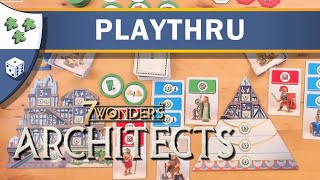
Card drafting is the engine of 7 Wonders: Architects. On each turn, a player chooses from a small set of cards offered by the neighboring decks and the central deck, then places the chosen card in front of them. Nights Around the Table walked through the options as the table played: a player could take the top card of the deck to their left, the top card of the deck to their right, or the top card of the central deck. The choice is more than a pick for the moment. The card a player takes becomes a resource to build with, a bonus to use, or a card to deny an opponent. Watch It Played described the core loop as drafting from decks passed between players, which keeps every player involved in what the others need.
The drafting decisions also carry some tension. A card that helps one player may be exactly what a neighbor is looking for, so reviewers describe a steady stream of small trade-offs about what to take now and what to leave for someone else. Because the wonders have different special abilities, the drafting choice is shaped by which wonder a player chose at the start of the game.
Resource Management
Resource management governs how far a player can take their wonder. Each stage of a wonder requires a specific combination of resources, and the requirements rise as the wonder grows. Nights Around the Table explained the pattern in plain terms: the early stages need two of one kind of resource, the next stage needs two identical resources, and the highest stages need a varied mix to complete. Yellow cards act as a wild resource that fills in any gap. Gray and yellow cards are consumed when a stage is built, so every card used to build the wonder is one that cannot be used for something else. That scarcity is what makes each draft choice meaningful, and it gives experienced players room to plan several turns ahead.
Reviewers note that the resource rules are easy to follow once they are learned, but they still require attention on the first few turns. The wild cards, the identical-or-different requirements, and the way completed stages unlock abilities are the points where new players most often need a reminder.
The 7 Wonders: Architects Experience
Light, Playful Fun
The dominant feeling of 7 Wonders: Architects is lighthearted. The art and theme are cartoonish, and the game does not ask players to take its historical setting seriously. Nights Around the Table made this explicit during its unboxing, joking that the table was there to have fun rather than to learn about the ancient world. That tone makes the game feel more like a social event than a heavy strategy session. Players laugh at the odd wonder descriptions, react to surprising cards, and tease each other over close draft choices. The atmosphere is relaxed even when the scoring is tight.
Quick, Tense Decisions
Beneath the light tone, the game produces short bursts of tension. Each turn is brief, but the choice of card can change the course of a player's wonder. When two players want the same card, reviewers describe a small moment of drama, and the decision is made quickly because the game moves at a steady pace. That combination of quick turns and meaningful choices is what keeps the table engaged, and it explains why many reviewers describe the game as easy to play but still satisfying to win.
What Makes 7 Wonders: Architects Stand Out
Accessibility
Accessibility is the feature reviewers praise most often. Allies Are Enemies recommended the game for newcomers and highlighted its approachable rules and attractive packaging. Dice Tower made the same case in Tom Vasel's review, calling it very easy and one of the best games to bring out for people who do not play often. The game can be taught in a few minutes, and the core turn structure is simple enough that players can focus on the wonder they are building rather than the rulebook. Reviewers see this as the reason it works well as a gateway into the 7 Wonders series.
Variety Among the Wonders
Each wonder has its own special ability, which gives replay value that reviewers mention repeatedly. Nights Around the Table listed several options during its setup, including Alexandria, Halicarnassus, Olympia, Giza, Babylon, Ephesus, and Rhodes, and walked through how each one changes the way a player draws or spends cards. Allies Are Enemies praised the wonder variety as well. Because the abilities differ, two games with the same players can feel quite different depending on which wonders are in play, which encourages repeated plays and gives players a reason to try a different wonder next time.
Potential Drawbacks
Luck and Repetition
The most common criticism is that the card supply introduces enough luck to frustrate players who prefer tight control. Check It Out described the game as fun and random, which some players enjoy and others find limiting. The same review noted that repeated play can feel repetitive once players have seen most of the cards and wonder abilities. Players who want to plan a long engine may find that the draw determines more of the outcome than they would like, especially in games where the top cards of the decks are poor for their wonder.
Simpler Than Its Predecessors
Some reviewers feel the game gives up depth in exchange for accessibility. Check It Out compared it directly with Seven Wonders and said the newer game is simpler. Players who have mastered the original may find fewer decisions to weigh, and the game may feel more like a light, social filler than a full strategy experience. Reviewers who want a deeper challenge tend to recommend moving on to Seven Wonders or Seven Wonders Duel after learning the basics.
If You Enjoy 7 Wonders: Architects
Players who enjoy 7 Wonders: Architects's card drafting will find similar satisfaction in the original 7 Wonders, which uses the same pass-and-choose rhythm with a deeper set of interactions between players. Those who want a head-to-head version of the same design should consider Seven Wonders Duel, which keeps the wonder theme but focuses on two players. Players who value the trade-offs of resource management and card-based building may enjoy Catan, which rewards careful planning around scarce resources. For a larger, more involved take on building a civilization, Catan: Cities & Knights offers a deeper experience with more decisions per turn.
What Reviewers Are Saying
"7 Wonders Architects is very easy. It's one of the best games to bring out period for people who don't play a ton of games."
— Tom Vasel, Dice Tower
"So it alternates. It's two identical here, three different, three identical, four different to get all the way up to the top."
— Nights Around the Table
"But for my money, Seven Wonders Architects is the best of the bunch. And I could just play this over and over."
— Allies Are Enemies