


A Game of Thrones: Hand of the King Deep Dive
What the Community Thinks About A Game of Thrones: Hand of the King
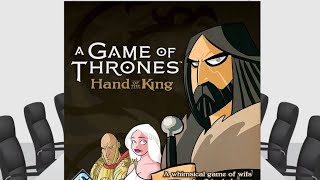
The reviewers covering this game are all from the Chairman of the Board channel, and they share a clear view of it: A Game of Thrones: Hand of the King is a light, quick, and tactical filler game with a strong theme. In a dedicated review, Chairman of the Board describes it as a two to four player card game that takes about 15 minutes, with no fiddly rules but enough depth to keep players interested. The same reviewer singles out the bright, cartoony artwork and the House symbology as a reason the game is especially appealing to anyone who likes the theme.
The reviewers agree that the game is strongest with two players. In a broader roundup of two-player games, Chairman of the Board places it among the recommended picks for two, arguing that the game becomes more chaotic as seats are added. In a separate retrospective on games that have left the collection, Chairman of the Board makes the same point from a different angle, noting that the game works noticeably better at two players because the outcomes feel more deterministic. Where the reviewers differ is less about quality than about staying power. Each one describes the game as an enjoyable, well-made title, but the retrospective reviewer also admits to burning out on it after many plays, which is a common reason a light game leaves a shelf even when it is well designed.
Core Mechanics That Define A Game of Thrones: Hand of the King
Varys Movement and House Majorities
The central mechanic is the movement of Varys, the Master of Whispers, across a 6x6 grid of character cards. Reviewers explain that each turn, a player chooses one of four orthogonal directions, moves Varys along that line until the last card of the chosen type, and claims every character from that House that Varys passes over. Collecting cards is the means, and majority control is the goal. Whoever holds the most characters from a House claims that House's banner, and at the end of the game the player with the most banners wins. The reviewer in the main review notes that the game is all about positioning, since leaving a particular card in place can give an opponent exactly the set they need. A tie is broken by whoever controls the largest family, and a player who matches another's total in a House can lose a banner they would otherwise have won, which pushes players to keep counting every move against their rivals.
Companion Cards and King's Landing
The second defining system is the companion cards, which the reviewers describe as the source of most of the game's variety. When the last member of a House is taken, or the last card of a House is taken from King's Landing, the player gains one of the companion characters from the book series. The reviewer in the main review lists examples such as Melisandre, who grants another turn, Bronn, who lets a player take Tyrion from King's Landing or any other play area, and Jon Snow, who counts as two characters toward any House. Only six companions are used in each game, so the set of available powers changes from one game to the next. The reviewer notes that these powers let a player manipulate the board to their advantage, which gives the game more replay value than its simple rules might suggest.
The A Game of Thrones: Hand of the King Experience
Quick, Tactical Tension
Reviewers describe the experience as a short session that still demands attention on every move. Because Varys can only travel in straight lines, the best choices often involve reading what the next player will be able to take. The reviewer in the main review says that the game is almost as much about not helping an opponent as it is about helping yourself, and calls that a nice touch for a game of this length. The feeling is one of careful, compact calculation rather than long strategic planning, which suits a quick filler game played between other titles.
A Thematic, Cartoony Pleasure
The second quality reviewers highlight is the way the theme comes through in the art and the companion powers. The main review praises the bright, cartoony depiction of the iconic characters, and the reviewer says that anyone who likes the source material will find the game especially satisfying. The retrospective review makes a similar point, describing the box as attractive and the game as a nice little package. The result is a feeling of playing a small piece of the Game of Thrones world, where the familiar faces and their powers do much of the storytelling.
What Makes A Game of Thrones: Hand of the King Stand Out
A Simple Rulebook With Real Decisions
Reviewers consistently point to the clean rules as the game's biggest strength. The main review describes it as nice, quick, and easy to explain, and says it has enough going on to keep players interested despite having no fiddly rules. For a filler game, that combination is hard to find, and the reviewer argues that it is the reason the game earns its place in a collection.
Companion Powers That Change Each Game
The companion system is the second standout. Because only six of the available companions are used in any one game, the reviewers note that the powers create genuine variation between plays. The main review highlights how the companions can break a House majority or remove key characters from the board, which turns a short card game into a series of different tactical problems. Reviewers credit this variety with keeping the game fresh even though the core rules stay the same.
Potential Drawbacks
Chaos and Luck at Higher Player Counts
The most consistent criticism concerns player count. The 25-games reviewer at Chairman of the Board says that with more than two players the game becomes more chaotic and more subject to luck, while two players produce a more tactical contest in which leaving opponents with few good options matters most. That reviewer also notes that the game shines particularly at two players, so groups that regularly play with larger numbers may find the experience less satisfying than the reviewers describe.
Shelf Life and Burnout
The second concern is that the game can wear thin after repeated plays. The retrospective reviewer at Chairman of the Board explains that the game was removed from the collection after playing it heavily, and that the reason was personal fatigue rather than any flaw in the design. The reviewer says it was explored thoroughly and was ready to move on, a reminder that a light game with a limited set of companion powers and House combinations can run out of new things to discover for a dedicated player.
If You Enjoy A Game of Thrones: Hand of the King
The only game that reviewers name as a direct comparison is Kariba, the small card game by Reiner Knizia. The 25-games reviewer at Chairman of the Board describes Kariba as similar to A Game of Thrones: Hand of the King in the way that a multiplayer game becomes chaotic while two-player play becomes far more tactical. Players who enjoy the tactical, leave-them-nothing feel of Varys movement will likely find that Kariba offers a similar sense of compact, card-driven decision making. No reviewer draws any other direct comparison, so that single recommendation reflects one reviewer's observation rather than a broader consensus.
What Reviewers Are Saying
"Nice and quick, nice and simple, easy to explain, but it has enough going on in it to keep you interested."
— Chairman of the Board
"I think this game did work a lot better at two player than it does at the higher play accounts, because there's a bit more of a deterministic feel to it."
— Chairman of the Board
"When you're playing with more than two players it becomes a bit more chaotic and you are a bit more subject to luck, whereas in two players it's extremely tactical."
— Chairman of the Board