













Alma Mater Deep Dive
What the Community Thinks About Alma Mater
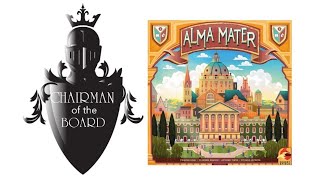
Alma Mater, a 2020 release from AG Reveal, gets a mixed reception in the videos that cover it. Reviewers agree on the basic shape of the game. It is a 2-4 player worker placement and resource management title set in fifteenth century European universities, where each player acts as the chancellor of a school. Opinions split on whether that shape pays off. Board Gaming Ramblings placed it among its top ten games of 2020 and called it a great euro game. Chairman of the Board found the design a miss, pointing to a long, drawn-out experience that felt mechanically cluttered. Preview coverage from John Gets Games and an underdog-style top ten list leaned anticipatory, pointing to the designer pedigree before the game hit the table. One roundtable episode also noted that the group actually loved playing it.
Core Mechanics That Define Alma Mater
Worker Placement
Workers are the way players interact with the shared board. Placing a worker on a space claims it for the turn, and another player can still reach the same space by committing more workers than the player already there. John Gets Games described the rhythm as a series of placements where the contest is over the same few spaces, so timing and the number of workers you can commit matter as much as the action itself. The result is a tight, tactical loop that rewards reading the board before each turn.
Resource Management
The economy of books sits at the center of the game. Players produce books for their university, track book reputation on a sliding market, and divide their stock between supply and display. Board Gaming Ramblings summed up the core loop as getting students and teachers into the university and then finding the best possible combinations. The book economy turns those basic actions into a set of trade-offs about which books to make, when to sell them, and how to keep the market working in your favor.
The Alma Mater Experience
Lighthearted
The theme keeps the tone playful even though the rules underneath are a dense euro. Players take on the role of headmasters of studious universities, and the preview coverage kept that light touch going, joking about a keg party and poking fun at student loans. That contrast between a serious academic setting and an irreverent presentation is part of what makes the game feel approachable on first contact.
Social
Table talk comes up in the discussion of how the game plays. Reactions suggest a game that gets a group talking about its choices, especially around competing for the same spaces and trading books with other players. The shared decisions are where the experience comes alive, which is why groups that enjoy strategic conversation tend to respond well to it.
What Makes Alma Mater Stand Out
Designer Pedigree
The game was designed by four Italian designers with a hand in Coimbra, Terra Mara, and Lorenzo il Magnifico. That lineage draws attention before anyone opens the box. John Gets Games also highlighted the artist, Chris Williams, who also worked on Coimbra, which connects the visual identity of the game to a well known title in the same family.
The Book Economy
Board Gaming Ramblings said that the core concept of placing students and teachers is enjoyable on its own, but that the book mechanism is what elevates it. The economics of making and trading books set the game apart from a standard placement design, and that is the feature reviewers most often return to when explaining why the game works.
Potential Drawbacks
Length and Clutter
Chairman of the Board described the game as mechanically cluttered and very long drawn out. The walkthrough shows why table time can feel heavy. Setup runs through fifteen steps, the game lasts six rounds across action, administrative, and income phases, and final scoring takes nine steps. The listed playtime of 90 to 120 minutes is a real commitment for a game that can feel bogged down in its details.
Limited Strategic Variety
Board Gaming Ramblings noted that there are not that many strategies and not that many ways to roam in the game. That narrowing matters most to players who want to explore different paths from one session to the next, even though the reviewer still enjoyed the core concepts. Players who value variety may find the options settle into a familiar pattern sooner than they would like.
If You Enjoy Alma Mater
Try Coimbra. John Gets Games observed that Alma Mater obviously looks a lot like Coimbra, and the two games share an artist and a design circle built around Italian designers. Players who enjoy the mix of worker placement and tile placement in Alma Mater will find Coimbra the closest reference point for the same style of play, and it is the natural next step for anyone who wants more of the feel that first drew them to this game.
What Reviewers Are Saying
"It is a great euro game. I enjoy the core concepts enough, like the, it's pretty straightforward, getting the students, getting the, the teachers, and getting that in, and then the best possible combinations. I enjoy that core concept, but what elevates it is that book mechanism, the economic of the books making that different."
— Board Gaming Ramblings
"I thought that game was pretty miss to be honest. Very long drawn out, but I like the company. I like the designer, but the game was just a massive miss for me."
— Chairman of the Board
"While you're playing through the game you are going to be essentially making books for your university. You are in charge of a university and then it sounds like you actually sell those books to your opponents or they take them away from you."
— John Gets Games