Game Info
Year
2018
Players
1-4
Age
14+
Playtime
90 min
Complexity
2.8/5
Collection
Ratings
Creator Score
Mechanic profile
Not enough video data yet
Vibe profile
Not enough video data yet
Description
No description available.
Featured Videos

Ask a Rules Question
All mentions
Browse transcript mentions, sentiments, pros/cons, mechanics, topics, quotes, and references.
Total mentions: 6
This page: 6
Sentiment:
pos 6 ·
mix 0 ·
neu 0 ·
neg 0
Showing 1–6 of 6
Video My1TO7FtTd8
Board Games UnLocked Unboxing at 7:19 sentiment: positive
video_pk 116868 · mention_pk 329777
Click to watch at 7:19 · YouTube ↗
Overall sentiment (raw)
positive
Pros
- This game does everything right.
- The company keeps supporting it.
Cons
- Host might have bought duplicates.
Thematic elements
Comparison games
none
Mechanics (from transcript analysis)
Mechanics unknown.
Video topics + discussion points
No key topics recorded for this video.
Quotes (from this video)
- I basically love this game so I have to order everything for it
- this I think this is a standalone single unum scenario
- I guess this uh creates more conflict that's uh that's interesting
- there's no room in the early on box I'm very surprised they have not made like a wooden insert for it
- this game is absolutely fantastic
- I just saw a run-through for it and I thought it looked really neat
- most of my kicks are lately have been I've been dead
- I hope I didn't do that for anything else I'm gonna be super upset if I did
References (from this video)
No references stored for this video.
Video 6bC-pRBmYqg
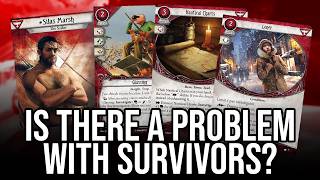
PlayingBoardGames Other at 0:08 sentiment: positive
video_pk 94244 · mention_pk 256625
Click to watch at 0:08 · YouTube ↗
Overall sentiment (raw)
positive
Pros
- The challenge run proved surprisingly not as challenging as expected.
- The combination of Carson and Silas worked very well together.
- The legacy card pool allowed for highly efficient plays.
- The deck outscaled the game's challenges.
- Finishing scenarios quickly significantly reduced the number of encounter cards drawn.
- Enemies were dealt with efficiently, often in a single action.
- The combination of extra actions and not failing skill tests provided significant advantage.
- The deck's ability to outpace the game consistently led to success.
- The combination of draw power, recursion, and action compression made the deck incredibly strong.
Cons
- The initial run had tactical errors and didn't materialize as expected.
- Carson's support role became less impactful as Silas's deck grew stronger.
- Carson sometimes had to spend actions on double action treacheries or weaknesses.
- The final scenarios became less engaging due to the safety net provided by the deck's power.
- In the City of Archives scenario, Carson had limited support options.
- The weakness 'Selfless to a Fault' was difficult to clear in certain scenarios.
- The weakness 'Siren Call' required awkward sequencing and could be a stress point.
- Hounds of Tindalos was a very scary enemy for Silas's deck.
- Chainsaw is a powerful weapon but survivors can do better for less cost and XP.
- The deck's power level might be considered 'dirty' or 'too powerful' in some contexts.
Thematic elements
- null
- null
- null
Comparison games
none
Mechanics (from transcript analysis)
Mechanics unknown.
Video topics + discussion points
No key topics recorded for this video.
Quotes (from this video)
- The whole idea really was about discussions of Carson and how good he is, how interesting he is to play, and just the I don't know. What does he bring to the table and how do you change uh that via the player count?
- I really wanted to say, 'What if we just lean into a two-player support where yeah, I mean he still can get clues and whatnot, but really his job is not to progress the game, but rather to help you, the other player, to do as much as possible.'
- And then you brought this to me and I immediately said, 'Well, if we're going to do this, I'm going to be Silas.'
- Yeah. And like so, my big thought was that uh uh I mean, I think like the big thing is I no matter what I probably would have chosen a survivor for this, right?
- The philosophy for this new version was just like go hard on tests, right? Like rather than try to make multiple small tests, what if I just made like impactful tests every turn?
- And that's kind of why Silas Marsh does.
- The reason we did restart. It wasn't because uh, the Doom of Eztli went bad. We would have kept trucking through it. But it was just felt like uh, the this would be a better version of what this challenge was.
- I feel like these uh if you flipped the investigators that you and I played, so I played Carson and you played Silas, I think it would have gone differently.
- Daniel's deck requires a lot of time and patience and set up. Take the time to play the assets. Daniel has to be patient to not feel like he has to advance the game state, but rather he has to improve his board. And then in my Silas deck, my Silas deck is go go go. Advance the game state every turn.
- The problem I mean so there's probably a few too many times where like my turn is just spending the actions to get rid of a double action treachery or weakness and that's kind of I mean someone's got to do it.
- The game is fun when you learn from it, not just as a uh a pure challenge where you just say, 'Whoops, we did something bad. I guess we have to live with that.'
- The survivor color pie breaks because of Carson, but that's okay, that's what Carson's supposed to do. But now you're using those actions to do even more things that you really aren't supposed to do with your deck.
- The best way to win the game is to win quickly.
References (from this video)
No references stored for this video.
Video XDRZxZN186c
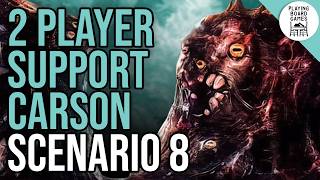
PlayingBoardGames Playthrough at 0:06 sentiment: positive
video_pk 93425 · mention_pk 252699
Click to watch at 0:06 · YouTube ↗
Overall sentiment (raw)
positive
Pros
- Exciting campaign with a lot of highs.
- The 'stomp' feeling when a deck is powerful is exciting.
- Having powerful decks gives a lot to think and talk about.
- The game is described as 'gorgeous' when viewed correctly.
- Players feel good when they have strong allies like Gish in play.
- The final scenario feels like a 'win the campaign' moment.
- The game is described as 'very strong still' even with specific card discards.
- The ending is described as 'fun'.
Cons
- A player's deck can sometimes be 'literal ass garbage'.
- Encounter cards can be brutal and punish players (e.g., losing actions, taking damage/horror).
- Specific weaknesses ('unrelenting' and 'lucky') are mentioned as being tough.
- Discarding powerful cards can be a difficult decision.
- The game can 'nerf you somehow' by forcing discards.
- A specific card ('sharp vision') is called 'the worst card in your deck'.
Thematic elements
Comparison games
none
Mechanics (from transcript analysis)
- Card draw — Players draw cards frequently throughout the game to improve their hand and options.
- clue gathering — Players gather clues from locations to progress the game.
- Combat — Players engage in combat with enemies, dealing damage to defeat them.
- Deck Building — Mentioned as a powerful deck strategy that can lead to a 'stomp' or 'ass garbage' depending on the player's luck and build.
- Doom placement — Doom is placed on enemies and locations, affecting the game state and advancing the agenda.
- Encounter cards — Players draw and resolve encounter cards, which can have negative effects like losing actions or dealing damage/horror.
- evade — Players can choose to evade enemies instead of fighting them.
- exploring — Players explore new locations, which can trigger abilities or place doom.
- Healing — Healing of horror and damage is mentioned as a positive effect.
- Investigating — Players investigate locations to gain clues.
- Mulligan — Players discuss resolving their mulligans and looking at specific cards.
- Resource Management — Players spend resources to play cards and use abilities, and also gain resources through various effects.
- Skill Tests — Players commit cards and use abilities to pass skill tests, often with modifiers and commitments from other players.
- Trauma — Players receive physical and mental trauma at the end of the campaign.
Video topics + discussion points
No key topics recorded for this video.
Quotes (from this video)
- This has been a very exciting campaign that has a lot of highs.
- So, the fun part, I think, is that it gives us a lot to think and talk about, and you know us.
- It's funny when you start the game with a million XP and you have all the good cards that you're looking at.
- The game has to nerf you somehow, Justin.
- We mended the tear in the fabric of time.
- Carson, who's been like quietly observing the whole time, says, 'This is my moment. I'm going to do this. I'm going to save the world.'
References (from this video)
No references stored for this video.
Video ObbZNOFbd_Q
PlayingBoardGames Analysis at 51:56 sentiment: positive
video_pk 81569 · mention_pk 203272
Click to watch at 51:56 · YouTube ↗
Overall sentiment (raw)
positive
Pros
none
Cons
none
Thematic elements
Comparison games
none
Mechanics (from transcript analysis)
Mechanics unknown.
Video topics + discussion points
No key topics recorded for this video.
Quotes (from this video)
- I think this police dog is a is a goated card.
- I think this is a very powerful card.
- Um in two to three years for a cycle to stay current and supported, I think that also means two to three years in print.
- I don't think this game is big enough to be scalpable.
- All I can say is that I personally intensely dislike the trend of scalping scalping games or anything for that matter.
- And Snakebird Priestess, that is a very funny message.
- Which is certainly there are many non-obvious signs that someone is chat GPT.
References (from this video)
No references stored for this video.
Video sV3k15gQHiU
PlayingBoardGames Playthrough at 0:03 sentiment: positive
video_pk 80357 · mention_pk 195484
Click to watch at 0:03 · YouTube ↗
Overall sentiment (raw)
positive
Pros
- Silas's effectiveness and synergy with the survivor card pool.
- Carson making investigators better.
- Skipping a disliked scenario (Heart of the Elders part one).
- Drawing an enemy at a convenient time.
- The combination of 'quick thinking' and 'brute force'.
- Deck building advice leading to a good hand.
- Playing Shintaka with a strong stat line.
- Making incredible time in the scenario.
- Successful investigation and clue gathering.
- Overcoming obstacles like perils and curses.
- Fastest completion of a scenario.
- Winning a scenario quickly on turn two.
Cons
- Heart of the Elders part one is disliked.
- A bad starting hand leading to a mulligan.
- Drawing an enemy that requires immediate attention.
- The 'deep dark' encounter card.
- A high shroud location making investigation difficult.
- The peril on a test.
- Drawing a 'creeping poison' treachery.
- A random card being shuffled into the exploration deck.
- An investigator being 'entombed'.
- Failing a test by three.
- The 'Harbinger' spawning.
Thematic elements
- The Forgotten Age
Comparison games
none
Mechanics (from transcript analysis)
- Action economy — Players have a limited number of actions per turn, and managing them efficiently is crucial.
- Card Play — Players play cards from their hand to perform actions, gain resources, or trigger abilities.
- character abilities — The unique abilities of investigators like Silas and Carson are utilized.
- clue gathering — Collecting clues is a primary objective to advance scenarios.
- Combat — The hosts engage in combat with enemies, dealing damage and defeating them.
- Deck Building — The concept of deck construction and optimizing card choices is discussed.
- Doom track — The doom track is mentioned and managed throughout the game.
- Enemy Management — Encountered enemies need to be dealt with through combat or evasion.
- explore — The act of exploring new locations is a core part of progressing through the scenario.
- Hand Management — Players manage their hand of cards, deciding which to play and which to hold.
- investigate — The hosts frequently perform the investigate action to gather clues from locations.
- Resource Management — Players gain and spend resources to play cards and perform actions.
- Scenario Advancement — Progressing through scenarios by meeting objectives is central to the gameplay.
- Skill checks — Tests are performed by committing cards or using abilities to overcome challenges, often involving icons representing skills like perception or combat.
- Treachery Cards — Treachery cards are drawn and have negative effects that must be dealt with.
Video topics + discussion points
No key topics recorded for this video.
Quotes (from this video)
- Silas is very good. I've I've been shouting it from the rooftops but now I have a great like case in point of seeing it in action here.
- Carson makes anybody better and he makes a very good investigator even very gooder.
- It's like eating a spoonful of poop with poop with like some whipped cream on top. So you know I do get a little bit of a sweet bite in there.
- Man, if I could play Studious I freaking would.
- We're not going to die, right? We're really good at this game.
- That quick thinking and brute force force go together really well.
- People saying Arkham is a game of random chance, and it is, but it's also about strategically going for the chance that is the highest success of what you want.
- Holy crap. My stat line is 4 4 5 5.
- That's the fastest we've ever played that one.
- This scenario this ca- This is a pretty good time when you don't have to play part of the Elders part one.
References (from this video)
No references stored for this video.
Video M8OwMIMt9h4
PlayingBoardGames Playthrough at 0:06 sentiment: positive
video_pk 80075 · mention_pk 194300
Click to watch at 0:06 · YouTube ↗
Overall sentiment (raw)
positive
Pros
- The game is described as 'pretty fun.'
- Players achieved victory and gained significant experience points.
- The scenario provided a satisfying conclusion to the campaign.
- The deck synergy and card plays were effective.
Cons
- Exploration luck was described as 'awful' at times.
- Encountering the 'murder ball' and significant threats like the Eater.
- Players sometimes struggled with difficult tests and enemy evasion.
Thematic elements
- A crumbling precipice, a little bit scary, and facing fate.
Comparison games
none
Mechanics (from transcript analysis)
- Combat — Players attack enemies to defeat them.
- Deck Building — Players utilize cards from their customized decks, with mentions of drawing, playing, and discarding cards.
- Doom — Doom tokens are placed on locations or the agenda, advancing the game towards a loss condition.
- evade — Players attempt to evade enemies to avoid engaging them in combat.
- Experience points — Investigators gain experience points that can be used to upgrade their decks.
- explore — Players reveal new locations and encounter cards by performing the 'explore' action.
- investigate — Players attempt to gain clues by performing the 'investigate' action at locations.
- pursuit — Enemies can enter the 'pursuit area,' affecting player progress.
- Resource Management — Players gain and spend resources (e.g., 'resources', 'actions') to play cards and perform actions.
- Skill Tests — Players perform tests using investigator skills (e.g., Willpower, Intellect, Combat, Agility) to overcome challenges.
- Trauma — Investigators can gain trauma, representing lasting harm.
- Vengeance — Vengeance tokens are accumulated, potentially leading to negative consequences.
- Victory Points — Certain objectives grant victory points, contributing to overall success.
- Weakness cards — Players draw weakness cards that hinder their progress.
Video topics + discussion points
No key topics recorded for this video.
Quotes (from this video)
- It's the steps, baby.
- We got the extra victory, which is I mean three XP, I could do something with that.
- This was a pretty smooth We Just for the record, we actually also we could have won before Gig showed up, which is not hasn't happened with me too much for this one.
- The exploration luck for this one.
- The luck is atrocious.
- This is why Carson doesn't take tests. He's just like, I don't want to do this. It always ends up bad for me.
- The Nexus is near.
- We found the missing relic.
References (from this video)
No references stored for this video.
Transcript Navigation
Showing 1–6 of 6