



Balance of Power Deep Dive
What the Community Thinks About Balance of Power
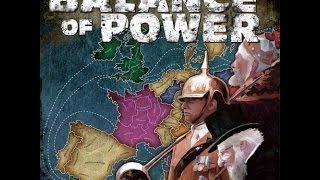
Balance of Power is a 2012 game from Catalyst Game Labs for two to six players, set in a Europe of 1815 where each player pushes for dominance through territory, pawns, and alliances. Reception across the available videos is mixed to negative, and the sources differ in kind. Only one of them is a full review. In that Board to Death TV review, the hosts liked the idea of a game with "Risk without the dice," but the play experience did not work for their group, and they concluded that "It just wasn't for us or our group of reviewers." They gave it a low score out of ten.
A second Board to Death TV video is a Gen Con booth tour narrated by Jason Hardy, the Shadowrun line developer at Catalyst Game Labs. Because the publisher is describing its own product, the enthusiasm in that segment reads more like a pitch than an independent verdict, though it still explains how the game works. A Watch It Played Gen Con vlog names Balance of Power only in passing, listing it among the Catalyst Game Labs demos the crew visited, and it offers no assessment of the game. The praise centers on the design idea and the table talk, while the criticism centers on luck, pacing, and novelty.
Core Mechanics That Define Balance of Power
Rock, Paper, Scissors Pawn Combat
Balance of Power replaces dice with a fixed hierarchy among three pawn types: generals, kings, and bankers. The Board to Death TV review explains that a general can eat a king, a king can eat a banker, and a banker can eat a general. The booth tour describes the same loop, with the king conquering the banker, the banker conquering the general, and the general conquering the king, and it stresses that the outcome is settled every time. Pawns can only be moved, attacked, or duplicated, and a territory can hold no more than three pawns at once, which keeps the board crowded and every skirmish readable.
Diplomacy and Alliance Building
The booth tour frames Balance of Power as a game where strategy depends on how players build alliances around the table. Players have to convince rivals that they are not the one to be attacked, or steer the table toward a player they want attacked so that they have room to expand. Because combat is predictable, the real contest is over who can persuade whom, and that negotiation is where the booth tour places most of the decision-making.
The Balance of Power Experience
Tense Table Diplomacy
The booth tour describes a game where the fun comes from talking as much as from moving pawns. The presenter says it is "a lot of fun" to do "that diplomacy around the table" while chasing victory, and the feel is closer to a political negotiation than a battle of rolls. Players who enjoy reading the table and making deals are the ones the reviewers imagine getting the most out of it.
Methodical, Sometimes Slow Turns
Turns can run long. Each turn offers one action per pawn type, up to three in total, and a bonus fourth action if a player controls the entire empire with no enemy units inside it. The Board to Death TV review says "some player turns can be long" and reports that they have seen players stall with analysis paralysis. The same review still describes the game as having "a lot of strategy," so the pace is slow but deliberate rather than aimless.
What Makes Balance of Power Stand Out
Risk Without the Dice
The concept that draws the most comment is the dice-free combat. The Board to Death TV review calls it "Risk without the dice," while the booth tour uses the phrase "risk without the luck." The booth tour uses the same framing as a shorthand for the game, and the review credits the idea even while faulting how it plays out for their group. For players who find Risk's dice too swingy, the fixed pawn hierarchy is the main reason to look at Balance of Power.
Production Quality and Piece Count
The Board to Death TV review calls the production "nice" and notes that players "get lots of pieces." The box includes a European map board, pawns in six colors for six players, reference cards that explain the actions and what beats what, and a scoring track. The reviewers treat the components as a clear strength, which matters for a game where so much of the fun comes from reading the board and the table.
Potential Drawbacks
The Missing Luck
The central complaint in the full review is that the group "kind of missed that element of luck." Risk players often value the single dramatic swing, where one hero can destroy an entire army, and the reviewers say Balance of Power does not offer that moment. Players who want unpredictability from their conquest games may find the deterministic pawn combat too calculated, and the review frames this as the main reason the game did not land for them.
Pacing, Novelty, and Replay Value
Beyond the missing luck, the review raises three further concerns. Some turns run long enough to cause analysis paralysis, the reviewers say the game "doesn't have any innovative mechanics," and they describe it as a "rock, paper, scissor Risk with low replay value." The reviewers do allow that it works as an introduction to area control, but they feel other games do that job better. Groups looking for a deep, varied experience may tire of its core loop.
If You Enjoy Balance of Power
Risk is the natural recommendation. Both Board to Death TV videos use Risk as the reference point, and the review's framing, a good concept with Risk's dice removed, explains why. Balance of Power keeps the goal of taking over a continent and adds a heavier layer of table diplomacy, but it swaps Risk's dice for pawn combat that always resolves the same way. If you enjoy the negotiation and want more chance in your conquest, Risk is the closer fit. If you want the no-luck version and are willing to accept long turns and a narrower core loop, Balance of Power is the one to try.
What Reviewers Are Saying
"Now, this game seems like it has a good concept, Risk without the dice. But when I actually played, we kind of missed that element of luck, and that single hero killing an entire army in Risk is always a good time."
— Board to Death TV
"The production quality is nice, and you get lots of pieces. There is a lot of strategy, but some player turns can be long, and we've had players with analysis paralysis playing this game."
— Board to Death TV
"And so it's very strategic and a lot of it is how you build up the alliances around the table. You're going to have to convince other players that you're not the one to be attacked or make sure they go after someone that you want attacked so that you have the room to expand to victory."
— Board to Death TV