



Barbarian Prince Deep Dive
What the Community Thinks About Barbarian Prince
Reviewers treat Barbarian Prince as a foundational solo adventure. In a video on solo hex crawls, The Dungeon Dive's Daniel calls it one of the granddaddies of the genre, and Rob's Tabletop World's Rob recommends it as an old-school print and play. Daniel explains that Reaper Miniatures gave permission to distribute a number of Dwarf Star Games titles freely, so the rules, events book, and map can be downloaded and printed at home. The shared view is that the game rewards players who enjoy dice-driven, sword and sorcery storytelling, and that it asks for patience with both luck and navigation.
Core Mechanics That Define Barbarian Prince
Dice Rolling
Dice decide most outcomes in Barbarian Prince. Daniel describes the game as mostly a matter of rolling dice and looking results up in the book's tables, and even the occasional choice usually ends with a random d6 result. Checks are built into travel, such as a 2d6 roll to see whether the party gets lost on entering a forest. Events trigger from a d12, so a player may go many turns without an encounter at all. Daniel sums up the approach as "rolling with the punches."
Hexagon Grid Exploration
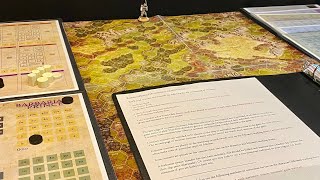
The map is a grid of hexes covering countryside, farmland, forest, hills, desert, road, swamp, and mountains, and each terrain type carries its own rules and event table. In The Dungeon Dive's guide to solo hex crawls, Daniel notes that the updated map is already filled in, so the player is not generating terrain while exploring, but must still track time of day and weather as they move from one hex to the next. Movement is where the grid asserts itself, and Daniel says it is "very easy to get lost in this game." Terrain also shapes who turns up: elves and pixies are more common in forests, and bandits are a constant presence on the road.
The Barbarian Prince Experience
Old-School Sword and Sorcery Storytelling
Daniel believes the strongest feeling is that of an old-school sword and sorcery tale told in installments. The event book gives only the barest elements of an encounter, such as a knight on a bridge, and leaves the player to embellish and connect the dots between nodes. Daniel recommends a journal for character names, the hex where each meeting happened, and events that persist if the party returns. Daniel also says the game has a ton of replay value, because a different direction or mix of terrain can change the flow, feel, and style of the adventure.
Tense, Luck-Driven Survival
The game feels like a race against a clock and hostile forces. The goal is to gather 500 gold and return to the kingdom within 70 days, and Daniel explains that a character who fails to cross the northern river by the end of the first day risks capture by royal guards. Daniel notes that the game usually ends in the death of the prince or in time running out, which gives each session a precarious, improvised quality. Players can trim the variance with small, deliberate choices, but Daniel stresses that much of the outcome is left to the dice.
What Makes Barbarian Prince Stand Out
Free, Print-and-Play Accessibility
Both channels emphasize how easy the game is to obtain and print. Daniel recommends the updated version posted on BoardGameGeek, which has the original errata built into the text and is slightly rebalanced, and notes that the essentials are a rulebook, an events book, and a map, with optional sheets for followers, character stats, and carried items. Rob describes it as "a good print and play" that anyone can find with a simple search. Low cost of entry is a large part of why the game remains a reference point for the solo hex crawl genre.
Learning Through Play
Barbarian Prince teaches itself. The event book directs the player to numbered rule paragraphs as needed, starting with paragraph 201 for starting attributes and 203 for daily actions. Daniel says the more you play, the fewer times you have to consult the rules, and advises players to trust the game to teach what is needed at the moment it is needed. For players put off by a rulebook read, this approach lowers the barrier to a first session considerably.
Potential Drawbacks
Heavy Reliance on Luck
Randomness defines the experience, and Daniel is direct that it may not suit players who dislike dice-driven games. Most choices resolve through a roll on a table, so careful play mostly softens the variance rather than removing it. Daniel also admits to skipping the encumbrance and food bookkeeping that the rules call for, since they add little fun and the game already feels hard enough without it.
Getting Lost on the Hex Map
Navigation can consume an entire run. Daniel recounts spending almost an entire week of game days trying to get from one hex to another, and warns that players can get stuck in a single hex for a long time. Because the 70-day limit keeps running during those detours, a few bad travel rolls can change the outcome of the whole game. Daniel suggests finding a guide to help, which signals how much of the challenge comes from the map itself.
If You Enjoy Barbarian Prince
Reviewers consistently point to The Drifter series as the closest relative. Rob calls The Drifter a homage to Barbarian Prince, and Daniel describes the series as an open-ended wilderness sandbox with almost no pre-written narrative, suited to players who like connecting the dots between random encounters. Daniel names The Adventurer as the fantasy entry in that series. Players who want more narrative direction may prefer Morin, which Daniel describes as more detailed and more complex than the Drifter books while still relying heavily on random elements.
What Reviewers Are Saying
"Ultimately I think this is one of the better solo games especially if you are into sword and sorcery fiction."
— The Dungeon Dive
"It is a good print and play that if you put it into the Google machine there, you will definitely find and be able to print out."
— Rob's Tabletop World
"If you are not a fan of randomness and of luck this game probably is not for you."
— The Dungeon Dive