/pic6352309.jpg)








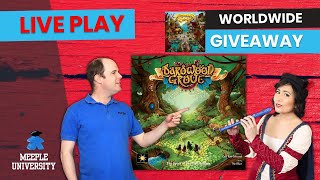




Bardwood Grove Deep Dive
What the Community Thinks About Bardwood Grove
Bardwood Grove arrives as a charming premise with a divisive execution. Meeple University walk through its deck-building twist and gorgeous art with genuine warmth, while 3 Minute Board Games came away frustrated, criticizing its pacing and identity. Reviewers recognize the creative potential of playing woodland creatures building a musical legacy, yet opinions diverge sharply on whether the game realizes that vision. The recurring tension is that reviewers love what Bardwood Grove looks and sounds like, but wrestle with what it actually plays like.
Core Mechanics That Define Bardwood Grove
Deck Building with a Twist
At its foundation, Bardwood Grove is a deck-building game, but one that breaks from convention by layering in a tempo wheel and a resource-conversion puzzle. Each turn you draw cards and choose which to play for immediate effect, building a persistent row that activates only when your tempo marker completes a full rotation around the dial. This deferred gratification creates anticipation, yet it also means much of a turn involves setup without payoff, such as drawing cards, shuffling, and waiting for your activation window. The deck-building itself focuses on acquiring cards that generate melodies, lyrics, and wild currency, all flowing toward board actions and the central push to collect crystals.
Resource Economy and Location Adjacency
Movement and action are tightly intertwined. You do not move freely; each turn you advance a set number of spaces determined by cards you discard, and only when you land on a space do you gain access to adjacent locations. You then spend resources to activate those locations or to reach farther. The locations form a web of conversion: trade lyrics for coins, soothe monsters with melodies to earn gems, and spend coins to buy better cards from the market. This location-based economy rewards spatial planning and punishes passive play, but reviewers note that the interlocking of movement and activation creates a pacing problem, since a mismatch between your tempo and your board position can leave you shuffling cards and waiting.
The Bardwood Grove Experience
Visual Beauty and Thematic Potential
Bardwood Grove is visually stunning. The art, created by the same artist behind Merchants Cove, saturates the game with whimsy and personality. Woodland creatures in their little huts, colorful resource tokens, and the magnetic tempo wheel all feel intentional and delightful. The theme of bards building their reputation by soothing beasts, gathering resources, and performing is evocative and immediately charming, and reviewers consistently praised the aesthetic as cozy, cute, and whimsical. The unlockable content, with new events and crystal types that mix and match, suggests a game designed for gradual discovery and replayability, setting a powerful expectation of a fun, lighthearted adventure.
Mechanical Disconnect from Theme
That expectation, however, collides with the ruleset. The complexity and mechanical density, spanning card acquisition, resource-conversion chains, tempo-wheel timing, badge placement, and many location types, felt at odds with the bard-in-the-woods fantasy. 3 Minute Board Games described the gameplay as too complex, busy, and mechanical for what feels like a whimsical adventure game. One reviewer noted that while the art direction is charming, the main decision point often comes down to which of two cards to take and which to discard, and that sometimes that was not much of a choice. The game seems to want to deliver both a heavy Euro experience and a lighthearted romp, and in trying to be both, it excels at neither.
What Makes Bardwood Grove Stand Out
Open Board Play and Replayability Systems
The board itself is genuinely open. You are not funneled through a prescribed sequence of actions; instead you roam and interact with whichever locations serve your strategy. One reviewer highlighted this freedom as a real strength, the ability to plot your own path to victory. Coupled with the unlockable events and crystal variants, the game promises variety and discovery. If the core loop itself were more satisfying, this openness would shine, though as it stands players sometimes find themselves free to move but unsure why, circling the board while waiting for the tempo wheel to turn.
Aspirational Design with Incomplete Tuning
Bardwood Grove does not stumble for lack of ambition; reviewers feel it stumbles because it seems unfinished. The components are carefully chosen, the art is inspired, and individual mechanics like the tempo wheel and badge economy are sound in isolation. But they do not fully cohere. The game asks players to optimize card-purchasing and tempo positioning as though building an economic engine, while the actual decision trees feel shallow and the pacing uneven. 3 Minute Board Games put it bluntly: the game does not quite know what it wants to be, leaning toward a bard adventure while also reaching for a Euro, and falling short of both.
Potential Drawbacks
Uneven Pacing and Passive Turns
The tempo-wheel system creates a rhythm where you only take a real turn every few turns. The intervening turns involve drawing cards, rotating the dial, and moving your pawn, all setup with minimal choice or reward. Intended to build anticipation, this rhythm instead creates dead air, and players report feeling sidelined on off-turns while they wait for their activation window. In a game of moderate length, spending a significant portion of it in passive setup drains momentum.
Flat Deck-Building and Shallow Decisions
The deck-building itself is narrow. You are not discovering deep synergies or building a unique engine so much as choosing between two cards and discarding the other. One reviewer stated plainly that the deck-building aspect feels a bit flat, since the card pool does not strongly reward clever combinations. The optimal path is often clear: buy the stronger card, discard the weaker, rotate the wheel. That straightforwardness would be fine in a lighter, faster game, but wrapped in this much complexity it can feel like going through the motions.
If You Enjoy Bardwood Grove
If Bardwood Grove's woodland charm appeals to you, Everdell delivers a beloved forest-creature tableau builder with richer engine-building and a stunning table presence. Merchants Cove, which shares Bardwood Grove's artist, offers asymmetric player powers and tighter economic decisions. For more of the cozy, story-driven animal-folk feel, Lands of Galzyr provides a lighter, whimsical adventure. And for deeper open-ended engine building if you do not mind a slower build, Ark Nova rewards long-term planning with far less pacing friction.
What Reviewers Are Saying
"It's a deck building game, but certainly with a twist, and certainly with a large board and some movement to play with. The beautiful art is by Mikko, the same artist as Merchants Cove."
— Meeple University
"Bardwood Grove doesn't quite know what it wants to be. It half-asses going into that kind of game, but then wants to also be a kind of Euro game as well, and it just fails at both of those things. It also has terrible pacing. You only get to take a real turn every three turns."
— 3 Minute Board Games
"The best thing about this game is its cute art direction. It all feels quite whimsical. However, it's a little too complex, busy, and mechanical for what feels like a theme better suited to a whimsical adventure game."
— 3 Minute Board Games