






Bargain Basement Bathysphere Deep Dive
What the Community Thinks About Bargain Basement Bathysphere
Reviewers generally agree that Bargain Basement Bathysphere is a charming solo package, though they differ on how much staying power it has. Beyond Solitaire calls it a cute, enjoyable push-your-luck roller with a campaign worth playing through, while stating plainly that the reviewer does not expect to return to it again and again. Watch It Played works through the opening scenarios on camera and comes away clearly delighted by the moments where a risky dive pays off at the last second. Tabletop Tokki is the most critical voice, arguing that after the first couple of maps the game left too little room for meaningful decisions. AzureDeath frames the game as an accessible way into solo play and legacy-style campaigns, noting that it can be printed at home on ordinary paper.
Core Mechanics That Define Bargain Basement Bathysphere
Push Your Luck Through Dice Allocation
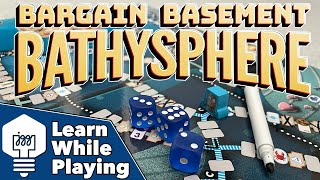
Getting Games explains that each turn begins with a pool of dice, one of which is chosen and used to move the bathysphere exactly that many spaces in a single direction, with no reversing mid-move. Every gray penalty space passed over forces a choice between losing oxygen or taking stress, while landing directly on such a space lets the player skip the penalty. Beyond Solitaire describes the same pressure as budgeting, since players spend dice to land on good spaces and dodge bad ones while re-rolling costs oxygen and skipped hazards accumulate. Watch It Played shows how quickly this tightens, as the reviewer keeps choosing stress over oxygen to reach a trapped diver, and each point of damage shrinks the number of dice that can be rolled. The further the bathysphere sinks, the more every roll matters.
Campaign Progression With Persistent Unlocks
The game is built around a 20-scenario campaign, and Getting Games notes that each scenario uses only part of one of three dry-erase maps while introducing new rules along the way. Results carry forward on a shared pad of pages, where completed tanks in the Aqua Museum grant a one-time bonus in a later dive. Watch It Played follows the same thread into scenario four, where the Salvage Rama lets players trade a die for a lasting special power. AzureDeath describes this kind of legacy design as permanent changes to how the game plays between sessions, which is what separates it from a standard roll-and-write. Beyond Solitaire credits the campaign with constantly adding something new so that the core loop never feels stale.
The Bargain Basement Bathysphere Experience
Tense, Suspenseful Diving
Watch It Played captures the tension of the dive in real time, with stress marks climbing, the dice pool thinning, and the oxygen track ticking down while a diver's clock runs out. The reviewer repeatedly second-guesses routes, sometimes changing a plan mid-turn and accepting damage to save a rescue. Beyond Solitaire describes a similarly fraught balancing act in which every oxygen spent on a re-roll is weighed against the penalties that might otherwise be taken. Losing on any one of the three tracks ends the dive, so the mood stays uneasy even when the scoring is going well.
Tongue-in-Cheek Nautical Adventure
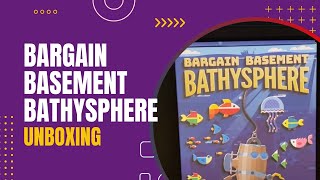
Beyond Solitaire singles out the writing as a major source of charm, pointing to rescued divers who wander off and to an aunt who leaves behind an empty aquarium despite being allergic to fish. The reviewer notes that the mechanisms feel less lively without the rulebook text, so the flavor is part of the experience rather than decoration. Getting Games opens the video by framing the player as the owner of a very small and dangerous submarine, one that is even more rickety than it could be. Watch It Played leans into the same comic tone, with the host joking about an eraser cap that keeps falling off and playfully punishing a rules slip. The result is a solo game that never takes its underwater peril too seriously.
What Makes Bargain Basement Bathysphere Stand Out
Short Sessions That Respect Your Time
Beyond Solitaire points out that the play time is about fifteen minutes outside the box and that each scenario is short, which makes the campaign easy to fit into a single evening or to finish in a few sittings. The reviewer appreciates that the game does not overstay its welcome, and that a player who performs well early can skip ahead rather than replay material that is largely the same. Getting Games similarly presents each scenario as a self-contained dive with a clear objective, such as reaching thirty points and surfacing before any track fills. That structure keeps each session focused on a single goal.
A Print-and-Play Origin With Affordable Retail Options
Beyond Solitaire explains that the game began as a print-and-play design that gained buzz on Board Game Geek before the published edition arrived. The reviewer finds the retail box a nice upgrade over scrounged household components, and feels the included campaign justifies the price. AzureDeath emphasizes that the free print-and-play version needs only ordinary printer paper, dice, and a pencil with an eraser. Together these reviews make the entry point unusually low for a campaign game.
Potential Drawbacks
Dice Luck and Limited Decisions
Tabletop Tokki found that after playing through the first few maps, the decisions felt constrained by the dice rather than by the player. The reviewer argues that stress and damage management often left little tension, since most choices were dictated by the roll in front of them. Getting Games shows a similar pattern when the roll comes up low and the player has to spend oxygen to roll again, though the reviewer still treats the outcome as part of the push-and-pull. Players who enjoy that tension will find it rewarding, while those who want deeper planning may find the randomness hard to forgive.
Shelf Life and Commitment to the Campaign
Beyond Solitaire warns that the early scenarios barely show what the game can do, so new players may need to commit to the campaign before they see its best ideas. The reviewer adds that the game is not likely to be one for the ages and does not expect to return to it repeatedly after finishing. Since the campaign is the main draw, players who only want a quick standalone roller may find the progression feels like a fixed path rather than an open sandbox. That makes the purchase a bet on the story and the unlocks as much as on the dice.
If You Enjoy Bargain Basement Bathysphere
Tabletop Tokki compares the game directly to Hold Your Breath and Deep Sea, noting the shared feeling of diving down while managing a vessel. Readers who enjoy that descent-and-return rhythm will recognize the core loop, although Tabletop Tokki's reservations about dice-driven decisions suggest comparing expectations before choosing. Those drawn to the legacy aspect may find Bargain Basement Bathysphere a comfortable first step, as AzureDeath presents it as an approachable introduction to changing, campaign-driven play.
What Reviewers Are Saying
"I really love that this game constantly is adding something new from stage to stage of the campaign because where mechanisms can get quite repetitive this game does a really good job of always giving you something new to either think about or work towards so that it keeps you moving through the campaign."
— Liz Davidson, Beyond Solitaire
"It felt like a lot of times you were just at the mercy of the dice and managing things like stress and damage on your bath sphere. Didn't really hold a lot of tension because a lot of the decisions that you made were just kind of based off of your die rolls."
— Tabletop Tokki
"We barely by the skin of our teeth survived Discovery Cove with one diver and a bunch of fish so let's take a look at what we scored in this round."
— Paula, Watch It Played