


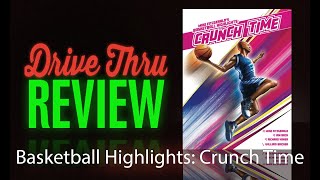

Basketball Highlights: Crunch Time Deep Dive
What the Community Thinks About Basketball Highlights: Crunch Time
Reviewers who have played Basketball Highlights: Crunch Time come away enthusiastic, and the praise is focused on one idea: this is a basketball game that captures how the sport actually feels. Drive Thru Games calls it the best basketball tabletop game they have played, and in a later year-end list they go further, saying that the title is the only good basketball game they know of on tabletop, card, or board game formats. Their reviews share a consistent argument that the game's short, card-driven structure is what makes it work, because it avoids the downtime that slows down many sports games on the table.
Watch It Played covers the game in a news segment rather than a full review, so its perspective is lighter. Matthew of Watch It Played places the game within Mike Fitzgerald's Highlights series alongside Baseball Highlights 2045 and Football Highlights, and frames the new basketball entry as a natural extension of a line the host already admires. The consensus across these voices is positive, with the main caveats centered on luck, the solo mode, and the reviewers' own enthusiasm for basketball.
Core Mechanics That Define Basketball Highlights: Crunch Time
Basketball Highlights: Crunch Time is a one- or two-player game designed by Mike Fitzgerald, with co-designers Ian Bach and Richard Yaner, and published by Eagle-Griffin Games. Its mechanics are built around two decks and a court with marked scoring zones.
Shot Cards and Zone Scoring
Each player is dealt seven cards from a shared deck and plays over five rounds. The reviewer at Drive Thru Games explains that the offense plays one shot card per turn, or two cards in certain rounds, and then moves up to two of their figures up to two spaces each. The defense responds by moving one defender one space. The goal is to place players in scoring positions, which include the diamonds near the hoop, which are worth two points, and the spaces beyond the three-point line. A scoring position only pays off if the player standing there is undefended, so the defensive move is as important as the offensive one. Playing two cards in one round does not add extra movement, but it opens more scoring opportunities. Drive Thru Games describes this as the core planning puzzle, in which each turn is an attempt to set up the next turn.
Star Cards and Superstar Scoring
Each player starts with one star card, and additional star cards are gained by completing every criterion on a shot card, which lets the player draw a new star card. Star cards can be played on offense or defense, and the reviewers stress that they score even when a player is defended, because they represent superstars. A star card must line up with a spot already filled by a shot card, and the same spot cannot be reused. The reviewer at Drive Thru Games notes that the defense can also play a star card to score, which can cut the offense's net points considerably. Unused star cards are worth one point each at the end of the game. If the score is tied after five rounds, the game moves into a sudden-death overtime in which each turn is scored and the remaining star cards keep their value.
The Basketball Highlights: Crunch Time Experience
Momentum That Mirrors the NBA
The feeling reviewers describe most often is momentum. Drive Thru Games argues that basketball is a sport built on runs, such as a 15-to-nothing stretch or a team that exploits a mismatch until the opponent adjusts, and that the game reproduces that dynamic. Early turns feel tidy because everyone starts bunched near the key, but the board opens up as players spread out, and a well-timed double-card turn can swing the score quickly. The reviewer also points out that professional teams rehearse set positions long before a game starts, and that Crunch Time recreates that kind of planning, which makes the game feel chess-like with a layer of surprise from the cards in hand.
Dramatic Swings and Comeback Tension
Reviewers consistently describe the late game as tense and swingy. Drive Thru Games recounts a session in which a lead of eight or nine points going into the final turn was erased, sending the match to overtime, and calls the experience tons of fun. The optional mercy rule for very large leads exists, but the reviewer advises players not to give up early, because a single turn can produce a dramatic reversal. The reviewer also says the balance of luck and tactics gives the game a puzzle-like feel, with enough planning to reward careful play and enough randomness to keep an opponent guessing.
What Makes Basketball Highlights: Crunch Time Stand Out
A Compact Game That Fits the Sport's Pace
Drive Thru Games repeatedly praises the game's short running time, which the box lists at about 20 minutes and which the reviewer says is roughly accurate. They contrast it with baseball and football games on the table, where long waits between plays slow down the experience. The reviewer argues that keeping the game short preserves the energy of a sports contest and avoids the blowouts that can make long sports simulations feel flat. Matthew of Watch It Played makes a similar point about the Highlights line, saying the series condenses the action into the moments that matter.
Basketball Translated to the Tabletop
The reviewers say that Crunch Time succeeds where other basketball games have not. Drive Thru Games describes the game as abstract, since it does not model movement or shooting in detail, yet it captures the planning and flow that make the NBA compelling. The reviewer highlights the moments when a player plans a fast break, moves a wing shooter into position, or sets up a drive and kick, and argues that these choices feel like real basketball decisions even though the game is card driven.
Potential Drawbacks
Abstraction and Luck From the Card Draw
The most consistent criticism is that the game is abstract and leans on luck. The reviewer at Drive Thru Games says the game is a little bit luck driven because it depends on which cards are drawn and which star cards a player manages to acquire, and because the opponent's hand remains hidden. Some players who prefer deeply strategic games may find this randomness frustrating, even though the reviewer considers the balance appropriate for the theme.
The Solo Mode and Its Limits
Reviewers describe the solo mode as decent but clearly secondary to two-player play. Drive Thru Games says the solo game is pretty good and that they like it, but they also say the automated opponent's behavior is a little bit random, since it flips cards and places its players according to a fixed procedure rather than a strategy. The same reviewer acknowledges a personal bias, because they love basketball, and says that players who do not care about the sport may not get much from the experience.
If You Enjoy Basketball Highlights: Crunch Time
Players who enjoy the card-driven scoring of Basketball Highlights: Crunch Time will find a natural next step in Baseball Highlights 2045 and Football Highlights. Both titles come from the same designer and share the Highlights series' focus on condensing a sporting event into a short, action-packed session. Players who value the idea of a fast, flowing contest that resists long downtime may also appreciate the contrast that Drive Thru Games draws with Blood Bowl, which the reviewer describes as a longer sports game that often runs 45 minutes or more and suits players who want a more sustained table experience.
What Reviewers Are Saying
"This is easily the best basketball tabletop game that I've played. It's a board game, it's kind of a card game too, so I almost want to call it a card game because it's so card driven."
— Drive Thru Games
"And for my money it's the only good basketball game in the world ever on tabletop or card or board game. This is a good quick 20 to 30 minute two-playing head-to-head game."
— Drive Thru Games
"I really do love baseball highlights. I like how the series condenses things to the action."
— Matthew, Watch It Played