/pic7314331.jpg)
Battle of GOG is a board game for 2-4 players set in the ancient land of Canaan. Designed by Vitali Minin, Battle of GOG challenges all family members to find 5 sacred scrolls as they battle over the land of Canaan.
Game rules are simple, combining strategy and luck equally, so anyone can win.
The game is easy to learn, but hard to master. Despite simple mechanics, game play involves complex strategic thinking. The map of the game can be assembled in numerous combinations, so each game session plays differently.
Sometimes you need to carefully consider whether to make a move that benefits yourself or one that puts your opponent at a disadvantage. You need to weigh many different pathways to victory: conquer cities, fight enemy soldiers, obtain the scrolls, or reach all 4 corners of the map to make a winning move.
With so many factors involved, even establishing 3 cities in the most abundant map areas won`t ensure your victory, as Ability Cards and Treasure Chest Cards can make the difference in a critical situation.
Lastly, remember that the Oracle of the game is GOG' and that he has the power to save you from the Angel of Retribution!
—description from the publisher

Battle of Gog (preview)
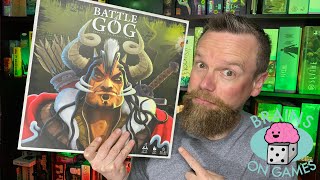
- Rich, modular map setup with strategic planning
- Multiple win conditions encourage diverse strategies
- Immersive theme and impressive component scale (Gog figure)
- High element of luck due to dice and treasure draws
- Complexity may be intimidating for new players
- Prototype nature means components and rules may change before release
- Conquest, resource management, city-building, and strategic combat
- Ancient myth-inspired realm featuring Gog and the Angel of Retribution on a modular map
- Preview/overview with setup and play demonstration
Mechanics (from transcript analysis)
- Ambush and one-off ability cards — Players can buy one-off abilities (e.g., ambush) to affect play; some cards are limited per game.
- Area Control — Aim to control cities and regions, with battles resolving through unit strength and dice.
- area control / conquest — Aim to control cities and regions, with battles resolving through unit strength and dice.
- City building and upgrading — Cities level up to increase resource yield and influence; upgrading requires resources.
- dice-driven movement and combat — Movement distances and combat outcomes are determined by dice rolls, with odds and doubles affecting events.
- Modular Board — Players place map tiles to create a variable board layout, with water adjacency rules.
- Modular board / tile placement — Players place map tiles to create a variable board layout, with water adjacency rules.
- Multi-Use Cards — Treasure cards grant bonuses or penalties; some affect all players except the user; some cards grant one-time abilities.
- Once-Per-Game Abilities — Players can buy one-off abilities (e.g., ambush) to affect play; some cards are limited per game.
- Resource Management — Gather wood, food, and gold to upgrade cities and recruit soldiers.
- Special spaces and tokens — Volcanoes, ruins, water-adjacent rules, camels for trading, and treasure spaces influence strategy.
- Treasure and ability cards — Treasure cards grant bonuses or penalties; some affect all players except the user; some cards grant one-time abilities.
- Win-condition variety — Three paths to victory: collect all scrolls, place a city in all four corners, or destroy all opponent cities.
Video topics + discussion points
Quotes (from this video)
- this is gog
- becoming king of the land of kanan
- executive functioning skills