
Game Info
Year
2024
Players
1
Age
12+
Playtime
60 min
Publisher
The Game Crafter
Collection
Ratings
Creator Score
Mechanic profile
Waiting on more creator content
Vibe profile
Waiting on more creator content
Description
A solo civilization-building card game played without a table where you score against rival civilizations by orienting your deck and upgrading your nation card over 12 rounds
Featured Videos

Ask a Rules Question
All mentions
Browse transcript mentions, sentiments, pros/cons, mechanics, topics, quotes, and references.
Total mentions: 1
This page: 1
Sentiment:
pos 1 ·
mix 0 ·
neu 0 ·
neg 0
Showing 1–1 of 1
Video 2vXOYKfH9tA
Sir Thecos Review at 0:21 sentiment: positive
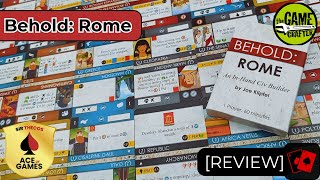
Click to watch at 0:21 · YouTube ↗
Overall sentiment (raw)
positive
Pros
- Thematic immersion is very strong.
- Actions, upgrades, and abilities make sense in the historic context.
- Art, iconography, and rules are well done.
- Gameplay is fluid and understandable.
- Simple concept with a lot of depth.
- Different opponents add depth and interest.
- Feels different from other in-hand card games.
- High replayability.
- Well designed.
Cons
- Steep learning curve.
- Getting good at the game takes many plays.
- Not a quick game to learn and play.
- Long play time.
- Can be complex to grasp initially.
Thematic elements
- building up your civilization over time
- historic context
Comparison games
- Dragons of Edge and Stone
Mechanics (from transcript analysis)
- Area Control — Conquering and controlling regions is a mechanic that can be used to gain resources and points. Conquered regions have a wealth value.
- Card upgrading/downgrading — Cards have levels and you can upgrade or downgrade them. This is a system present in many inhand games.
- Deck Building — You are really building a small civilization with just 18 cards.
- Hand Management — The game is fully playable in your hand. You only work with the cards you have in hand. It requires manipulating cards and keeping the deck firm in your hand.
- Resource Management — You can store resources like population and materials during the course of the game. Storing resources is key to upgrading your civilization.
- Set Collection — Specific combinations of symbols or conditions on cards can lead to scoring points or activating abilities.
- Tableau Building — Upgrading cards and activating them in your play area contributes to your civilization's engine.
Video topics + discussion points
No key topics recorded for this video.
Quotes (from this video)
- The theme really shines in this game.
- It recreates the feeling of building up your civ over time really well.
- It doesn't just have a cool theme, but it's actually quite thematic since a lot of actions, upgrades, and abilities do make sense in the historic context.
- It's just a game that looks the part, making you more excited to dive into it.
- The concept is simple, but has a lot of depth.
- While it's an in-hand card game, it surely feels way different than the ones most of you may know.
- Because, yes, it's very long and complex.
- The game has a really steep learning curve.
- Getting good at this game takes a lot of plays in my opinion.
- That's why it has a higher replayability, which I truly appreciate.
- It is very, very well designed.
- I'm just not getting better at it, but I'm still having fun playing it.
References (from this video)
No references stored for this video.
Transcript Navigation
Showing 1–1 of 1