/pic3787537.jpg)
Artaios, the First Father, had six children with his wife, Branwen, the First Mother. They grew up to be gods and guardians of the biosphere. The siblings loved each other very much. They were strong of build and sharp of mind. Whatever they attempted, they succeeded with ease, and faultlessly. When the young gods had grown to adulthood, Artaois and Branwen bade them each create something to add it to their creation, so that it would enrich the world and populate it. And thus, the gods created six very different types.
Time passed and the creations of the gods multiplied and spread without restraint across the biosphere. And so it came to pass that Artaios and Branwen bade their children bring order to their creation. Whoever would be the first to bring their population into accord with the biological order would be called "Lord of Creation" from thereon.
In Biosphere, the player siblings each control groups of different populations (dubbed "types" in game terms). In each round, a percentage of the types goes extinct, then players receive and spend evolutionary points to make their types either larger or smaller, and more versatile or more dedicated depending on what they think is appropriate for the landscape (which is scaled based on the number of players) and the current state of the game. Reproduction, movement, and lifespan can all be modified by players during the game. If a player meets the right conditions, they can play one development card from hand, gaining benefits from this. Players then move across the landscape, reproduce, and fill the different terrains based on their positions relative to other players.
How do the siblings prove their worth to Artaios and Branwen? By fulfilling assignments revealed at the start of play. One assignment is drawn from each of seven categories, and once a player completes an assignment, they mark it, with others still being able to mark it later. Whoever first fulfills five assignments wins the game.


Mechanics (from transcript analysis)
Video topics + discussion points
Quotes (from this video)
- Village Green which I really enjoy
- that's life that's like one of the best like Cooperative games ever
- Polynesia you know what came out last year
- Sushi or sushi I have no idea to pronounce it I'm sorry
- it's a bit long but it's very interesting mechanics it evolving in some ways
References (from this video)
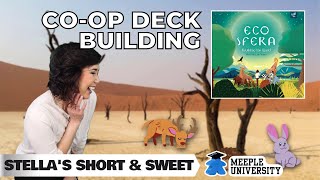
- Cooperative deck-building is highlighted as a refreshing twist.
- Engaging environmental restoration theme.
- Colorblind-friendly and eco-conscious production notes (FSC, renewable energy).
- Strategic depth in planning with a team.
- Components shown are prototype and rules are not final.
- ecological restoration and biodiversity
- environmentalists attempting to restore seven biomes
- cooperative problem-solving toward restoring habitats
Mechanics (from transcript analysis)
- Biodome construction — Collect two matching animals to build biodomes, the central objective to win.
- Card Drafting — On your turn you draw cards and purchase from the common display; chain purchases are possible.
- Card drafting/purchasing from display — On your turn you draw cards and purchase from the common display; chain purchases are possible.
- Cooperative Game — Players collaborate and can trade/give cards to support each other.
- cooperative play — Players collaborate and can trade/give cards to support each other.
- Deck Building — Each player starts with a small deck and adds cards from a common display; some cards can be used immediately to buy more, enabling chains.
- deck-building — Each player starts with a small deck and adds cards from a common display; some cards can be used immediately to buy more, enabling chains.
- Disaster mechanics — Disasters penalize players; three disasters on your display can extend or end the game for the team.
- Set Collection — Gaining animal cards by matching plant/fungi symbols and other symbols to build biodomes.
- token-based actions — Tokens allow refreshing card displays or discarding to support others.
Video topics + discussion points
Quotes (from this video)
- the game is of light to medium complexity
- you start with your own deck of five
- two disaster cards
- on your turn you draw four cards and must purchased at least one card from the common display using your plate cards
- it is possible to use it immediately to buy another card
- there isn't a lot of Cooperative deck building out there
- planning the strategy with your team is a must if you want to save the animals
- the twists is refreshing things like buying card is compulsory leaving some cards in the market for other players to buy
- colorblind friendly with the color plus symbol for each card
- collect all seven biomes then to win
- 100 renewable energy FSC certified
- the components featured in this video are prototype so rules are not final
References (from this video)
- Unknown
- Unknown
Mechanics (from transcript analysis)
Video topics + discussion points
Quotes (from this video)
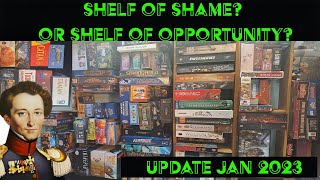
- I used to call this a shelf of shame that was a pretty common thing to call it back in the day and I don't never really liked that term because I don't feel shame that I haven't got to these games
- this is mostly work like this is just a backload of things I probably should get to
- people will still be looking for it
- it doesn't matter if the game is like 20 years old people will still be looking for it
- I've painted this one and I spent a lot of time doing it
- there's no point putting them on the channel I think both of them have been out of print for like a decade
- one of the worst kickstarters by one of the worst studios in board gaming history
- Golden Bell Studios did everything wrong you could possibly think of
- purely toxic company run by incredibly terrible people
- it would be kind of a joke that I'd be able to do a three minute video of feudum
- this game has a tutorial video online that's like 40 minutes long
- The Rose explanation video feels like a parody but it's actually how the game is played
- nothing personally to me puts me off playing a game that then sitting down unboxing it and having a craft assignment
- stop making me spend hours assembling your damn games
- this is an uncontrollable mess right now
- I'm a full-time dad and I'm really doing this in the evenings
- I have a finite space and also it just puts pressure and stress on me having a whole bunch of crap there that I know I'm not going to get to
- I'm going to do a big cull
- I will be published by this company but that doesn't mean I'm going to be slavishly devoted to every single game they put out
- I am a sucker for cute animal games like I really am