


Booze Barons Deep Dive
What the Community Thinks About Booze Barons
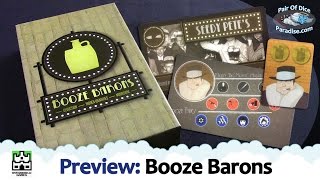
Booze Barons is a hidden identity game set during Prohibition, published by Overworld Games, the same company behind Good Cop, Bad Cop. The reviewers who covered it agree on the premise and disagree on how well that premise holds up in play. Pair Of Dice Paradise opens by describing the 1920s, when selling alcohol meant either going without or starting a shady business, and the game places players in that trade as rival kingpins smuggling liquor to speakeasies while dodging the law. That video is a promotional preview for the Kickstarter campaign and was filmed with a pre-production prototype whose artwork and components may change, so its tone is enthusiastic rather than critical.
The critical voices are more reserved. Board to Death TV - Board Game Reviews gave the game a three out of 10 and argued that its theme is stronger than its design. The Dice Tower revisited the game in a retrospective and scored it five out of 10, placing it below the publisher's earlier title. The shared view is that the idea of smuggling goods while hiding your allegiance is appealing, but that the deduction and tension depend on a balance the game does not fully achieve.
Core Mechanics That Define Booze Barons
Simultaneous Movement and Location Actions
Each round begins with a movement phase in which every player secretly selects one of their movement cards and places it face down to choose a location board. Board to Death TV explains that the cards are revealed together and that each pawn moves to the chosen location, so no one can stay put. The action phase then runs in turn order, beginning with the Booze Baron, and each player takes one action: collect a delivery card, trigger the printed event at the location, tail or expose another player, or pass. Pair Of Dice Paradise notes that location actions vary and that some can only be used under certain circumstances, which turns the choice of where to land into a strategic decision. Movement cards carry value beyond their function, since Board to Death TV counts two coins for each movement card a player holds at the end of the game, including cards taken from rivals.
Tailing and Exposing Opponents
The deduction core runs through delivery cards and tailing. A player can take a delivery card only if it shows the outfit icon of their secret mob, so every successful delivery reveals a little more about who they are. Instead of delivering, a player may tail a rival in the same location and, according to Pair Of Dice Paradise, peek at that rival's collected delivery cards for about 20 seconds. The tailing player may then steal a matching card or attempt an exposure by guessing the rival's secret booze type. A correct guess flips the exposed player's identity card face up, gives the exposer that player's current movement card worth two points, and bars the exposed player from the chosen location. The first player to expose another also takes a snitch token. The game ends when only one unexposed player remains, and the most coins wins.
The Booze Barons Experience
Nervous Hidden-Identity Tension
The strongest feeling Booze Barons creates is the quiet anxiety of working in plain sight. Each delivery is a move in a bluff, and each tail risks handing an opponent the clue they need. Pair Of Dice Paradise captures this with its warning not to get cocky about deliveries, and the 20-second peek adds time pressure as the tailing player tries to memorize what they see. Board to Death TV describes the appeal in these terms: the theme involved "making delivery, trying to stay hidden as long as possible, and denouncing others." That tension is sharpest early, before exposures have revealed anything, and Board to Death TV observed that it fades once other players are exposed.
The Frustration of an Easy Guess
The second feeling is frustration when deductions stop feeling earned. Board to Death TV found that identities were too easy to pin down, and that many apparent deductions were really the game pointing players toward an opponent's likely destinations or identity. A correct guess therefore felt less like the result of careful reasoning and more like something the rules handed over. The reviewers compared the resulting experience to a simple game of Guess Who, with the hidden-information theme present but the decisions lightweight. The frustration is not with losing, but with the sense that the outcome was already decided.
What Makes Booze Barons Stand Out
A Prohibition Premise With a Clear Narrative Reason
Reviewers praised the theme as a strong foundation even when they criticized the execution. Board to Death TV called the concept "a cool concept" and identified its core loop of delivering, hiding, and denouncing rivals as a natural fit for the period. Pair Of Dice Paradise framed the game around the Prohibition-era choice between no legal alcohol and a dangerous underground trade, which gives the hidden-identity mechanics a clear reason to exist. Because the setting supports the mechanics so directly, the criticism focuses on how the design delivers on the theme rather than on the idea itself.
Sturdy Components and an Inclusive Cast
Board to Death TV singled out the physical production, describing the components as nice, big, and sturdy. The same review praised the game's representation, saying of its cast that there is "a big kudos to gender and racial equality in this game." Board to Death TV was less enthusiastic about the artwork, finding the muted palette so unusual that it looked like a printing error. Pair Of Dice Paradise showed a pre-production prototype, so the final art may differ from what was judged in these videos.
Potential Drawbacks
Identities That Are Too Easy to Guess
The central criticism in Board to Death TV's review is that deduction is too easy. Once exposures begin, the remaining identities become evident, and the matching-icon strategy that players build early quickly loses its value. Board to Death TV proposed that the game would have worked better with more outfits for each mob family and a penalty for wrong guesses, arguing that the missing ingredient was risk. Without that risk, the reviewers felt the game became a race that was disconnected from its theme. Pair Of Dice Paradise, as a promotional preview, does not dwell on this issue, so the criticism rests mainly on the more critical reviews.
Thin Consequences and Limited Replay
Board to Death TV argued that the lack of consequences for wrong guesses left failure unrewarding. The reviewer wrote that "regardless if a game is casual or not, it needs to have that rewarding feel that you did something." The conclusion was that the game "isn't fun enough for it to have replay value, and it loses its novelty fairly quickly." The Dice Tower's retrospective reached a similar verdict from a different angle, rating the game five out of 10 and treating it as a weaker title from its publisher.
If You Enjoy Booze Barons
The Dice Tower offers the clearest comparison. Its retrospective says that Booze Barons did not reach the level of Good Cop, Bad Cop, the other Overworld Games title named in the transcripts. Players who enjoy the secret-identity bluffing of Booze Barons but want the version that reviewers considered more successful should look to Good Cop, Bad Cop. That recommendation rests on the publisher's track record as described by reviewers, so it is best read as a direct step up in polish rather than as a copy of the same mechanics.
What Reviewers Are Saying
"That's what the game was missing, some risk. Without it, it simply became a race, which to me felt like it was really disconnected from the theme."
— John Carlo and Felicia, Board to Death TV - Board Game Reviews
"Players may only take delivery cards matching their secret booze type so every delivery that you make gives another clue to your competitors as to the secret of your identity so don't get cocky. Instead of making a potentially incriminating delivery player may choose to take the tail action instead."
— Pair Of Dice Paradise
"I reviewed Booze Barons. This is from Overworld Games. You probably know them best for Good Cop, Bad Cop."
— Tom Vassel, The Dice Tower