








Boss Monster Deep Dive
What the Community Thinks About Boss Monster
Boss Monster, the dungeon-building card game from Brotherwise Games, is remembered fondly by nearly everyone who covers it, though most of that coverage is affectionate rather than deeply analytical. The fullest review comes from Felicia and John Carlo of Board to Death TV, who score it 8.5 out of 10 and call it great for a filler game. Board Stupid puts it on a top five list of card games and says the whole 8-bit artwork gives it the feeling of a video game. Cardboard Crew names it an oldie but goodie in a recommendations list, and Nights Around a Table picks it as a small game that fits in a backpack and can be taught to a group within 30 minutes. The warmth is not universal. Mark of Board Game Coffee, looking back on it years later, remembers liking it but suspects many people did not share that feeling. The shared verdict is a light, silly, lucky card game whose presentation does a lot of the work.
Core Mechanics That Define Boss Monster
Building a Five-Room Dungeon
Each player is a boss monster building a dungeon of room cards to the left of the boss card. Board to Death TV walks through the structure. Every turn has a build phase in which a player adds one room, either a regular room or an advanced room with a gold icon, which must be built on top of an existing room that shares at least one treasure type. A dungeon holds at most five rooms, and completing the fifth levels the boss up and triggers its ability, which happens only once per game. Watch It Played's two-part playthrough shows how rooms combine. Rodney Smith leans on the Boulder Ramp, which lets a player destroy another room in the dungeon to deal five extra damage, and pairs it with the Recycling Center, which draws two room cards whenever another room in that dungeon is destroyed. Luke Smith opens with the Construction Zone, which allows an extra room to be built immediately. Rodney also clarifies a rule that confused viewers: a room's own destroy ability only resolves when a player chooses to destroy it for that purpose, not when another effect such as the Boulder Ramp removes it.
Luring Heroes With Treasure
The heart of the game is attracting heroes. At the start of each turn, a number of heroes equal to the player count arrive in town, and in the bait phase each one goes to the dungeon showing the most of the treasure symbol it wants. A tie leaves the hero in town. The hero then walks the dungeon, taking each room's damage in turn. A hero who dies becomes a soul, and a hero who survives the whole dungeon wounds the boss. Ten souls wins, and five wounds knocks a player out. Once the regular hero deck runs out, epic heroes are revealed instead. Watch It Played shows the treasure race in action, with Rodney building a room to cover a bag of gold so that two thieves would go elsewhere, and a fool hero that goes to whoever has the fewest souls.
The Boss Monster Experience
A Retro Video Game Feel
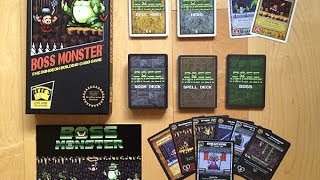
The 8-bit presentation is the first thing every reviewer mentions. Board to Death TV calls it marketing genius: pixel art throughout, a box made to look like an old Nintendo cartridge, and an expansion boxed like a Game Boy game. Board Game Coffee recalls the same cartridge boxes as the clever part. Board Stupid says the artwork gives the gameplay a video game feel, and Cardboard Crew compares sending a hero through a dungeon to the nostalgia of old side scrollers, adding that it is not Mario but gives the same vibes. Board to Death TV also points out that the cards allude to other games and geek culture, from Game of Thrones to Magic: The Gathering.
Silly, Light and Portable
Reviewers treat Boss Monster as a light game. Board to Death TV calls the gameplay solid fun and silly, the kind of game that is enjoyable win or lose, and suggests it works best at three to four players with the expansion. Nights Around a Table values it as a backpack game for any four people. The Smiths' playthrough captures the tone well, full of good-natured ribbing as one dungeon falls behind and a joke about quitting the game on camera before the final count. Cardboard Crew frames the goal playfully: make the dungeon the most exciting place heroes could possibly visit.
What Makes Boss Monster Stand Out
Tactics Hidden in a Simple Race
Beneath the luck, Board to Death TV sees real tactical choices, mainly in which spells to play and which rooms to build to bait a hero, or to stall one before it reaches the leading player's dungeon. The Watch It Played sessions bear this out: Rodney builds a room specifically to cover a treasure symbol and dodge two thieves, and both players time Boulder Ramp destructions to finish off epic heroes. Spells can be played in the build phase, such as one that stops a room from being built that turn, or in the adventure phase.
Staying Power
Boss Monster has lasted. Grant Lyon's roundup of new retail editions covers the 10th anniversary edition from Brotherwise Games, which adds new room cards and four new bosses, and credits the game as the one that put Brotherwise on the map. Grant stresses that staying in print for ten years is a real achievement when many games never get a second print run. Board Stupid notes it has gained a few expansions, and Board to Death TV reviews the Tools of Hero-Kind expansion, which gives heroes items that make them tougher and lets a boss keep a slain hero's item in a one-slot treasure room.
Potential Drawbacks
Luck and Uneven Cards
Board to Death TV is direct about it: the game is heavily based on luck in card draws, and some cards are simply overpowered compared to others. The pair single out the All-Seeing Eye, which they think should deal less damage given how powerful its ability is. Watch It Played's playthrough shows how lopsided a game can get, with Rodney admitting partway through to being in the losing position by quite a bit.
Fuzzy Spell Timing and Mixed Feelings on Expansions
Board to Death TV warns that gamers may find spell responses unclear, such as whether one spell can be played in response to another, and concludes that only the counterspell appears to allow it. The pair accept this because the game is far more casual than Magic: The Gathering. Expansions divide opinion too. Board to Death TV scores the game with Tools of Hero-Kind in play, while Mark of Board Game Coffee disliked the expansion enough to vow never to play with it again.
If You Enjoy Boss Monster
Reviewers rarely set Boss Monster beside other board games. The one direct comparison comes from Board to Death TV, which contrasts its loose spell responses with Magic: The Gathering and notes that the cards reference Magic, so players who enjoy the card-game in-jokes may find more of that world there. Cardboard Crew's point of reference is not a board game at all but side-scrolling video games like Mario, which is the nostalgia Boss Monster is built to trigger.
What Reviewers Are Saying
"The game play is solid fun, silly, and win or lose you'll have a great time playing it. Yes, it's heavily based on luck in the sense of card draws and some cards are just overpowered compared to others."
— Felicia and John Carlo, Board to Death TV
"Boss Monster is a very fun, small game that I can always put in my backpack and pretty much just have any four people around me and teach them within 30 minutes."
— Nights Around a Table
"You just want to make it the most exciting possible place you can be, because then who doesn't want to go to an exciting dungeon? Who doesn't want the greatest treasures of all time?"
— Cardboard Crew