


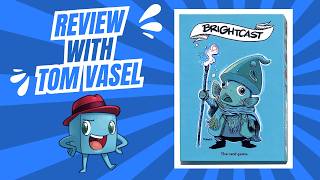

Brightcast Deep Dive
What the Community Thinks About Brightcast
Brightcast, a two-player card game published by Dryad Games in 2024, drew a mostly critical response from the reviewers covered here. The one point of broad agreement is the art. The Dice Tower called the artwork "fantastic," and Tabletop Tokki said they "really liked the art for this one," but neither channel recommended the game on the strength of its play.
Tom Vasel's segment on Brightcast came in a roundup of six games that Tom did not enjoy, and the segment closed with a rating of three out of ten. The Dice Tower's dedicated video was similarly unimpressed, describing the game as "very very forgettable." Tabletop Tokki was more measured, calling the game "functional" but not "unique or novel outside of just the aesthetics." Taken together, reviewers saw an attractive box around a game that offered little to remember once the cards were put away.
Core Mechanics That Define Brightcast
Take That Interaction
Take That is the heart of how Brightcast plays. Each Spellcaster card a player puts into play triggers an action aimed at the opponent: the Druid lets a player take a card from the opponent's hand, the Sorcerer removes one of the opponent's cards from play, and the Dragon removes three of them and is itself killed. The Dice Tower compared the game directly to this style, saying "it's like a take that two-player game." Reviewers described the result as a steady exchange of discards and card draw rather than a contest with long-term consequences.
Spellcaster Set Collection
The second mechanic is a set collection race built on the Spellcaster cards. A player wins by getting one of each of the six Spellcaster types into play, or five copies of the same type. Underneath that goal sits a simple hand management loop: players start with four cards, draw one each turn, and play one to trigger its action. The Dice Tower described the same loop when explaining the rules, which is the engine that keeps the race moving.
The Brightcast Experience
Repetitive, Predictable Turns
The most consistent feeling reviewers reported is repetition. The Dice Tower summed up the loop by saying that "you rinse and repeat till someone just gets the victory condition," and argued that the game's strategy amounts to playing cards that make an opponent discard and then cards that give the player more cards. Tabletop Tokki found that a lot of the powers were "very basic," which made the game feel functional rather than tense. Reviewers did not describe moments of real suspense or a sense of building toward a climax.
Striking Art With Thin Play
The other experience is a gap between how the game looks and how it plays. The cover art, a fish wizard, and the card illustrations were the features reviewers kept returning to, and The Dice Tower said the "artwork is fantastic." The same reviewer's conclusion was blunt, though: "Unfortunately, that's the best I can say about this game." For these reviewers, the box promised more than the card play delivered, and the visual appeal did not carry the experience once the rules were understood.
What Makes Brightcast Stand Out
Artwork That Reviewers Praised
Art is the one feature every reviewer treated as a genuine strength. The Dice Tower opened with praise for the cover illustration and assumed the same artist designed the game. Tabletop Tokki said the aesthetics were what set the game apart from others of its kind. Reviewers who disliked the mechanics still described the look of the game as "cool" and "classy," which suggests the visual identity is the part of Brightcast most likely to be remembered.
A Compact Two-Player Package
Brightcast is built for a single pair of players in a small footprint. The Dice Tower read the box's claims that the game "takes minutes to learn" and offers "Seven unique characters with their own special abilities," and Tabletop Tokki noted simply that it "only plays two players." Reviewers did not argue that the format was wrong for a quick duel. Their objection was that the quick duel did not contain enough decisions to hold attention.
Potential Drawbacks
Little Strategy and Few Distinct Powers
The most serious criticism is that Brightcast offers little strategy. The Dice Tower said plainly that "There is no strategy in this game," adding that "You just play cards that make your opponent discard cards" and then play cards that give the player more. Tabletop Tokki reached a similar conclusion, noting that many of the powers were basic take-that, draw, and discard effects and that the game was not "necessarily unique or novel." Reviewers who wanted meaningful choices or a distinct identity did not find them here.
Abilities Kept Off the Cards
The Dice Tower also objected to the way the game presents its information. The reviewer asked why the abilities were not printed on the cards and noted that they sit on a separate reference card instead. Because the artwork takes up most of each card, the reviewer argued that the designers should have added the ability text, or at least symbols, to the cards themselves. For a game that depends on players remembering what each Spellcaster does, this was a real friction point at the table.
If You Enjoy Brightcast
Brightcast is best suited to players who want a short, low-commitment two-player duel and care most about illustration. The take-that interaction and the Spellcaster race give the game a quick, direct rhythm, and players who enjoy looking at attractive cards between turns may find enough to like. Reviewers were clear, however, that this is not a game for players looking for strategic depth, tension, or a memorable identity. Players who want more decisions per turn will likely find this one thin.
What Reviewers Are Saying
"There is no strategy in this game. I know they talk about strategic. You just play cards that make your opponent discard cards, and then you play cards that give you cards."
— The Dice Tower
"I really liked the art for this one, but it wasn't for me. It only plays two players, and a lot of the powers were very basic, kind of take that, draw more, go through, discard, etc."
— Tabletop Tokki
"Just put them on the cards. You spent the whole card with artwork. The artwork's nice, but put the ability on the card, or at least some symbols that tell me what that card does."
— The Dice Tower