


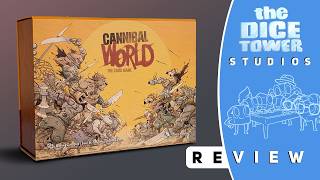


Cannibal World Deep Dive
What the Community Thinks About Cannibal World
Cannibal World is a head-to-head card game in which factions of animal combatants fight in a post-apocalyptic world, each trying to destroy the other's habitat. Reviewers at The Dice Tower agree that the game looks striking and offers a few ideas that set it apart from other dueling card games, but they disagree about how much those ideas are worth. The artwork and production earn the most consistent praise. The rulebook and iconography earn the most consistent complaints. In a later week-in-review segment, Joey Evans, The Dice Tower described the game as fine but almost there, with icons that were a little complicated, and gave it a 6.5.
The sharpest criticism is that the game feels derivative. Reviewers acknowledge that the front and back row layout, the defend-and-destroy structure, and the trading-card style of deck building have all been seen before, and they say a crowded market makes that familiarity harder to forgive. Even so, the reviewers do not dismiss the game. The consensus is that Cannibal World rewards players who commit to learning it and who are willing to live with its clunkier edges.
Core Mechanics That Define Cannibal World
Meat Tokens and Opponent-Turn Interaction
Each turn a player draws a card and spends meat tokens as the action currency, then replenishes back up to four from the supply. The distinctive part is that a player can spend two of their own meat tokens during the opponent's turn to cancel an incoming combat or triggered ability. Reviewers describe this as a meaningful choice: you can spend those actions to block, or take the hit and keep your full turn. The decision feels like defense versus offense, so the defending player is not simply sitting back and watching. The cost is that heavy spending on the opponent's turn leaves a truncated turn of your own, so every block has to be weighed against what you will need on your next turn.
Repeatable Attacks Without Exhaustion
Units that attack in Cannibal World do not exhaust or tap, so a sturdy creature can attack again and again until it dies, as long as its owner can pay for each attack. Damage is permanent, so one tanky unit can keep pressing an opponent's board across several exchanges. Reviewers singled this out as the clearest departure from familiar head-to-head games. The attack structure rests on a front row, a back row, and a habitat card. Front-row units can attack directly, attacks pass to the back row or through to the habitat when the rows in front are empty, and the habitat must lose all three of its tokens to end the game.
The Cannibal World Experience
A Clunky Learning Curve That Eases With Repetition
Reviewers describe the first few sessions as demanding. Cards use a range of small colored symbols, the faction abilities are printed in very small type, and several rules had to be looked up during play, including the fact that a stunned unit needs an action to recover and that some tokens come from the supply rather than a player's own pool. Joey Evans summed up the experience by noting that there are little clunky things, but that the more a player dives into the game, the more they will enjoy it. Reviewers expect the icons to become second nature once two players have been playing regularly.
A Striking, Minimalist Table Presence
Reviewers consistently said the game looks good on the table. Habitat cards display their hit points openly, so the state of the game is readable at a glance, and the minimalist layout gives the play area a stark, graphic feel. The components support this. The plastic tokens are double-sided, with a wound on one side and meat on the other, and the cards are large format. The magnetic box and its artwork were also well received, and reviewers agreed the production is very nice. The look is central to the appeal, and one reviewer noted that the game lands differently for players who already know the source comics.
What Makes Cannibal World Stand Out
Oscar Martin's Stylized Artwork
The art is the most consistently praised element. The game draws on the Solo comic books of illustrator Oscar Martin, and reviewers describe the artwork as stylized and thoroughly in the artist's own voice. Reviewers were clear that the art can be adult, with a fair amount of nudity and many scantily clad figures, so the style is likely to divide players. For fans of Martin's work, the artwork is a major draw, and reviewers agree that it lifts the game's presentation well above its mechanical peers.
Reinforcements and Side-Deck Customization
Reviewers singled out the reinforcements rule as a clever mechanic. Units can be pulled from a side pile built during deck construction, so a player who loses a unit can bring in a replacement and keep the pressure on. Reviewers liked that this adds a layer of planning, since the side pile is part of the strategy rather than an afterthought. Deck customization also lets players swap out any character they dislike for another from the box, and one reviewer felt that this flexibility is where the game would shine.
Potential Drawbacks
A Derivative Feel in a Crowded Market
The most serious criticism is that Cannibal World feels derivative. Reviewers said that the core loop of attacking an opponent's board and wiping out their units is well-trodden territory, and that the game plays as a tactically fine but somewhat repetitive entry in a crowded field. The attack-without-exhaustion rule is treated as a real departure, but reviewers felt the surrounding framework is familiar. Reviewers also pointed out that the market contains many single-box games that reach the table more easily and place less demand on the player's knowledge of iconography.
Rulebook Organization, Iconography, and Points-Based Deck Building
Reviewers were frustrated by several presentation choices. The rulebook is organized in a way one reviewer found confusing, with essential rules placed under a heading that suggests they can be skipped by experienced card game players. The difference between the shoot and stab icons is unclear, and the rule that a win by exhausting the opponent's cards depends on the remaining attack total compared with the meat on the habitat was described as more complicated than necessary. Deck building is also demanding. Decks run between 15 and 25 cards and must total 160 points or less, and reviewers said that math is not for everyone. An online deck builder exists, but the box does not include a QR code that links to it.
If You Enjoy Cannibal World
Reviewers repeatedly compared Cannibal World to Radlands. One described Cannibal World as a poor man's Radlands, arguing that Radlands has more mechanical and strategic punch while sharing the same minimalist visual style and marching-orders structure. Cannibal World, by contrast, was judged to execute those ideas more clumsily and less elegantly. Players who appreciate minimalist head-to-head design and want a cleaner rulebook and more readable iconography are the natural audience for Radlands. Reviewers noted that Radlands feels like it inhabits the same world, even with its different setup, so players who enjoy Cannibal World's tactical structure may find it an easy next step. The Dice Tower made this recommendation in its review.
What Reviewers Are Saying
"I like the game. I enjoy it. I don't know how often I'd go back to it."
— Joey Evans, The Dice Tower
"There are little clunky things. I think the more you dive into it, the more you'd enjoy. And again, I would just take the decks they tell you to use."
— Joey Evans, The Dice Tower
"Because again, if you know the IP, it's different. I love the feel of this and again, the look on the table."
— Joey Evans, The Dice Tower