
This game uses a collection of smallish hexagon clusters arranged in a circle. Mercenaries, in the form of small wooden blocks, are placed onto the land pieces. Players can then use these blocks to attempt to gain control of the corresponding mercenary type, or place the same small blocks onto the board which can help the player who controls that color.
Once a player has majority of control markers on a piece of land, he can build a tower there. The tower serves as a semi-permanent control marker, as well as a way to win. If two land pieces are controlled by the same player, the land pieces are combined into one, which makes the position harder to take by the other players.
The first player to place a set number of towers wins the game, but the game can also end when the land masses are reduced to three or fewer, in which case the player with the most towers placed wins.
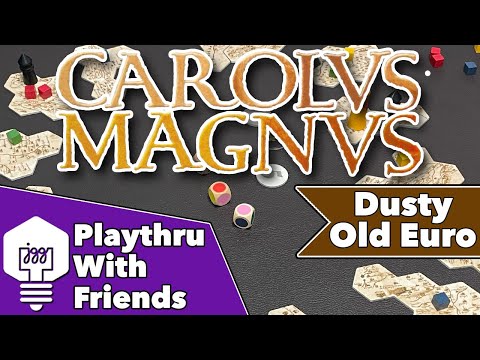
Carolus Magnus - Playthrough With Friends
- neat mechanism ideas (majorities, castle placement, land merging)
- dice-driven resource generation adds unpredictability
- turn order and emperor movement create tension
- heavy luck factor due to dice
- two-player view can be frustrating with limited choices
- early rounds can feel constrained and brutal
- endgame swings can be rare according to discussion
- majorities and territorial control; castle building; Rondell merging
- Charlemagne's realm; players build castles for his security
- educational playthrough with live discussion
- Caesar
Mechanics (from transcript analysis)
- Action Drafting — each round players in order pick one action tile from a common pool and then execute their chosen actions
- Area Majority — placing cubes to create majorities on islands to claim a 'Clan Emblem' and potentially swap castles
- castle placement and end condition — when a castle is placed adjacent to another, lands merge and end condition is placing 10 castles
- Dice-driven resource generation — at the end of a turn, a five-sided dice is rolled giving colored resources and wild; these affect future placements
- early rounds have limited options — initial rounds restrictive with limited majorities and choices, making early decisions impactful
- emperor movement — the emperor moves clockwise a number of spaces based on the chosen action tile; landing on majority spots can trigger castle placement
- land merging / Rondell shrinking — adjacent castles merge lands into a smaller Rondell, increasing strategic tension
- majorities and majority markers — placing cubes to create majorities on islands to claim a 'Clan Emblem' and potentially swap castles
- paladins as resources — pink/red/yellow/green/blue cubes (paladins) are rolled to determine available color resources and placed on islands or in the player's court
- tile drafting / action tile draft — each round players in order pick one action tile from a common pool and then execute their chosen actions
Video topics + discussion points
Quotes (from this video)
- Charlemagne has requested his contentious heirs the players to build castles for his security
- this seems like a pretty neat game
- it's a fast game
- that was not a fun game