/pic2509383.jpg)
The universe is about to collapse, and your final hope lies in an ancient mysterious artifact, the Ovoid. Whoever controls this "cosmic egg" can shape the birthing of the next universe according to their own agenda. Players are secret agents from a handful of surviving worlds, zipping from planet to planet in special “amnion suits” that allow for interstellar travel, space combat and planetary landings.
Each planet has its own envelope of cards. When you arrive on a planet, you decide which cards you want to take and which to leave behind. Knowledge is the most powerful resource in the game, and being able to predict the cards your opponents possess at any given time is a powerful advantage as you build up a handful of weapons, tactical gear, vaults and traps, as well as cards that counter your opponents' cards. The best players will keep their hand fluid, constantly changing tactics while they search from world to world for the Ovoid or find a safe place to stash it.
Balance your hand of cards, spend your turn actions wisely, and cleverly use your special alien powers to stay one step ahead of your opponents. When the Chaos Clock reaches zero, only the player who possesses the Ovoid will become master of the new universe.


- Fun mechanic set
- Intuitive rules
- Potential for explosive moments
- Fun to play with friends
- Mini-expansion and variants elevate the game
- Can be bad if everyone decides to collide
- Starting player can collect tricks in a big bang scenario
- Can be hard to track nines in a variant
Mechanics (from transcript analysis)
- Collision — if you play a card and someone plays the same rank card, they collide and they flip down
- endgame trigger — That is the endgame trigger
- Majority Control — the majority of the suits is the one that will win the trick.
- Set Collection — Then you're set collecting for the cards
- Trick-Taking — Now, this game you don't want to win tricks.
Video topics + discussion points
Quotes (from this video)
- The player who played the second highest card in the lead suit wins the trick.
- You're trying to sting the other players with bees.
- If you collect the same valued bee, same color, same value, you get eliminated by going into anaphylaxis shock.
- This is the meanest trick taking game I've ever played.
- The market adds a lot of unique and interesting aspects to this game because of the way that everybody else can see it.
- The hierarchy gets really difficult to follow like there's so many different combinations that occur.
- The first phase is actually trick taking for cards. And the cards that you win, you'll be playing the second phase in a card shedding phase.
- The way that this game works is you'll shuffle those two decks together.
- I find it chaotically pleasing.
- I think that experience along with the trick taking is very unique.
References (from this video)
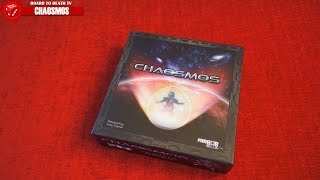
- high fun factor and strong player interaction
- innovative deduction mechanics and fresh thematic integration
- excellent production quality with thematic artwork
- high replayability due to modular rules, advanced options, and home-brew potential
- alien race abilities can be imbalanced at times
- equipment cards may show minor balance issues
- envelope and card management can be intimidating for new players
- covert agents using deception, deduction, and maneuvering to influence planetary control
- Galactic factions vying for a singular artifact in a universe on the brink of collapse
- open-ended, dramatic, with hidden agendas and evolving board state
- Cosmos
- Chaos
Mechanics (from transcript analysis)
- Action economy — On a turn a player has three actions to spend on movement, playing cards, or other actions, shaping tempo and risk.
- card management and envelopes — Players manage equipment cards and envelopes containing face-up/face-down cards that can trap or hinder others; envelopes can be opened or exchanged under rules.
- chaos clock — A central timer that advances; the ooid owner wins when it reaches zero, creating a race against time.
- Combat — Dice-based combat using attacker and defender dice, including the infinity rule when mirrors align, determining spoils and control.
- Combat: Dice — Dice-based combat using attacker and defender dice, including the infinity rule when mirrors align, determining spoils and control.
- free actions and trading — Certain actions can be performed as free actions (eg trading with a cosmic pool) under specific conditions, adding strategic flexibility.
- Hidden Information — Hidden information through envelopes and face-down cards creates bluffing and deduction opportunities.
- Movement — Move between planets, wormholes, and hyperspace, with certain spaces and routes offering strategic advantages.
- territory control and spoils — Control planets via envelopes and claim or banish spoils based on combat outcomes and strategic play.
Video topics + discussion points
Quotes (from this video)
- A New Concept in board gaming nowadays
- Chaosmos gets an eight out of 10
- the production quality is really good
- it's a style and it works so only half Point penalty on alien variety
- there's lots of player interaction and never feeling out of the race before the end