


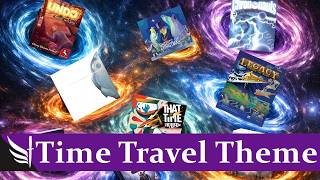


Chrononauts Deep Dive
What the Community Thinks About Chrononauts
Chrononauts is a time travel card game from Looney Labs, the company best known for Flux. Players take on the role of time travelers who jump through the 20th century and change historical events, so the question of what would have happened if the Titanic never sank becomes the central playground of the game.
Reviewers agree on the premise and disagree on the play. JestaThaRogue is the most enthusiastic of the reviewers, ranking Chrononauts fourth in a list of five time travel games and praising its playful tone and what the channel calls the flux fun factor. Tom Vasel of The Dice Tower takes a more measured line. In their top ten time travel games they place Chrononauts at number ten, saying they do not particularly love it as a game even though they love its concept. In a separate "pile of mid games" episode from the same channel, Vasel is more skeptical still, saying the game plays like Flux and that they do not have it rated very highly. The shared point is that linking changes to history through cards is the strongest part of the design.
Core Mechanics That Define Chrononauts
Lynchpin Cards
The mechanic reviewers return to most often is the lynchpin. Vasel explains that some cards in the timeline are lynchpins: when one is flipped, other events that depended on it flip too, because they could never have happened in the new version of history. Their example is John F. Kennedy, whose assassination can be undone by flipping a card, with consequences that spread from there. JestaThaRogue describes the same engine in terms of paradoxes. A change can affect several other points in history, and those paradoxes must be repaired before the timeline collapses. Looney Labs is named as the publisher in both videos, but neither review names the designer, so no designer credit is given here.
Secret Alternate-Reality Goals
Each player also holds a secret goal, which JestaThaRogue describes as the alternate reality that player is trying to create. Everyone is reshaping one shared timeline toward a different version of history, which turns a set of individual edits into a contest. JestaThaRogue links this to a broader question the game raises: once history is being rewritten, who actually invented anything in the first place? Vasel notes that Chrononauts has themed versions, but they find the original the most interesting, which points to the core system as the source of the design's character.
The Chrononauts Experience
Chaotic, Silly Alternate History
The game is described as light, chaotic, and playful. JestaThaRogue calls it silly and chaotic, and says the appeal lies in seeing how strange history can get when everyone is meddling with it. The example they give is a seemingly small change in 1920 that leads to a big change in the events of 1990. That kind of delayed consequence gives the table a running sense of surprise, where each flip can reshape events that seemed settled a few turns earlier.
The Thrill of a Reversed Event
Vasel approaches the experience from a different angle. They single out the lynchpin cards as the part they find interesting and super fun, the moment a card reveals that an event could never have happened. That sense of discovery carries the experience for them even when the rest of the play feels less engaging. The satisfaction comes from rearranging a familiar piece of history rather than from tight strategy.
What Makes Chrononauts Stand Out
A Concept Reviewers Love
The concept is the feature reviewers praise most consistently. Vasel says Chrononauts earned a place on their list because it has a lot of fun with time travel, and they admit they love the concept even while disliking the game. A reviewer who does not care for the play still ranks it among their favorite time travel titles, which shows how much the premise is doing. Vasel also points out that the publisher has produced themed versions of the game, though their preference remains with the original.
Looney Labs Energy
JestaThaRogue points to the publisher's house style as part of the appeal. The game carries the random flux energy Looney Labs is known for, and the channel adds that it also has the flux fun factor. JestaThaRogue treats that randomness as a plus, which fits a theme built on unpredictable history.
Potential Drawbacks
Familiar Flux-Style Play
The most direct criticism comes from Vasel, who says Chrononauts plays like Flux. For players who want something distinct from the publisher's better-known design, that resemblance makes the game feel less original than its theme suggests. In a separate mid-games review, Vasel also says they do not have the game rated very highly, so the critique is consistent across their two videos.
A Thin Win Condition
Vasel is frank that the rest of the game amounts to collecting three things to win, and says this is a major reason they do not love it as a game. Because the win condition is so simple, the appeal rests almost entirely on manipulating the timeline. Reviewers who want a deeper scoring engine will find less to hold onto here than in the time travel titles Vasel ranks above it.
If You Enjoy Chrononauts
Players who enjoy Chrononauts's card-driven chaos will find the closest feel in Flux, the game Vasel says Chrononauts plays like. For those who like an alternate timeline growing out of earlier choices, Legacy: Gears of Time is a good match. Vasel describes it as a bit alternate timeline-esque and almost like Chrononauts, but with much better gameplay. Players who prefer cooperative time travel to competitive rewriting can look at Time Stories, which JestaThaRogue calls a very fun co-op that uses time travel well.
What Reviewers Are Saying
"The core rule is that every historical change has consequences. Fixing paradoxes, controlling events, and nudging the timeline towards your preferred version of history is the heart of the game. It's chaotic, silly, and all about seeing how strange history can get when everyone is meddling with it."
— JestaThaRogue
"Sometimes these cards are lynchpins, and when they get flipped over, they will flip over other things cuz if this event happened, then this event never even had a chance to happen. And I find stuff like that really interesting."
— Tom Vasel, The Dice Tower
"When you change them, it will change other things throughout history. I like that concept a lot. It plays like Flux, unfortunately, but the concept's really cool."
— Tom Vasel, The Dice Tower