


Conflicting Legends Deep Dive
What the Community Thinks About Conflicting Legends
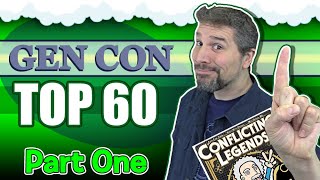
Reviewers who have covered Conflicting Legends on the Pair of Dice Paradise channel describe it as a light, goofy game that thrives on table energy rather than careful planning. Host Chaz Marlar, in a Gen Con preview, calls it a fast-paced, highly interactive and unique strategy game and says it ranks among the most pleasant surprises encountered in board games that year, and adds hope of becoming an evangelist for it. In a separate Victorian parlor game episode, Chaz Marlar calls it one of the goofiest area control games played to date. The enthusiasm is consistent across both appearances: the game is treated as a crowd-pleaser for game night, not as a serious strategy title. The BoardGameCo channel does not cover the game in its featured video, so the discussion here comes from the Pair of Dice Paradise reviews.
Core Mechanics That Define Conflicting Legends
Area Control
Published by Indie Boards and Cards in 2019, Conflicting Legends borrows the territorial structure of a classic conquest game. Chaz Marlar explains that players hold cards representing the regions of the world they want to conquer, and they use those cards to take or invade different territories. The result is a map-driven contest in which players are always weighing where to push next and which regions are worth contesting. Chaz Marlar describes the overall experience as essentially Risk in a very broad sense, which gives players a familiar starting point before the game's own twists take over. The area control framework provides the stakes, while the individual fights decide who gains ground.
Rock-Paper-Scissors
The defining feature, according to reviewers, is that every conflict between players is resolved through a game of rock-paper-scissors. Players take on the roles of historical personalities, and those personalities grant special abilities that augment how they play each throw. This turns each contested region into a short duel of prediction and bluffing rather than a dice roll or a simple numbers comparison. Because the throws are read against an opponent's likely choice, the outcome of each conflict depends on the players involved as much as on the cards they hold. Reviewers see this as the source of the game's laughs, since the rock-paper-scissors moments are quick, visible, and often accompanied by table-wide reactions.
The Conflicting Legends Experience
Historical Personalities in a Goofy Frame
Reviewers emphasize that players are not commanding armies as abstract factions. Instead, each player fields a figure from history and uses that persona's abilities to tilt the rock-paper-scissors contests in their favor. Chaz Marlar frames the premise as ridiculous on purpose, describing a game in which people use different personalities from throughout history to play rock-paper-scissors in order to take over different people's countries. The humor comes from that absurd pairing of serious historical names with a playground game, and it sets a tone that reviewers say should not be taken too seriously.
Fast, Laughter-Filled Table Moments
The second feeling reviewers return to is pace. Conflicting Legends is described as a quirky, fast-paced, fun little game that always results in a lot of laughs when the group plays it. Chaz Marlar says that every game played so far, several by now, produces a moment where the whole table reacts together. Those shared reactions, rather than a single winning plan, are what keep players coming back. The game fits into a relaxed evening where the group wants quick rounds and frequent moments of surprise.
What Makes Conflicting Legends Stand Out
Rock-Paper-Scissors Conflicts With Persona Powers
Reviewers single out the way the game turns a familiar hand game into a meaningful contest. Chaz Marlar explains that the players get special abilities that augment their rock-paper-scissors playing, and that this combination of area control and hand game is what makes the design unusual. The persona powers give players a reason to think about which figure they hold and when to use its advantage, which adds decision-making on top of the throw itself. This is the feature that most clearly separates Conflicting Legends from the conquest games it resembles.
An Easy Fit for Game Night
Accessibility is the other standout reviewers praise. The game supports three to six players, plays in under an hour according to the reviewer's experience, and needs no electricity. Chaz Marlar notes that these qualities make it an easy recommendation for someone's next game night, particularly for groups that want something lighter than a heavy strategy session. The low barrier to entry is a large part of why reviewers frame the game as a party title first.
Potential Drawbacks
Outcomes Hinge on the Throw
Because every conflict is settled by rock-paper-scissors, the result of any individual fight depends heavily on the throw and on how well a player reads the table. Chaz Marlar calls the overall concept ridiculous, and is explicit that it works best for players who are willing to accept that randomness and guesswork are central to the experience. Players who expect a method of consistent, planned outcomes may find the game frustrating, even though reviewers themselves treat that unpredictability as part of the fun.
Lighter Strategic Depth
Reviewers do not present Conflicting Legends as a deep strategy game. The recommendation is to track it down and play it for fun, and to avoid taking it too seriously. Chaz Marlar stresses that the game is a quirky, lighthearted option, which means the decisions are shorter and more reactive than in heavier area control titles. Groups looking for long-term planning, tight optimization, or detailed tactical control should view it as a diversion rather than a centerpiece.
If You Enjoy Conflicting Legends
The most direct comparison in the reviews is Risk. Chaz Marlar describes Conflicting Legends as essentially Risk in a very broad sense, since both games center on taking territory through conflict. Fans of Risk will recognize the basic loop of claiming regions and pushing into rival areas, but Conflicting Legends replaces the dice-based resolution with rock-paper-scissors contests enhanced by persona abilities. That swap is what gives the game its distinct table personality. Players who enjoy the conquest framework but want shorter, more social rounds will find the same appeal here.
Players who enjoy the goofy, social side of Conflicting Legends may also appreciate other quick party games that rely on a simple hand-based challenge and a lot of table reaction. Reviewers consistently describe the game as best when the group is laughing together, so the shared-moment quality of the game is the main reason to pick it for a night out.
What Reviewers Are Saying
"Conflicting Legends is one of the goofiest area control games I have ever played. This is essentially, in a very broad sense, Risk."
— Pair of Dice Paradise
"Conflicting Legends is a fast-paced, highly interactive and unique strategy game based on rock-paper-scissors."
— Pair of Dice Paradise
"Every single game of this that I have played, and there have been a few, has always had a moment where the entire table goes, 'Oh, I love that.'"
— Pair of Dice Paradise