



Cultist Chaos Deep Dive
What the Community Thinks About Cultist Chaos
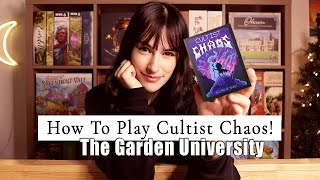
Cultist Chaos, a two to six player card drafting game from Wizard of Barge, has drawn consistent enthusiasm from The Board Game Garden. Host Jenna has covered the game on three separate occasions, and each one shows a different angle. In a full how-to-play video, Jenna walks viewers through every card type and the scoring rules, presenting the game as a compact title that is easy to teach. In a video about the games packed for a holiday trip to Mexico, the game is chosen largely because it accommodates a group of six. In a trip recap and unboxing, the game arrives by mail, and Jenna describes it as a straightforward drafting game that the host is eager to play, having carried a copy to California without getting a table session in.
Across these occasions, the channel's view is that Cultist Chaos is a light, approachable game with a distinctive personality. Jenna repeatedly returns to its size and the speed of teaching it, and to its theme, which Jenna calls rare in a market where cult-themed games are seldom seen. The enthusiasm is strongest for the game's accessibility and tone rather than for deep strategic play, a topic not discussed at length in any of the three videos.
Core Mechanics That Define Cultist Chaos
Card Drafting
Card drafting is the foundation of Cultist Chaos. Each round begins with every player holding 13 cards. Each player picks one card, places it in their altar, and passes the rest to the cultist on their left. The pass continues until every hand is empty, and then players total the points in their altars. Jenna calls the cards "the most important thing" in the game, spending a large part of the walkthrough explaining what each one does before describing the draft itself. The item cards score in different ways: the All-Seeing Orb is worth three points, the Staff of Chaos two, and the Boots of Doom six per pair. Goblin skulls reward holding more than your neighbors on either side. Zone cards pay off based on the rest of your altar, with the Castle scoring one point for each different card you have and the Portal scoring one point per sacrifice.
Because the altars are wiped between rounds, the draft is the whole scoring engine for each round, and every pick has to balance immediate points against what neighbors are likely to take. Designer Dakota Cates, who is known by the Wizard of Barge name, built the game around this familiar pick-and-pass loop. Jenna links it directly to Seven Wonders, Sushi Go Party and Planted, all of which earn praise for the same structure of holding a hand, choosing one card, and passing the rest.
Hand Management
Because the hand shrinks by one card with every pick, the choices become tighter as a round goes on. The walkthrough also makes clear that timing matters beyond the draft. Deities are the game's largest scoring cards, and a player can place a deity in the altar before owning the sacrifices it needs, but every required sacrifice must be placed underneath that deity before the game ends in order to collect its points. Some deities also require Goblin skulls. Players therefore have to plan which sacrificial items to hold back and when to commit a deity to the altar, rather than simply collecting the most valuable cards.
Spell cards add another timing layer. Soul Steal swaps a card with one in another player's altar and changes its point value, Mimic makes one of your altar cards a copy of another, and Hex forces an opponent to discard a card from their altar. These are played against opponents at moments the player chooses, which gives the hand a second use beyond building a scoring altar.
The Cultist Chaos Experience
Cult-Theme Humor
Cultist Chaos leans into its premise, and reviewers respond to the humor. Jenna describes the game as one of "Mischief, Magic and Mayhem," and the spell cards must be called out aloud when played, which adds theatrical flair to the table. The reaction to the art and theme is playful throughout, with a "I Love My Cult" bumper sticker shown off that came with the copy. The unboxing opens with a cheerful "Welcome to the cult, welcome home," which sets the tone for the rest of the coverage. The result is a game that reviewers treat as a comedy in box form, where the joke of being a cult leader is part of the appeal.
Family-Friendly Mischief
The game's pitch is accessibility. Jenna calls it "easy to learn" and says it can be taught to anyone. The published play time of 15 to 30 minutes, and the option to play just one round for a shorter game, make it suitable for a casual group. The game's mischief is gentle: players snatch cards from one another, steal altars, and force discards, but the stakes are light and the rules are short. Jenna chose it for a Christmas trip with the partner's family for exactly that reason, presenting it as a game for a mixed group rather than a serious strategy session.
What Makes Cultist Chaos Stand Out
Dakota Cates's Art and Theme
Reviewers consistently praise the visual identity of Cultist Chaos. Jenna says Dakota Cates's art is "so fun and so quirky," highlighting the bright, colorful palette in the walkthrough, and also notes that cult-themed games are rarely made, which makes the subject feel fresh on a shelf dominated by other themes. Dakota Cates is an artist who has also collaborated with Magic: The Gathering, and Jenna frames Dakota Cates's Wizard of Barge work as a passion project that began as a card game and found a home on Kickstarter before reaching retail.
A Small Box That Travels Well
Portability is one of the most repeated points in the coverage. Jenna describes the game as a "compact game that you can bring anywhere," highlighting the small box as the reason it works for travel. The Mexico packing video names the six-player support as the main reason it was brought along, and the California trip shows the game going along for the ride as well. For a reviewer who packs a large collection for trips, a title that fits easily into a bag and teaches quickly stands out.
Potential Drawbacks
Light Strategic Depth
The most frequent caveat is that Cultist Chaos is a lighter experience than heavier strategy titles. Jenna describes the basic loop as "pretty straightforward," calling it a "fun basic card drafting game" rather than a deep one. The draft is the central decision, and the channel's coverage does not describe a long arc of strategy across the rounds. Players who want complex optimization may find the game brief, and the channel's praise rests more on how quickly it plays and teaches than on how much it rewards long-term planning.
Rules Overhead Around Deities
The scoring conditions around deities are the part of the game that required the most explanation. In the walkthrough, Jenna has to explain that deities can be placed before their sacrifices are ready, that every sacrifice must eventually be placed beneath the deity, that some deities also demand Goblin skulls, and that the Portal scores sacrifices whether they were sacrificed for deities or not. Tracking these conditions adds bookkeeping to an otherwise short game. The channel's coverage also reflects an incomplete picture: the unboxing video was filmed before the game had hit the table, so reviewers have not yet delivered a full table verdict on how these rules play out in a real session.
If You Enjoy Cultist Chaos
Jenna's coverage points toward a clear set of comparisons. Seven Wonders is the first title mentioned when discussing the drafting structure, with Jenna describing a fondness for the mechanism that appears in it. Sushi Go Party is the second comparison, highlighted for the same reason: a hand of cards, one card picked, and the rest passed to a neighbor. Both are natural next steps for players who enjoy Cultist Chaos's draft at its core. Planted, bought at Target and described as a drafting game where players drop cards to gather resources, is a comparison in theme and structure that Jenna was looking forward to playing. Players who enjoy the cult humor and light scoring of Cultist Chaos can look to these titles for similar drafting loops with different themes.
What Reviewers Are Saying
"Dakota's art is also like just so fun and so quirky and I just love the theme. You typically don't see cult kind of themed games. I just think it is so cool and colorful."
— The Board Game Garden
"It plays up to six players which is the main reason I'm bringing it and it's just a fun card drafting game which I love."
— The Board Game Garden
"Welcome to the cult, welcome home. Oh my goodness, I'm very excited for this one."
— The Board Game Garden