


Dark Heists Deep Dive
What the Community Thinks About Dark Heists
The reviews of Dark Heists come mostly from first impressions, and they share a clear consensus: the game‘s heist theme is handled well, and its structure is the reason. Jamie, Stonemaier Games, describes the game as a deck-building title with a spooky, slightly fantasy tone, where the player characters are monsters carrying out larceny to build a crew. Jamie says the game mostly delivers the feeling of a great heist movie, and the pleasant surprise came from learning it at Geekway with the designer teaching the table.
Neon Gorilla covered the game in an Origins roundup of indie publishers. In that segment, the designer, who runs Asmadi Games, pitched it as a spooky deck builder where players recruit monsters and criminals to pull off haunted heists, with a playing mat, a box full of components, and optional metal coins. The pitch emphasized theme and variety, while Jamie‘s later reviews focused on how the rules create tension.
Across the coverage, reviewers agree that the heist structure is the standout element and that the theme goes beyond a typical heist story. Jamie also later recounts playing a session of Dark Heists at Geekway, praising the story element of the heists and the way they give deck-building a clear goal. The transcripts offer little sustained criticism, so the community view here is mostly positive with a few practical cautions.
Core Mechanics That Define Dark Heists
Deck Building
Dark Heists is built on deck building. Players use their hand each turn to recruit scoundrels and perform larceny, and that buying step gradually strengthens the deck the player cycles through. Jamie compares it directly to Dominion, the classic deck builder, and notes that the game‘s cards are often thematically tied to the crew. Some cards hurt the player by default but can improve depending on other cards played alongside them, which Jamie describes as a clever way to make the deck‘s weaker cards useful later.
Heist Progression
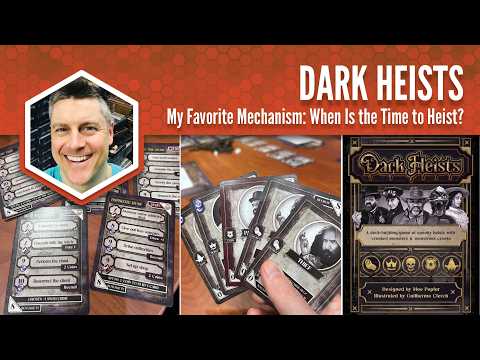
The distinctive mechanic is the heist itself. Instead of building the deck on a turn, a player can spend the turn attempting a heist. Jamie walks through a basic heist that begins by spending six sway to bribe security, which requires drawing a new hand and then cracking a safe with crime. The final step requires disguises to escape. Each step is resolved with a fresh hand, so a failed step adds a heat card, but the heist can continue on the next turn rather than being wasted. Jamie notes that the designers said the system was partially inspired by Blades in the Dark.
The Dark Heists Experience
Tension Across Multiple Payoffs
Reviewers describe the game as a sequence of build-up and payoff rather than a single race. Jamie observes that the game has three separate tipping points, each one a moment when a player decides a hand is strong enough for a heist instead of more deck building. That choice creates steady tension, because a player committing to a heist does not know what the next hands will contain, and the risk of pushing luck is part of the appeal.
Thematic Crew Satisfaction
The second feeling reviewers mention is the satisfaction of a crew with personality. Neon Gorilla‘s pitch describes haunted heists such as resurrecting a client, poisoning a chalice at a party, and making a deal with a demon. Jamie‘s account frames the experience as a heist fan‘s dream, with the story unfolding through each step rather than as an abstract scoring exercise. The mood is playful and spooky, closer to a caper than a grim horror game.
What Makes Dark Heists Stand Out
Heists as Structured Turning Points
Jamie consistently returns to the heist as the game‘s highlight. Rather than a single moment when deck building ends and scoring begins, the heists create three turning points that break up the game and give each phase a clear purpose. Jamie describes this as a less abstract way to handle the tipping point seen in many deck builders, because the goal is a specific thematic job with points attached.
Bad Cards That Can Turn Good
The second praised feature is the handling of negative cards. Jamie calls the system clever because heat cards and similar liabilities can become useful depending on what else is in the crew. This makes the deck‘s problem cards part of the strategy instead of dead weight, and it reinforces the idea that the crew is the engine.
Potential Drawbacks
Luck in the Heist Draws
The main caution in the transcripts concerns the randomness inherent in heists. Because each step relies on the cards drawn in that step‘s hand, a heist can fail after a commitment has already been made. Jamie presents this as part of the push-your-luck design and notes that a failure produces heat but does not waste the turn, which softens the sting. Players who dislike variance in card draws may find this part of the experience less comfortable.
If You Enjoy Dark Heists
Players who enjoy the heist-driven progression of Dark Heists will find a natural comparison in Dominion, the deck builder Jamie uses as a reference point. Dominion shares the core loop of buying cards to improve a deck, but Dark Heists replaces its abstract tipping point with thematic jobs that must be completed in stages. The designers‘ acknowledged inspiration from Blades in the Dark suggests the game will appeal to fans of heist fiction and tabletop roleplaying who like structured, story-driven objectives. The best fit is a player who wants a deck builder with a clear narrative engine and enjoys the tension of committing to a plan before the cards are drawn.
What Reviewers Are Saying
"I really like this. There isn‘t like a single tipping point. There are three different tipping points throughout the game where you‘re saying, "Okay, right now I have a hand that‘s really good for this one heist.""
— Jamie, Stonemaier Games
"I love the heist fiction. I love deck-building games. It‘s both of those things. And it has a really nice story element as you‘re going on the heist because each heist has multiple things that you need to accomplish to complete the heist."
— Jamie, Stonemaier Games
"Dark Heist is a spooky deck builder game where you recruit monsters and criminals to do haunted heists. You‘re going to do heists like the vampire hit, like resurrecting your client, going into a party and poisoning a chalice and making a deal with a demon."
— Neon Gorilla