






DC Deck-Building Game: Rebirth Deep Dive
What the Community Thinks About DC Deck-Building Game: Rebirth
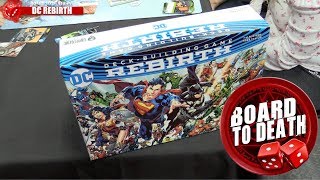
DC Deck-Building Game: Rebirth arrives as a radical departure from its predecessor, and reviewers consistently praise it as the fix the original game needed. Board Games UnLocked has covered Rebirth extensively throughout their Top 100 and Top 50 lists, with reviewers treating it as a standalone game rather than just another expansion. Board to Death TV, meanwhile, captured the initial Gen Con 2019 announcement, offering an outside perspective on what was a significant pivot for the franchise.
The consensus is striking: Rebirth transforms the DC Deck-Building Game into something reviewers wished existed from the beginning. The original's negative reputation haunted it, but reviewers see Rebirth as redemptive. Rather than trying to fix the old game piecemeal, Rebirth rethinks the entire approach by moving beyond pure competition and hand management into something that feels thematic and purposeful.
Core Mechanics That Define DC Deck-Building Game: Rebirth
Deck-Building
Rebirth retains the deck-building foundation but reshapes it fundamentally. In competitive DC Deck-Building, defeated villains enter your deck, cluttering it with uncontrollable additions. Rebirth abandons this entirely. When you defeat a villain or enemy, they vanish from play, giving you a one-time reward instead. This single change resolves what reviewers identified as the primary flaw of the original: the game no longer punishes you for winning encounters. Your deck stays focused on the strategies you deliberately build, creating genuine progression rather than inevitable bloat.
Movement and Spatial Positioning
Movement is the headline new mechanic for Rebirth. Players control standees representing heroes like Batman, Superman, Wonder Woman, The Flash, and Aquaman, positioning them on a board with ten distinct locations. To buy cards, you must physically occupy the location where those cards are sold. This forces meaningful navigation decisions. You spend a separate currency for movement, creating tension between advancing your deck and advancing your position. Reviewers note this creates genuine narrative moments: anticipating where villains will move, calculating whether you have enough movement to intercept them, and watching opponents' plans interact with your own positioning.
The DC Deck-Building Game: Rebirth Experience
Cooperative Campaign Storytelling
Rebirth commits to cooperation through an eight-scenario campaign delivered in resealable packets. Each scenario unlocks gradually, revealing pieces of the story as you progress. Character abilities persist across scenarios, creating a sense of growth without permanence. You can reset and replay scenarios with different groups or attempt the campaign multiple times with fresh eyes. Reviewers describe this campaign structure as replayable legacy, capturing the best parts of legacy games without the irreversible destruction that makes some players hesitant to commit. The storytelling emerges naturally from the mechanics rather than feeling grafted on.
Narrative Spatial Tension
What sets Rebirth apart emotionally is how movement creates story. One reviewer recounted a moment that crystallizes this: racing to intercept a villain before it reaches its destination, running out of movement, only to have another player use Superman's flight ability to carry them to the critical location. These are not arbitrary mechanical interactions; they feel like moments from the DC universe, heroes working together, making sacrifices for the mission. The spatial board transforms deck-building from an abstract resource-optimization puzzle into a tactical operation.
What Makes DC Deck-Building Game: Rebirth Stand Out
Redemption of a Maligned Franchise
The original DC Deck-Building Game carries a heavy reputation in board gaming communities. It is routinely dismissed as thematic nonsense where Superman inexplicably wields Batman's equipment. Reviewers spent years making jokes about this incongruity. Rebirth doesn't solve the theming problem entirely, but it sidesteps it by making the mechanics so compelling that the theme dissonance recedes into background noise. More importantly, by removing the mechanic of villains entering your deck, Rebirth removes the constant reminder that the game's rules betray the theme. This single design choice rehabilitates the entire experience.
Accessibility to Solo Play
Reviewers consistently highlight Rebirth's solo experience as exceptional. The campaign structure naturally supports one player controlling heroes independently, and the spatial elements create genuine challenge. Enemies move predictably but threaten real consequences if ignored. Resource management remains tight; you cannot acquire cards everywhere on the board, forcing strategic choices about where to position yourself. Solo players report the game flows quickly, feels substantial, and provides the kind of cooperative challenge that distinguishes good solo design from mere AI autopilots.
Potential Drawbacks
Thematic Dissonance Lingers
Reviewers acknowledge that while the mechanics improved, the theme still contains awkward moments. Characters still acquire abilities that feel narratively mismatched, and reviewers describe the overall theming as disjointed. This is not a deal-breaker, as reviewers emphasize the mechanical quality overrides theme concerns, but it remains noticeable for those attuned to thematic coherence.
Box Design Confusion with Expansions
A practical frustration emerged: Rebirth ships in a standard rectangular box nearly identical to the original game and its expansions. Reviewers note this creates confusion in stores and collections. Visually, Rebirth looks like an expansion rather than a complete, standalone reimagining. Some reviewers suggest a distinct box shape or dramatically different packaging would have communicated that this is a new entry point, not just another add-on. This marketing misstep may have suppressed sales among players intimidated by the original game's reputation.
If You Enjoy DC Deck-Building Game: Rebirth
Reviewers recommend Marvel Legendary for players seeking a similar cooperative deck-building experience. Marvel Legendary shares Rebirth's focus on building a strong deck to overcome challenges, though Legendary typically features more direct player interaction and less spatial positioning. The original DC Deck Building Game is conspicuously absent from recommendations; reviewers suggest Rebirth has replaced it entirely in consideration.
For those drawn to campaign storytelling without permanent destruction, Reviewers suggest exploring other replayable legacy experiences. For fans of spatial gameplay combined with deck-building, few games merge these systems as seamlessly as Rebirth does. The game fills a specific niche: it offers cooperative play, board positioning, card drafting, and narrative progression all in one box, with none of these elements feeling sacrificed for the others.
What Reviewers Are Saying
"Creates a very narrative game experience at least when I played with my friends. The villains will also move and if they reach their location they become more powerful. So I had a card that would stop the villain and I was like oh no but I have already used up all my movement. Then Superman had a flight card and he was like oh I can get you there and so Superman helped me get there. Oh that is really almost like a story in itself while you are playing."
— Board to Death TV
"The worst part of the DC deck building game was when you defeated a bad guy they went into your deck and then gave you stuff. But this one they don't—you beat the bad guys they don't go into your deck so they got rid of that part of it."
— Board Games UnLocked
"It's like what DC deck building games should have been at the beginning but it was purely competitive back then. This one just adds all the solo aspect and the movement and it's challenging because you're trying to protect these areas of the city from the bad guys that are doing stuff."
— Board Games UnLocked