
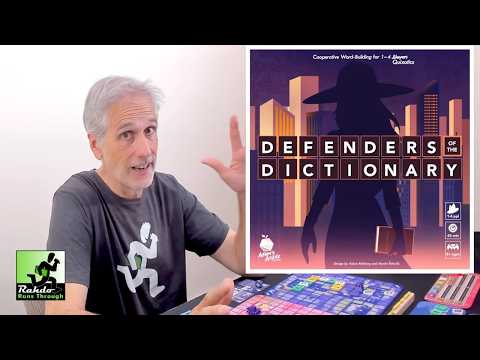







Defenders of the Dictionary Deep Dive
What the Community Thinks About Defenders of the Dictionary
Reviewers across the board express enthusiastic, even surprised praise for Defenders of the Dictionary. The game has generated significant excitement at gaming events and in early plays, with a strong consensus that this cooperative word game transcends the typical word game experience. Board Game Dad describes it as a "phenomenal cooperative crossword game," while Rahdo Runs Through celebrates it as potentially one of the best games of the year, particularly noting their household's exceptional enthusiasm for continuing campaign play. The reception is consistently positive, with reviewers highlighting unexpected strategic depth and accessibility for players who would normally avoid word games.
Core Mechanics That Define Defenders of the Dictionary
Cooperative Letter Selection and Word Formation
At its heart, Defenders of the Dictionary operates through a tightly controlled letter-management system. Each round, players simultaneously and secretly select letters from their personal pool and contribute them to a shared reserve. These contributed letters, combined with mission-specific "danger letters" that must be used or penalized, form the available word-building material. Players then work together to form valid words on a grid-based map. The mechanic creates genuine tension between contributing high-value letters and managing uncertainty, since players cannot see what teammates will contribute. BoardGameCo's Professor Meg emphasizes that players must coordinate strategically without full information, deciding which letters to hold for future rounds and which to contribute now.
Mission-Based Campaign with Evolving Rules
The game unfolds across seventeen distinct missions forming a campaign narrative where players defend the city of Wordopolis from villains. Each mission introduces new rule cards that fundamentally alter gameplay. Early missions teach basic word placement and scoring, while later missions layer on mechanics like directional restrictions, movement-based win conditions, and obstacle avoidance. Missions also track achievements that affect the campaign's final ending. The escalating rule complexity means that mastering one mission does not prepare players for the next, demanding continuous adaptation and creative problem-solving. This structure allows the game to reward careful attention to each mission's unique mechanics while maintaining forward narrative momentum.
The Defenders of the Dictionary Experience
Surprising Strategic Depth
Reviewers consistently note that the game delivers far more strategic substance than its word-game premise suggests. Beyond simply forming valid English words, players must think several turns ahead about letter availability, understand spatial relationships on the map, and anticipate which letters teammates might contribute. Rahdo describes engaging in card-counting logic, probability management, and maze traversal as integral to success. Even players who dislike traditional word games find themselves intellectually engaged by the layered decision-making required to win missions. The strategic layer exists independently of vocabulary skill, allowing players with different word knowledge to contribute meaningfully to team success.
Satisfying Cooperative Problem-Solving
The cooperative structure creates moments of genuine accomplishment that reviewers emphasize as deeply satisfying. When players successfully interpret each other's contributions and collectively discover a word that meets mission objectives, the payoff feels earned. BoardGameCo highlights the pleasure of "creating that" when players construct longer words by building off existing board letters and intersections. The shared challenge creates positive emotional peaks: players feel like they are truly collaborating to defend language itself. The household's eagerness to continue playing through the campaign indicates that this satisfaction sustains engagement across multiple sessions, transcending typical word game fatigue.
What Makes Defenders of the Dictionary Stand Out
Accessibility for Non-Word-Game Players
A remarkable aspect of the game is its ability to appeal to players who normally avoid word games. Rahdo explicitly states a lifelong distaste for word games, citing stress and frustration, yet finds themselves captivated by Defenders of the Dictionary. Rahdo credits the cooperative structure and strategic puzzle elements that exist beyond pure vocabulary skill. The game reframes word-building as a collaborative constraint puzzle rather than a competitive test of linguistic prowess. Board Game Dad notes that the game works as both a straightforward word game for enthusiasts and as a gateway game for those skeptical of the genre, making it genuinely inclusive.
Campaign Structure with Meaningful Consequences
The campaign framework elevates the game beyond standalone mission play. Unlike many campaign games, Defenders of the Dictionary ties success metrics directly to narrative outcomes: performance across seventeen missions determines which ending players experience and what final villain encounter they face. Players are incentivized to replay failed missions because failing twice vs. succeeding affects the campaign's resolution. This creates narrative stakes that go beyond simple pass-fail conditions. Reviewers emphasize that the multiple-endings design adds replay value and encourages players to engage strategically with every mission, not just the final encounter.
Potential Drawbacks
Analysis Paralysis and Decision Complexity
The strategic depth that makes the game engaging can also lead to extended turns as players consider optimal letter contributions and word placements. Rahdo acknowledges that limiting removed tiles to face-down could create analysis paralysis by preventing long-term strategic planning. Even as a solo player, they occasionally struggle to decide between multiple strategic paths. In multiplayer games with players of varying decision speed, turns could extend significantly. The simultaneous letter-selection phase mitigates some of this by keeping turns bounded, but the word-placement phase can invite extensive deliberation over spatial and future-turn implications.
Dictionary Rule Ambiguity and Word Verification Risk
Reviewers note that the game's dictionary rule remains somewhat in flux during the prototype phase. Players can use any dictionary they choose for word verification, creating the potential for disputes or unexpected word rejections at mission end. Rahdo recounts a story where using an obscure word (the French term "ver," found in a 1907 Oxford English Dictionary edition) required creative interpretation of the rules. The risk of committing to words of uncertain validity adds tension but can also frustrate players who advocate for a word's legitimacy. The current rules' flexibility is both a strength (accommodating diverse linguistic knowledge) and a weakness (inviting edge-case disputes).
If You Enjoy Defenders of the Dictionary
Reviewers draw natural comparisons to several related games. Scrabble stands as the obvious baseline comparison, with Defenders functioning as what Rahdo calls "cooperative Scrabble with superheroes." For players who loved the cooperative deck-building of Paperback and its sequels Hardback and Paperback Adventures, Defenders of the Dictionary offers a similar cooperative ethos applied to word formation itself. Players who enjoy Pandemic will recognize the mission-based campaign structure and the satisfaction of collective problem-solving under escalating constraints. Planet Unknown (the previous work from Adam Reber, the game's publisher) fans should find the creative spatial puzzle element and thematic coherence familiar. The game also speaks to lovers of grid-based word games like Speltz and word-puzzle fans, but with the critical difference of full cooperation rather than competitive play.
What Reviewers Are Saying
"From the ground up it's cooperative. It's basically cooperative Scrabble with superheroes, which is everything I could hope it would be."
— Rahdo Runs Through
"This is a game that is strategic where you are going to be building out these different words, but you're also going to be playing through a story. Mission by mission is going to add new rule cards that are going to change how you understand the game and how you approach it."
— BoardGameCo
"This is a phenomenal cooperative crossword game. Players are working together to create a good tile rack in order to play words across a map of the city in order to defeat some sort of villain. There are several missions in this game where the words get placed has to meet certain criteria for each mission and navigate the city."
— Board Game Dad